Buying a Better Lock
Acheter un meilleur antivol
Leo and Emma visit a bike shop to buy a stronger lock. The shop worker shows them how to use it and gives them a simple safety tip.
Leo et Emma se rendent dans un magasin de vélos pour acheter un antivol plus solide. Le vendeur leur montre comment l’utiliser et leur donne un conseil simple pour protéger leur vélo.
Dialogue8
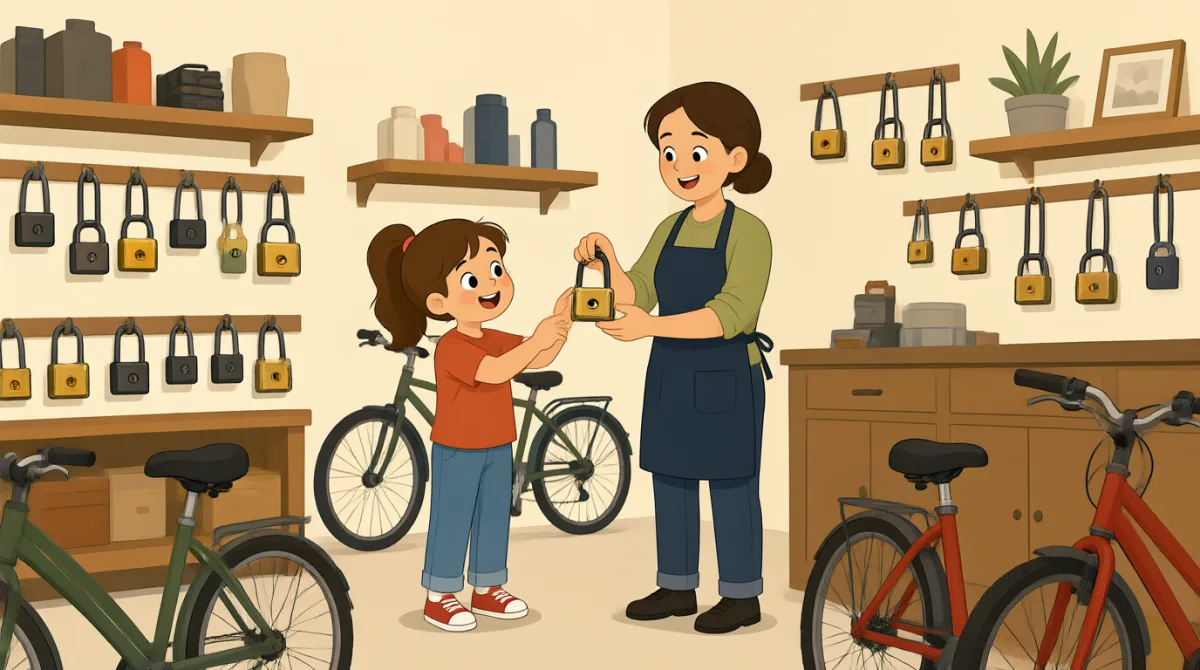

I need a stronger lock. My bike was stolen yesterday.
Il me faut un antivol plus solide. On m’a volé mon vélo hier.

Let’s get one that’s hard to cut through.
Prenons-en un qu’il est difficile de couper.

This U-lock is strong and easy to carry.
Cet antivol en U est solide et facile à transporter.
How do I lock up my bike with it?
Comment je m’en sers pour attacher mon vélo ?
Put it around the frame and the bike rack, like this.
Passez-le autour du cadre et de l’arceau à vélo, comme ça.
Should we lock the front wheel too?
On devrait aussi attacher la roue avant ?
Yes. If you can, lock both wheels and the frame.
Oui. Si vous pouvez, attachez les deux roues et le cadre.
Got it. I’ll keep the key somewhere safe.
D’accord. Je garderai la clé dans un endroit sûr.
Vocabulaire7
- stronger lockantivol plus solide
A lock that is harder to break. Use this phrase when you need more protection for your bike or other belongings.
Un antivol plus difficile à casser. Utilisez cette expression quand vous avez besoin de mieux protéger votre vélo ou d’autres affaires.
- stolenvolé
Taken without permission. Here, Leo’s bike was taken by someone yesterday.
Pris sans permission. Ici, quelqu’un a pris le vélo de Leo hier.
- cut throughcouper
To use a tool to cut and break something. A lock that is hard to cut through is difficult to break.
Utiliser un outil pour couper et casser quelque chose. Un antivol qu’il est difficile de couper est difficile à casser.
- U-lockantivol en U
A strong lock shaped like the letter U. It is often used to secure a bike.
Un antivol solide qui a la forme de la lettre U. On l’utilise souvent pour attacher un vélo.
- lock upattacher avec un antivol
To secure something with a lock. You can say, “I need to lock up my bike.”
Sécuriser quelque chose à l’aide d’un antivol. Vous pouvez dire : “I need to lock up my bike.” (Je dois attacher mon vélo avec un antivol.)
- bike rackarceau à vélo
A stand where people can park and lock their bikes. You can attach your bike to a bike rack.
Un support où l’on peut garer et attacher son vélo. Vous pouvez attacher votre vélo à un arceau à vélo.
- somewhere safedans un endroit sûr
A place where something is unlikely to get lost or stolen. Use this phrase when talking about keeping an important item secure.
Un endroit où quelque chose risque peu d’être perdu ou volé. Utilisez cette expression pour parler de la sécurité d’un objet important.
Phrases clés7
- 1
My bike was stolen yesterday.
On m’a volé mon vélo hier.
Use this sentence to explain that someone took your bike. You can replace “my bike” with another thing that was stolen.
Utilisez cette phrase pour expliquer que quelqu’un a pris votre vélo. Vous pouvez remplacer “my bike” par le nom d’un autre objet qui a été volé.
- 2
Let’s get one that’s hard to cut through.
Prenons-en un qu’il est difficile de couper.
Use this to suggest choosing something that is difficult to break. Replace “one” with the item you need.
Utilisez cette phrase pour proposer de choisir quelque chose de difficile à casser. Remplacez “one” par le nom de l’objet dont vous avez besoin.
- 3
This U-lock is strong and easy to carry.
Cet antivol en U est solide et facile à transporter.
This sentence describes an item and gives two useful qualities. You can use “strong and easy to carry” to compare locks or other products.
Cette phrase décrit un objet en donnant deux qualités utiles. Vous pouvez utiliser “strong and easy to carry” (solide et facile à transporter) pour comparer des antivols ou d’autres produits.
- 4
How do I lock up my bike with it?
Comment je m’en sers pour attacher mon vélo ?
Use this question when you need instructions for using something. Replace “my bike” with the item you want to secure.
Utilisez cette question quand vous avez besoin d’explications pour utiliser quelque chose. Remplacez “my bike” par le nom de l’objet que vous voulez sécuriser.
- 5
Put it around the frame and the bike rack, like this.
Passez-le autour du cadre et de l’arceau à vélo, comme ça.
This gives a simple instruction for securing a bike. Use “Put it around…” to explain where to place or attach something.
Cette phrase donne une instruction simple pour attacher un vélo. Utilisez “Put it around…” pour expliquer où placer ou attacher quelque chose.
- 6
Should we lock the front wheel too?
On devrait aussi attacher la roue avant ?
Use this question to ask whether another thing should also be secured. Replace “the front wheel” with another part or item.
Utilisez cette question pour demander s’il faut aussi sécuriser un autre élément. Remplacez “the front wheel” par le nom d’une autre partie ou d’un autre objet.
- 7
I’ll keep the key somewhere safe.
Je garderai la clé dans un endroit sûr.
Use this sentence to say that you will put something important in a secure place. Replace “the key” with another item you need to look after.
Utilisez cette phrase pour dire que vous allez mettre un objet important dans un endroit sûr. Remplacez “the key” par le nom d’un autre objet dont vous devez prendre soin.