Dancing at the Party
Danser à la fête
At the reception, Emma and Jack enjoy the music and dance together as the wedding party continues.
À la réception, Emma et Jack profitent de la musique et dansent ensemble tandis que la fête de mariage bat son plein.
Dialogue8
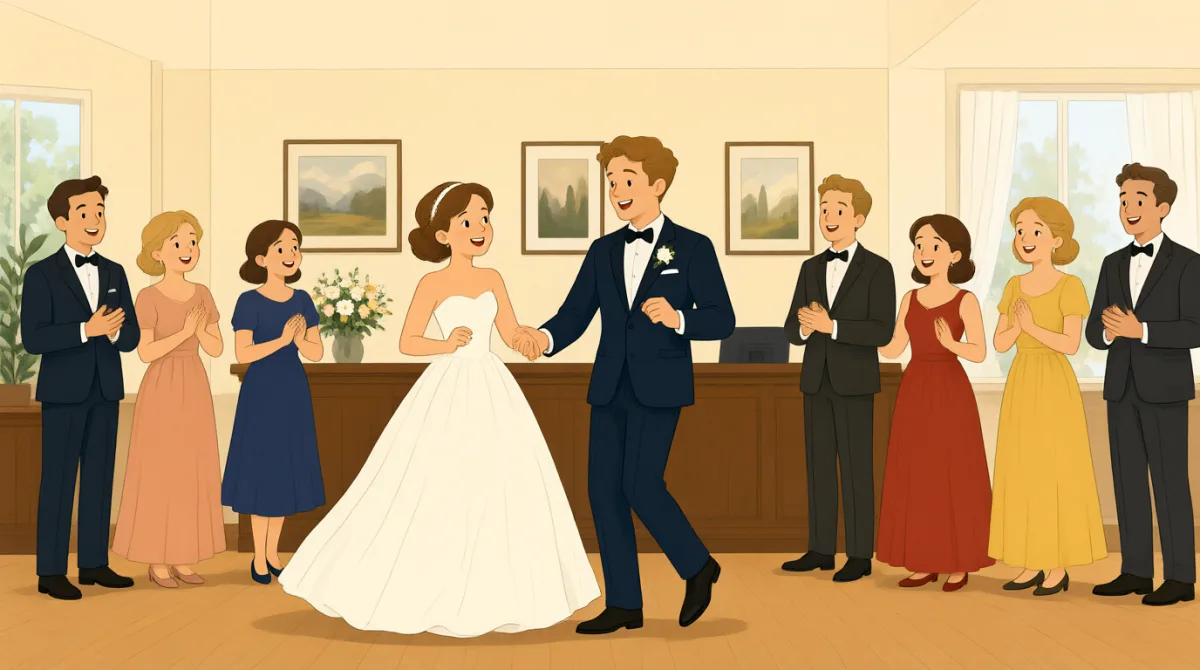

This song is great! Do you want to dance?
Cette chanson est géniale ! Tu veux danser ?

Sure! I’m not a great dancer, but I’ll give it a try.
Avec plaisir ! Je ne suis pas un très bon danseur, mais je vais essayer.
Neither am I. Let’s just follow the music.
Moi non plus. Laissons-nous simplement porter par la musique.
Good plan. This party is much more fun than I expected.
Bonne idée. Cette fête est bien plus amusante que je ne le pensais.
I know! The couple looks so happy, and everyone is celebrating.
Je sais ! Les mariés ont l’air tellement heureux, et tout le monde fait la fête.
Watch your step! I almost bumped into that chair.
Attention où tu mets les pieds ! J’ai failli rentrer dans cette chaise.
Thanks! Let’s get some water after this song.
Merci ! Allons boire un peu d’eau après cette chanson.
Sounds good. Then we can come back for another dance.
Ça marche. Ensuite, on pourra revenir danser.
Vocabulaire8
- give it a tryessayer
To give something a try means to try doing it, even if you are not sure you will be good at it. Jack uses this phrase when he agrees to dance.
“Give something a try” signifie essayer de faire quelque chose, même si on n’est pas sûr d’y être doué. Jack emploie cette expression quand il accepte de danser.
- follow the musicse laisser porter par la musique
To follow the music means to move along with its rhythm. You can use this phrase when dancing or moving to a song.
“Follow the music” signifie bouger au rythme de la musique. Tu peux utiliser cette expression quand tu danses ou que tu bouges en musique.
- much more funbeaucoup plus amusant
This phrase compares two experiences and says one is a lot more enjoyable. You can say, “The game was much more fun than I expected.”
Cette expression compare deux expériences et indique que l’une est bien plus agréable que l’autre. Tu peux dire : “The game was much more fun than I expected.” (Le jeu était bien plus amusant que je ne le pensais.)
- I expectedje ne le pensais
This means what you thought would happen or how something would be before it happened. Use “than I expected” to say something was different from your prediction.
“I expected” désigne ce que tu pensais qu’il allait se passer ou la façon dont tu imaginais quelque chose avant que cela arrive. Utilise “than I expected” pour dire que quelque chose était différent de ce que tu avais prévu.
- Watch your step!Attention où tu mets les pieds !
This is a warning to be careful where you walk. You can say it if someone might trip or bump into something.
C’est un avertissement qui invite à faire attention où l’on marche. Tu peux le dire si quelqu’un risque de trébucher ou de heurter quelque chose.
- bumped intorentrer dans
To bump into something means to hit it by accident. You can also bump into a person when you meet them unexpectedly.
“Bump into” signifie heurter quelque chose par accident. On peut aussi employer cette expression pour dire qu’on rencontre quelqu’un par hasard.
- after this songaprès cette chanson
This phrase means when the current song has finished. You can use “after this” to say you will do something once an activity is over.
Cette expression signifie une fois que la chanson en cours sera terminée. Tu peux utiliser “after this” pour dire que tu feras quelque chose quand une activité sera finie.
- come backrevenir
To come back means to return to a place. Here, Jack means they can return to the dance floor after getting water.
“Come back” signifie retourner quelque part. Ici, Jack veut dire qu’ils pourront retourner sur la piste après être allés boire de l’eau.
Phrases clés8
- 1
Do you want to dance?
Tu veux danser ?
This is a simple, friendly way to invite someone to dance. You can replace “dance” with another activity, such as “get some coffee.”
C’est une façon simple et amicale d’inviter quelqu’un à danser. Tu peux remplacer “dance” par une autre activité, comme dans “get some coffee” (aller prendre un café).
- 2
I’m not a great dancer, but I’ll give it a try.
Je ne suis pas un très bon danseur, mais je vais essayer.
This sentence shows that you are willing to try something, even if you do not feel confident. Use “I’m not a great [role], but I’ll give it a try” for other activities.
Cette phrase montre que tu es prêt à essayer quelque chose, même si tu n’as pas confiance en toi. Tu peux utiliser “I’m not a great [role], but I’ll give it a try” pour parler d’autres activités.
- 3
Let’s just follow the music.
Laissons-nous simplement porter par la musique.
This is a relaxed way to suggest enjoying the rhythm without worrying about dancing perfectly. “Let’s just…” is useful for making a simple, low-pressure suggestion.
C’est une façon décontractée de proposer de profiter du rythme sans se soucier de bien danser. “Let’s just…” est utile pour faire une suggestion simple, sans mettre de pression.
- 4
This party is much more fun than I expected.
Cette fête est bien plus amusante que je ne le pensais.
Use this sentence to say that something is more enjoyable than you thought it would be. You can change “party” to another event or activity.
Utilise cette phrase pour dire que quelque chose est plus agréable que tu ne le pensais. Tu peux remplacer “party” par un autre événement ou une autre activité.
- 5
The couple looks so happy, and everyone is celebrating.
Les mariés ont l’air tellement heureux, et tout le monde fait la fête.
This sentence describes how people look and what they are doing at a celebration. You can use “everyone is celebrating” for weddings, birthdays, and other special events.
Cette phrase décrit l’apparence des gens et ce qu’ils font lors d’une célébration. Tu peux utiliser “everyone is celebrating” pour les mariages, les anniversaires et d’autres événements spéciaux.
- 6
Watch your step!
Attention où tu mets les pieds !
This short warning helps someone avoid tripping or hitting something. Say it when there is an obstacle or uneven ground nearby.
Cet avertissement bref aide quelqu’un à éviter de trébucher ou de heurter quelque chose. Dis-le s’il y a un obstacle ou un sol irrégulier à proximité.
- 7
Let’s get some water after this song.
Allons boire un peu d’eau après cette chanson.
This is a clear way to suggest doing something once the current song is finished. You can replace “get some water” with another activity.
C’est une façon claire de proposer de faire quelque chose une fois la chanson en cours terminée. Tu peux remplacer “get some water” par une autre activité.
- 8
Then we can come back for another dance.
Ensuite, on pourra revenir danser.
This sentence suggests returning to an activity after a short break. Use “come back for another…” when you plan to do something again.
Cette phrase propose de reprendre une activité après une courte pause. Utilise “come back for another…” quand tu as prévu de refaire quelque chose.