A Friend Gets a New Job
Une amie décroche un nouvel emploi
Emma tells Mia about her new job. Mia congratulates her and asks when she starts.
Emma parle à Mia de son nouvel emploi. Mia la félicite et lui demande quand elle commence.
Dialogue7
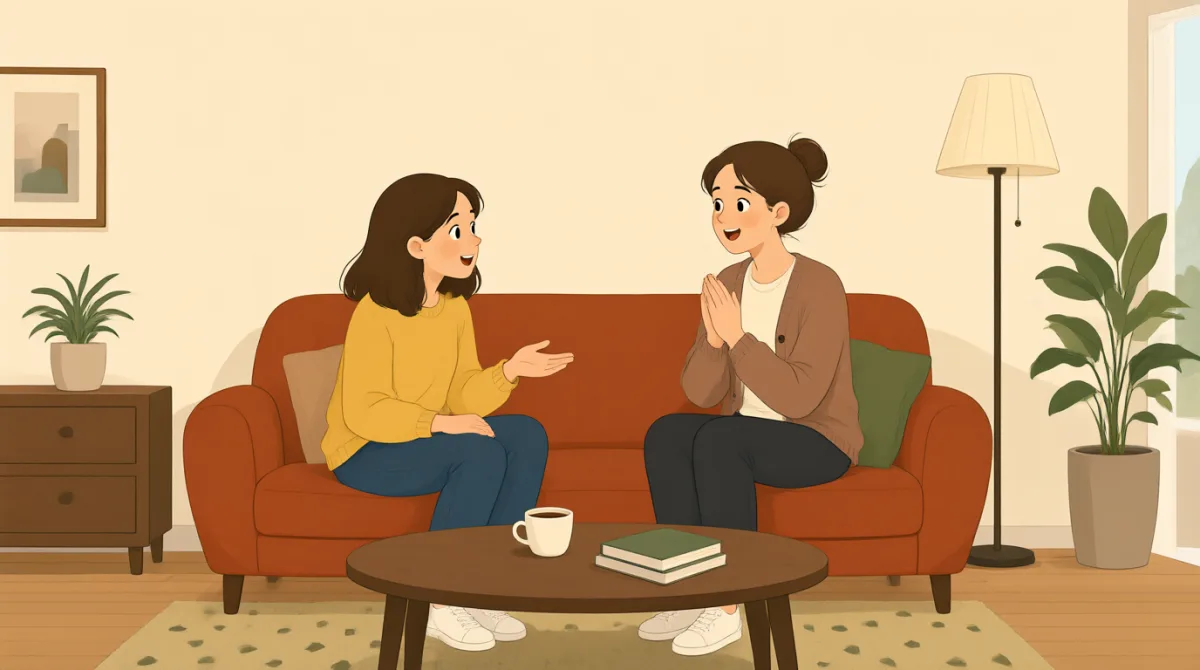

I have a new job!
J’ai un nouvel emploi !

That’s great! Congratulations!
C’est génial ! Félicitations !
Thank you! I’m so happy.
Merci ! Je suis tellement contente.
When do you start?
Tu commences quand ?
I start next Monday.
Je commence lundi prochain.
That’s soon! What’s your new job?
C’est bientôt ! C’est quoi, ton nouvel emploi ?
I’m a teacher. I can’t wait!
Je suis enseignante. J’ai trop hâte !
Vocabulaire7
- new jobnouvel emploi
A new job is work that someone has just started or will start soon. You can say, “I have a new job!” to share the news.
Un « nouvel emploi », c’est un travail qu’une personne vient de commencer ou qu’elle va bientôt commencer. Tu peux dire « I have a new job! » (« J’ai un nouvel emploi ! ») pour annoncer la nouvelle.
- That’s great!C’est génial !
This is a happy way to respond to good news. You can use it when a friend tells you something exciting.
C’est une façon enthousiaste de réagir à une bonne nouvelle. Tu peux l’utiliser quand une amie te raconte quelque chose d’excitant.
- Congratulations!Félicitations !
Say this to show that you are happy for someone’s success or good news.
Dis cela pour montrer que tu es heureuse pour quelqu’un qui a réussi quelque chose ou qui a une bonne nouvelle.
- so happytellement contente
This means very happy. You can use “I’m so happy” to share a strong, positive feeling.
Cela veut dire très heureuse. Tu peux dire « I’m so happy » (« Je suis tellement contente ») pour exprimer une émotion très positive.
- When do you start?Tu commences quand ?
Use this question to ask when someone begins a job, class, or activity.
Utilise cette question pour demander quand quelqu’un commence un travail, un cours ou une activité.
- next Mondaylundi prochain
This means the Monday coming soon. You can use it to say when something will happen.
Cela désigne le lundi qui arrive bientôt. Tu peux l’utiliser pour dire quand quelque chose va se passer.
- can’t waitavoir hâte
This means you are very excited about something that will happen. You can say, “I can’t wait!” when you feel eager.
Cela signifie que tu es très enthousiaste à propos de quelque chose qui va arriver. Tu peux dire « I can’t wait! » (« J’ai trop hâte ! ») quand tu es impatiente.
Phrases clés8
- 1
I have a new job!
J’ai un nouvel emploi !
Use this simple sentence to share exciting news about work. You can replace “job” with another new thing, such as “a new class.”
Utilise cette phrase simple pour annoncer une bonne nouvelle à propos du travail. Tu peux remplacer « job » par autre chose, par exemple « a new class ».
- 2
That’s great!
C’est génial !
This is a friendly response to good news. You can use it when someone shares something positive.
C’est une réaction amicale à une bonne nouvelle. Tu peux l’utiliser quand quelqu’un te raconte quelque chose de positif.
- 3
Congratulations!
Félicitations !
Use this phrase to celebrate someone’s good news or success. You can say it on its own or after “That’s great!”
Utilise cette expression pour célébrer une bonne nouvelle ou une réussite. Tu peux la dire seule ou après « That’s great! ».
- 4
Thank you!
Merci !
This is a polite way to respond when someone says something kind. You can use it after praise or congratulations.
C’est une façon polie de répondre quand quelqu’un te dit quelque chose de gentil. Tu peux l’utiliser après un compliment ou des félicitations.
- 5
When do you start?
Tu commences quand ?
Use this question to ask when someone begins something. You can also ask, “When do you start school?”
Utilise cette question pour demander quand quelqu’un commence quelque chose. Tu peux aussi demander « When do you start school? ».
- 6
I start next Monday.
Je commence lundi prochain.
Use this sentence to say when an activity or job begins. Replace “next Monday” with another day or date.
Utilise cette phrase pour dire quand une activité ou un travail commence. Remplace « next Monday » par un autre jour ou une autre date.
- 7
I’m a teacher.
Je suis enseignante.
Use this sentence to tell someone your job. Replace “teacher” with another job, such as “cook” or “doctor.”
Utilise cette phrase pour dire à quelqu’un quel est ton métier. Remplace « teacher » par un autre métier, comme « cook » ou « doctor ».
- 8
I can’t wait!
J’ai trop hâte !
Use this sentence to show that you are very excited about something coming soon. You can say it after sharing a future plan.
Utilise cette phrase pour montrer que tu es très enthousiaste à propos de quelque chose qui va bientôt arriver. Tu peux la dire après avoir parlé d’un projet à venir.