Arriving With Flowers
Llegada con flores
Emma arrives at her grandparents’ home with flowers. They welcome her inside and thank her for the gift.
Emma llega a casa de sus abuelos con flores. Ellos la invitan a pasar y le agradecen el regalo.
Diálogo8
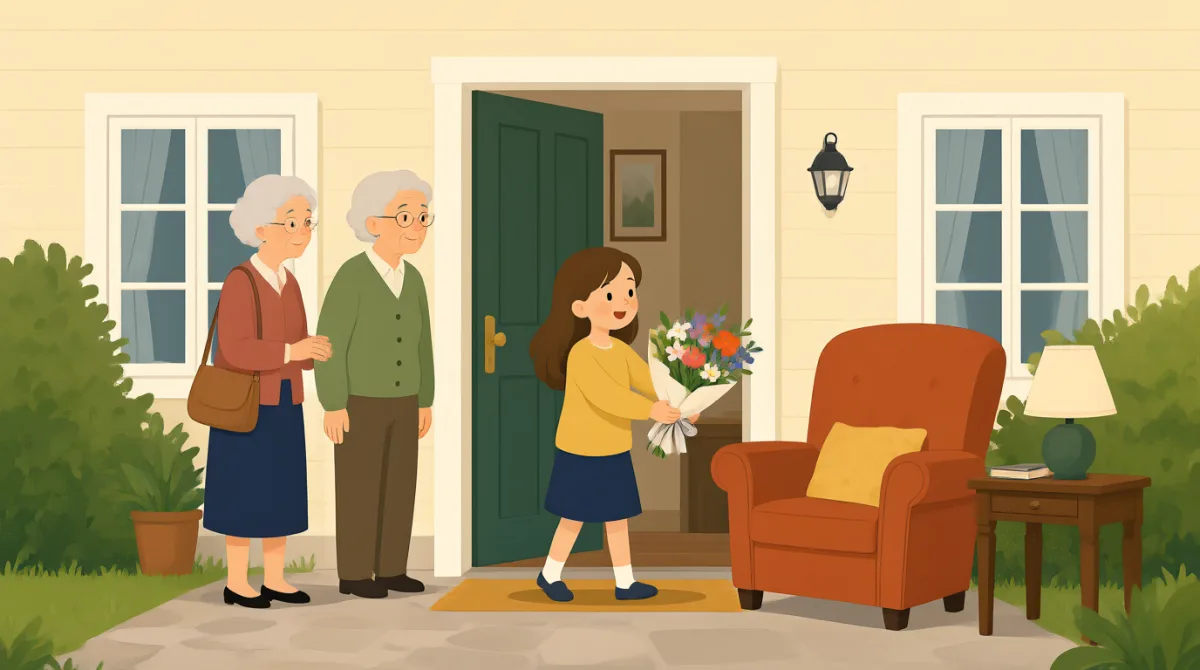

Hi, Grandma! Hi, Grandpa! I brought you some flowers.
¡Hola, abuela! ¡Hola, abuelo! Les traje unas flores.

Emma, what a lovely surprise! Come in, dear.
¡Emma, qué sorpresa tan bonita! Pasa, querida.

Those flowers are beautiful. Thank you for bringing them.
Qué bonitas son esas flores. Gracias por traerlas.
You’re welcome! I saw them at the flower shop on my way here.
¡De nada! Las vi en la florería de camino para acá.
They smell wonderful. Let me find a vase for them.
Huelen de maravilla. Voy a buscarles un jarrón.
Take off your coat, Emma. It’s warm inside.
Quítate el abrigo, Emma. Aquí adentro hace calor.
Thanks, Grandpa. It’s nice to visit you both today.
Gracias, abuelo. Qué lindo es venir a visitarlos hoy.
We’re happy you came. Would you like some tea?
Nos alegra que hayas venido. ¿Te gustaría tomar un té?
Vocabulario8
- what a lovely surprisequé sorpresa tan bonita
This is a warm way to show that something makes you happy and you did not expect it.
Esta es una forma cariñosa de expresar que algo te alegra y que no te lo esperabas.
- Come inPasa
This is a friendly way to invite someone to enter your home.
Es una forma amable de invitar a alguien a entrar en tu casa.
- bringing themtraerlas
Here, this means carrying the flowers to someone. You can use “bringing” for things you take to another person.
Aquí significa llevar las flores a alguien. Puedes usar “bringing” para hablar de cosas que llevas a otra persona.
- on my way herede camino para acá
This means while traveling to this place. You can use it to explain when you did something.
Significa mientras venías a este lugar. Puedes usar esta expresión para explicar cuándo hiciste algo.
- smell wonderfuloler de maravilla
This means to have a very nice smell. You can use “smell” to describe flowers, food, or other things.
Significa tener un olor muy agradable. Puedes usar “smell” para describir flores, comida u otras cosas.
- find a vasebuscar un jarrón
This means to look for and get a container for flowers. You can use “find” when you need to look for something.
Significa buscar y conseguir un recipiente para las flores. Puedes usar “find” cuando necesitas buscar algo.
- Take off your coatQuítate el abrigo
This is a friendly suggestion to remove your coat. “Take off” is a common phrasal verb for removing clothing.
Es una sugerencia amable para que alguien se quite el abrigo. “Take off” es un verbo frasal muy común para hablar de quitarse una prenda.
- Would you like some tea?¿Te gustaría tomar un té?
This is a polite way to offer someone tea. You can replace “tea” with another food or drink.
Es una forma cortés de ofrecerle té a alguien. Puedes cambiar “tea” por otra comida o bebida.
Frases clave8
- 1
I brought you some flowers.
Les traje unas flores.
Use this sentence to tell someone you brought them a gift. You can replace “flowers” with another thing, such as “some cookies.”
Usa esta oración para decirle a alguien que le trajiste un regalo. Puedes cambiar “flowers” por otra cosa, como “some cookies”.
- 2
Come in, dear.
Pasa, querida.
This is a warm way to invite someone into your home. You can use “Come in” with guests or visitors.
Es una forma cariñosa de invitar a alguien a entrar en tu casa. Puedes usar “Come in” con invitados o visitas.
- 3
Those flowers are beautiful.
Qué bonitas son esas flores.
Use this sentence to give a simple compliment. You can replace “flowers” with another plural noun, such as “pictures.”
Usa esta oración para hacer un cumplido sencillo. Puedes cambiar “flowers” por otro sustantivo en plural, como “pictures”.
- 4
I saw them at the flower shop on my way here.
Las vi en la florería de camino para acá.
This sentence explains where and when you saw something. You can replace “the flower shop” with another place.
Esta oración explica dónde y cuándo viste algo. Puedes cambiar “the flower shop” por otro lugar.
- 5
Let me find a vase for them.
Voy a buscarles un jarrón.
Use “Let me” to offer to do something for someone. You can replace “find a vase” with another helpful action.
Usa “Let me” para ofrecerte a hacer algo por alguien. Puedes cambiar “find a vase” por otra acción útil.
- 6
Take off your coat, Emma.
Quítate el abrigo, Emma.
This is a friendly way to suggest that someone remove their coat. You can use “Take off your…” with other clothing.
Es una forma amable de sugerir que alguien se quite el abrigo. Puedes usar “Take off your…” con otras prendas.
- 7
It’s nice to visit you both today.
Qué lindo es venir a visitarlos hoy.
Use this sentence to say you are happy to visit two people. You can replace “you both” with the person or people you are visiting.
Usa esta oración para decir que te alegra visitar a dos personas. Puedes cambiar “you both” por la persona o las personas a quienes visitas.
- 8
We’re happy you came.
Nos alegra que hayas venido.
This is a warm way to tell someone you are glad they visited. You can use it to welcome a guest.
Es una forma cariñosa de decirle a alguien que te alegra que haya venido de visita. Puedes usarla para dar la bienvenida a un invitado.