Carrying It All Home
Llevándolo todo a casa
After shopping, Emma and Jack figure out how to carry everything home. They split the bags and make sure nothing gets left behind.
Después de hacer las compras, Emma y Jack deciden cómo llevar todo a casa. Se reparten las bolsas y se aseguran de no dejar nada atrás.
Diálogo8
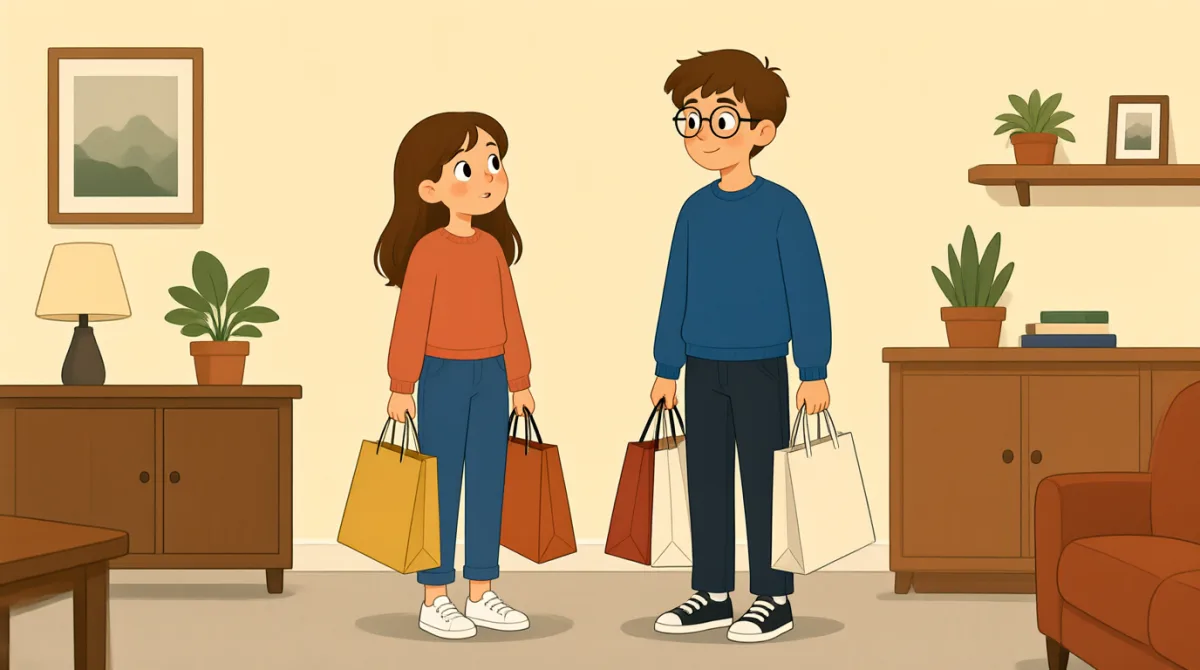

These bags are heavier than I thought. Can you carry the drinks?
Estas bolsas pesan más de lo que pensaba. ¿Puedes llevar las bebidas?

Sure. I’ll take the drinks and the paper plates. You take the food.
Claro. Yo llevo las bebidas y los platos de papel. Tú lleva la comida.
Good idea. Let’s split the bags so neither of us carries too much.
Buena idea. Repartamos las bolsas para que ninguno de los dos cargue demasiado.
I’ll put the bread on top. We don’t want it to get squashed.
Pondré el pan arriba. No queremos que se aplaste.
Thanks! Did we get everything? I don’t want to leave anything behind.
¡Gracias! ¿Tenemos todo? No quiero dejar nada atrás.
Let me check the list. We have the food, drinks, cups, and napkins.
Déjame revisar la lista. Tenemos la comida, las bebidas, los vasos y las servilletas.
Great. I’ll carry this bag, and you can take the last two.
Genial. Yo llevo esta bolsa y tú puedes llevar las otras dos.
Okay. Let’s head home before the ice cream melts.
Vale. Vámonos a casa antes de que se derrita el helado.
Vocabulario8
- carryllevar
To hold and take something with you. Here, Emma and Jack carry the shopping bags home.
Sujetar algo y transportarlo contigo. Aquí, Emma y Jack llevan las bolsas de la compra a casa.
- split the bagsrepartirse las bolsas
To share the bags between two people. You can use this phrase when dividing things so everyone carries a fair amount.
Compartir las bolsas entre dos personas. Puedes usar esta expresión cuando se reparten cosas para que todos carguen una cantidad razonable.
- on toparriba
In the highest position, above other things. Here, Jack puts the bread on top to protect it.
En la posición más alta, por encima de otras cosas. Aquí, Jack pone el pan arriba para protegerlo.
- get squashedaplastarse
To be pressed and become flat or damaged. Use this phrase when something soft might be crushed under heavier items.
Ser presionado hasta quedar plano o dañarse. Usa esta expresión cuando algo blando podría aplastarse debajo de objetos más pesados.
- leave anything behinddejar algo atrás
To forget or not take something with you. You can use this phrase to check that you have all your belongings.
Olvidar algo o no llevártelo contigo. Puedes usar esta expresión para comprobar que tienes todas tus cosas.
- check the listrevisar la lista
To look at a list and make sure everything is included. This is useful when checking items before you leave a shop.
Mirar una lista para asegurarte de que todo esté incluido. Es útil para comprobar que tienes todo antes de salir de una tienda.
- head homeirse a casa
To start going home. You can use this common phrase when you are ready to leave and go back home.
Empezar a volver a casa. Puedes usar esta expresión común cuando estás listo para irte y regresar a casa.
- meltsse derrite
Changes from solid to liquid because of heat. Here, the ice cream may melt if they take too long to get home.
Pasa de sólido a líquido por el calor. Aquí, el helado podría derretirse si tardan demasiado en llegar a casa.
Frases clave7
- 1
Can you carry the drinks?
¿Puedes llevar las bebidas?
A simple way to ask someone to carry something. Replace “the drinks” with another item, such as “the bags” or “the boxes.”
Una forma sencilla de pedirle a alguien que lleve algo. Sustituye “the drinks” por otro artículo, como “the bags” o “the boxes”.
- 2
Let’s split the bags so neither of us carries too much.
Repartamos las bolsas para que ninguno de los dos cargue demasiado.
Use this to suggest sharing a task fairly. You can replace “the bags” with other things you need to divide.
Usa esta frase para proponer que se repartan una tarea de manera equitativa. Puedes sustituir “the bags” por otras cosas que necesites dividir.
- 3
We don’t want it to get squashed.
No queremos que se aplaste.
This explains why something needs to be handled carefully. Replace “it” with an item that could be crushed, such as bread or fruit.
Esto explica por qué hay que manejar algo con cuidado. Sustituye “it” por un artículo que podría aplastarse, como el pan o la fruta.
- 4
Did we get everything?
¿Tenemos todo?
A useful question for checking that you have all the things you need. You can ask it before leaving a shop or another place.
Una pregunta útil para comprobar que tienes todo lo que necesitas. Puedes hacerla antes de salir de una tienda o de otro lugar.
- 5
I don’t want to leave anything behind.
No quiero dejar nada atrás.
Use this to say that you want to take all your belongings with you. It is helpful when checking a list or packing up.
Usa esta frase para decir que quieres llevarte todas tus cosas. Es útil cuando revisas una lista o recoges tus pertenencias.
- 6
Let me check the list.
Déjame revisar la lista.
A natural way to say that you will look at a list to confirm something. You can use it when shopping, preparing for a trip, or checking tasks.
Una forma natural de decir que vas a mirar una lista para confirmar algo. Puedes usarla cuando haces compras, preparas un viaje o revisas tareas.
- 7
Let’s head home before the ice cream melts.
Vámonos a casa antes de que se derrita el helado.
This suggests going home soon and gives a reason for leaving. Replace “the ice cream melts” with another reason to hurry.
Esta frase sugiere irse pronto a casa y da una razón para salir. Sustituye “the ice cream melts” por otro motivo para darse prisa.