Seeing the Poster
Ver el cartel
Emma and Mia see a poster for a neighborhood clean-up day at the park. They talk about joining the event.
Emma y Mia ven en el parque un cartel sobre una jornada de limpieza del vecindario. Hablan de participar en el evento.
Diálogo8
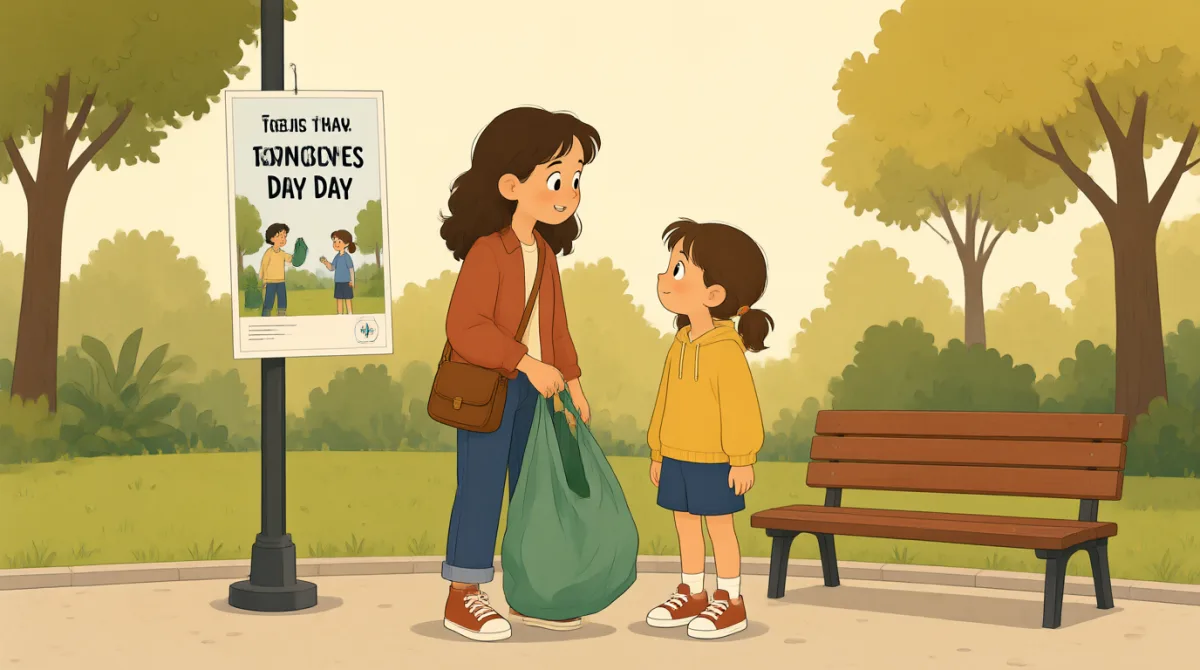

Mia, look at that poster by the park gate. It says “Neighborhood Clean-Up Day.”
Mia, mira ese cartel junto a la entrada del parque. Dice: «Jornada de limpieza del vecindario».

Oh, nice! When is it? I’d like to help clean up the park.
¡Qué bien! ¿Cuándo es? Me gustaría ayudar a limpiar el parque.
It’s this Saturday morning, from nine to noon. Are you free then?
Es este sábado por la mañana, de nueve a doce. ¿Estás libre entonces?
Yes, I am. I usually take a walk there on Saturdays anyway.
Sí. De todos modos, suelo pasear por allí los sábados.
Great! We can pick up litter and make the park look nicer.
¡Genial! Podemos recoger basura y hacer que el parque se vea más bonito.
Do we need to bring anything, like gloves or trash bags?
¿Tenemos que llevar algo, como guantes o bolsas de basura?
The poster says tools will be provided. We just need to show up on time.
El cartel dice que proporcionarán las herramientas. Solo tenemos que llegar a tiempo.
Sounds good. Let’s join! We can ask the organizer where to meet.
¡Perfecto! ¡Participemos! Podemos preguntarle a la persona que organiza el evento dónde tenemos que encontrarnos.
Vocabulario7
- clean uplimpiar
To clean a place by removing dirt or rubbish. Here, Mia wants to help clean the park.
Limpiar un lugar quitando la suciedad o la basura. En este caso, Mia quiere ayudar a limpiar el parque.
- pick up litterrecoger basura
To collect rubbish from the ground. You can use this phrase when talking about cleaning a public place.
Juntar la basura que hay en el suelo. Puedes usar esta expresión para hablar de la limpieza de un espacio público.
- look nicerverse más bonito
To appear more attractive or pleasant. Use it to describe how a place may look after cleaning.
Tener un aspecto más atractivo o agradable. Usa esta expresión para describir cómo puede verse un lugar después de limpiarlo.
- be providedproporcionarse
To be supplied or given for people to use. Here, the organizers will supply the tools.
Ser suministrado o entregado para que la gente lo use. Aquí, los organizadores proporcionarán las herramientas.
- show up on timellegar a tiempo
To arrive at the expected time. This phrase is useful for plans and events.
Llegar a la hora prevista. Esta expresión es útil al hablar de planes y eventos.
- joinparticipar
To take part in an activity with other people. Here, Mia agrees to take part in the clean-up.
Tomar parte en una actividad con otras personas. Aquí, Mia acepta participar en la jornada de limpieza.
- ask the organizerpreguntarle a la persona que organiza el evento
To speak to the person who plans or manages an event. You can ask the organizer for information about where to meet.
Hablar con la persona que planifica o coordina un evento. Puedes preguntarle dónde encontrarse.
Frases clave8
- 1
When is it?
¿Cuándo es?
This is a simple way to ask when an event or activity will happen. You can use it after someone tells you about a plan.
Esta es una forma sencilla de preguntar cuándo será un evento o una actividad. Puedes usarla después de que alguien te cuente un plan.
- 2
I’d like to help clean up the park.
Me gustaría ayudar a limpiar el parque.
Use “I’d like to” to say what you want to do politely. You can replace “clean up the park” with another activity.
Usa “I’d like to” para decir de forma amable lo que quieres hacer. Puedes sustituir “clean up the park” por otra actividad.
- 3
Are you free then?
¿Estás libre entonces?
This is a common way to ask if someone is available at a particular time. “Then” refers to a time that was just mentioned.
Esta es una forma habitual de preguntar si alguien está disponible a una hora determinada. “Then” se refiere a una hora que se acaba de mencionar.
- 4
We can pick up litter and make the park look nicer.
Podemos recoger basura y hacer que el parque se vea más bonito.
This sentence suggests two things people can do together. Use “We can” to talk about possible activities or plans.
Esta frase propone dos cosas que pueden hacer juntos. Usa “We can” para hablar de actividades posibles o de planes.
- 5
Do we need to bring anything, like gloves or trash bags?
¿Tenemos que llevar algo, como guantes o bolsas de basura?
Use this question to find out what you should bring to an event. “Like” introduces examples of useful things.
Usa esta pregunta para averiguar qué deberías llevar a un evento. “Like” introduce ejemplos de cosas útiles.
- 6
We just need to show up on time.
Solo tenemos que llegar a tiempo.
This tells someone what they need to do. Use “just need to” when the task or requirement is simple.
Esta frase le dice a alguien qué tiene que hacer. Usa “just need to” cuando la tarea o el requisito es sencillo.
- 7
Let’s join!
¡Participemos!
Use “Let’s” to suggest doing something together. You can replace “join” with another activity, such as “Let’s go.”
Usa “Let’s” para proponer hacer algo juntos. Puedes sustituir “join” por otra actividad, como en “Let’s go.”
- 8
We can ask the organizer where to meet.
Podemos preguntarle a la persona que organiza el evento dónde tenemos que encontrarnos.
This sentence suggests asking someone for information. Use “where to meet” when you need to find out the meeting place.
Esta frase propone pedirle información a alguien. Usa “where to meet” cuando necesitas averiguar el lugar de encuentro.