Cooking Over a Fire
Cocinar al fuego
Emma and Jack cook dinner over the campsite fire. They prepare a simple meal and talk about what they want to do the next day.
Emma y Jack preparan la cena sobre el fuego del campamento. Cocinan algo sencillo y hablan de lo que quieren hacer al día siguiente.
Diálogo8
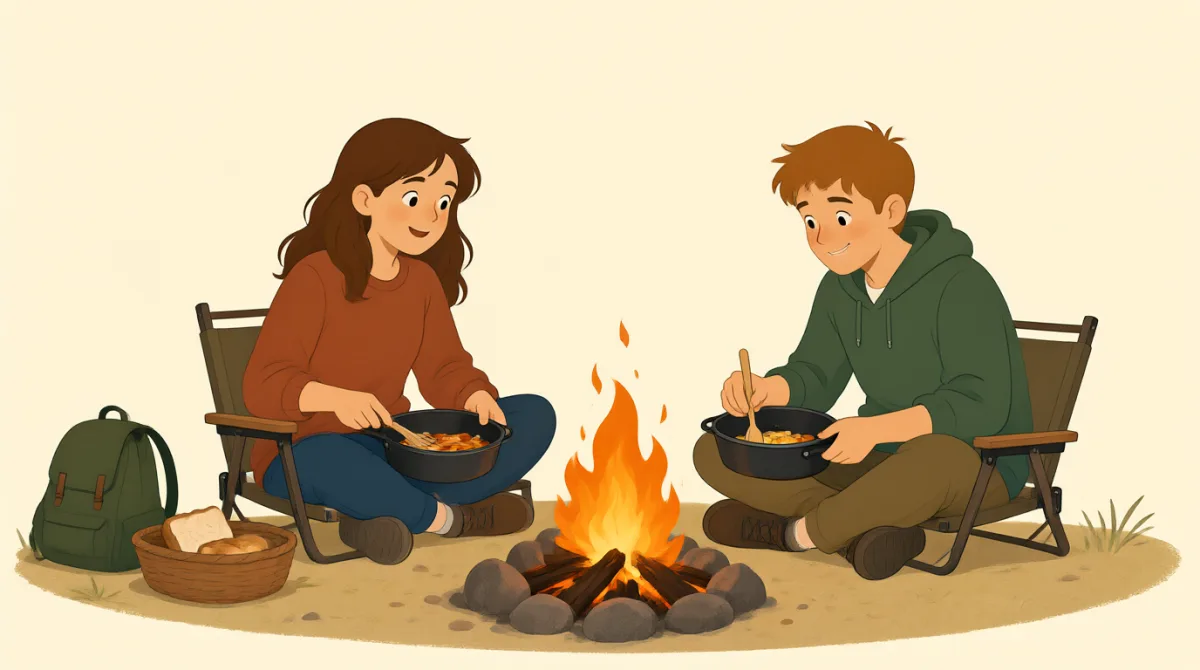

The fire is ready. What should we cook for dinner?
El fuego ya está listo. ¿Qué cocinamos para cenar?

Let’s cook sausages and potatoes. I brought some bread, too.
Cocinemos salchichas y papas. También traje pan.
Great! Can you put the potatoes in the pan?
¡Genial! ¿Puedes poner las papas en la sartén?
Sure. We should cook them slowly so they don’t burn.
Claro. Deberíamos cocinarlas despacio para que no se quemen.
I’ll turn the sausages. They smell really good.
Voy a voltear las salchichas. Huelen muy bien.
Dinner will be ready soon. What do you want to do tomorrow?
La cena estará lista pronto. ¿Qué quieres hacer mañana?
I’d like to hike by the lake and take some pictures.
Me gustaría caminar por el lago y tomar algunas fotos.
Sounds good. Let’s eat, then plan our morning.
Suena bien. Comamos y después planeemos la mañana.
Vocabulario8
- cook for dinnercocinar para la cena
This means to prepare food for the evening meal. You can ask, “What should we cook for dinner?”
Significa preparar comida para la cena. Puedes preguntar: “What should we cook for dinner?” (¿Qué cocinamos para cenar?).
- broughttraje
“Brought” is the past form of “bring.” Use it to say you carried something with you, such as food on a camping trip.
“Brought” es el pasado de “bring”. Se usa para decir que llevaste algo contigo, como comida para un viaje de campamento.
- put the potatoes in the panponer las papas en la sartén
This means to place the potatoes inside the pan. You can use “put [something] in [a container]” when giving a simple instruction.
Significa colocar las papas dentro de la sartén. Puedes usar “put [something] in [a container]” para dar una instrucción sencilla.
- cook them slowlycocinarlas despacio
This means to heat the food gently over time. You can use this phrase when food needs to cook without burning.
Significa calentar la comida suavemente durante un tiempo. Puedes usar esta expresión cuando hace falta cocinar algo sin que se queme.
- turn the sausagesvoltear las salchichas
This means to move or flip the sausages so they cook on the other side. It is useful when cooking food in a pan or over a fire.
Significa mover o dar vuelta a las salchichas para que se cocinen del otro lado. Es útil cuando cocinas en una sartén o sobre el fuego.
- burnquemarse
Food burns when it gets too hot or cooks for too long. You can say, “Watch the food so it doesn’t burn.”
La comida se quema cuando se calienta demasiado o se cocina durante mucho tiempo. Puedes decir: “Watch the food so it doesn’t burn.” (Vigila la comida para que no se queme.).
- by the lakejunto al lago
This means near or beside the lake. Use “by” to describe a place next to something.
Significa cerca del lago o a su lado. Usa “by” para describir un lugar que está junto a algo.
- take some picturestomar algunas fotos
This means to use a camera or phone to make photographs. You can say, “I’d like to take some pictures” when talking about plans.
Significa usar una cámara o un teléfono para hacer fotografías. Puedes decir “I’d like to take some pictures” cuando hablas de tus planes.
Frases clave8
- 1
What should we cook for dinner?
¿Qué cocinamos para cenar?
Use this question to ask for ideas about what to prepare for an evening meal. You can replace “dinner” with another meal or occasion.
Usa esta pregunta para pedir ideas sobre qué preparar para la cena. Puedes reemplazar “dinner” por otra comida u ocasión.
- 2
I brought some bread, too.
También traje pan.
This sentence tells someone that you brought an additional item. Use “I brought [something], too” to mention something you have with you.
Esta frase le dice a alguien que trajiste algo más. Usa “I brought [something], too” para mencionar algo que llevas contigo.
- 3
Can you put the potatoes in the pan?
¿Puedes poner las papas en la sartén?
This is a polite way to ask someone to do a task. Replace “the potatoes” and “the pan” with other things and places.
Esta es una forma amable de pedirle a alguien que haga algo. Reemplaza “the potatoes” y “the pan” por otras cosas y lugares.
- 4
We should cook them slowly so they don’t burn.
Deberíamos cocinarlas despacio para que no se quemen.
Use “We should” to make a suggestion, and “so” to explain the reason. You can use this pattern to give practical advice.
Usa “We should” para hacer una sugerencia y “so” para explicar el motivo. Puedes usar este patrón para dar consejos prácticos.
- 5
I’ll turn the sausages.
Voy a voltear las salchichas.
Use “I’ll” to offer to do something now or soon. Replace “turn the sausages” with another helpful task.
Usa “I’ll” para ofrecerte a hacer algo ahora o pronto. Reemplaza “turn the sausages” por otra tarea útil.
- 6
What do you want to do tomorrow?
¿Qué quieres hacer mañana?
Use this question to ask someone about their plans for the next day. You can replace “tomorrow” with another time.
Usa esta pregunta para preguntarle a alguien qué planes tiene para el día siguiente. Puedes reemplazar “tomorrow” por otro momento.
- 7
I’d like to hike by the lake and take some pictures.
Me gustaría caminar por el lago y tomar algunas fotos.
Use “I’d like to” to talk about something you want to do. Add two activities with “and” to describe your plans.
Usa “I’d like to” para hablar de algo que quieres hacer. Añade dos actividades con “and” para describir tus planes.
- 8
Let’s eat, then plan our morning.
Comamos y después planeemos la mañana.
Use “Let’s” to suggest doing something together. “Then” shows the order of the activities: eat first and plan afterward.
Usa “Let’s” para sugerir hacer algo juntos. “Then” indica el orden de las actividades: primero comemos y después hacemos planes.