Talking About a Family Member
Hablar de un familiar
Leo tells David about his older sister and shares what makes her patient and helpful, even when they disagree.
Leo le habla a David de su hermana mayor y le cuenta por qué es paciente y servicial, incluso cuando no están de acuerdo.
Diálogo9
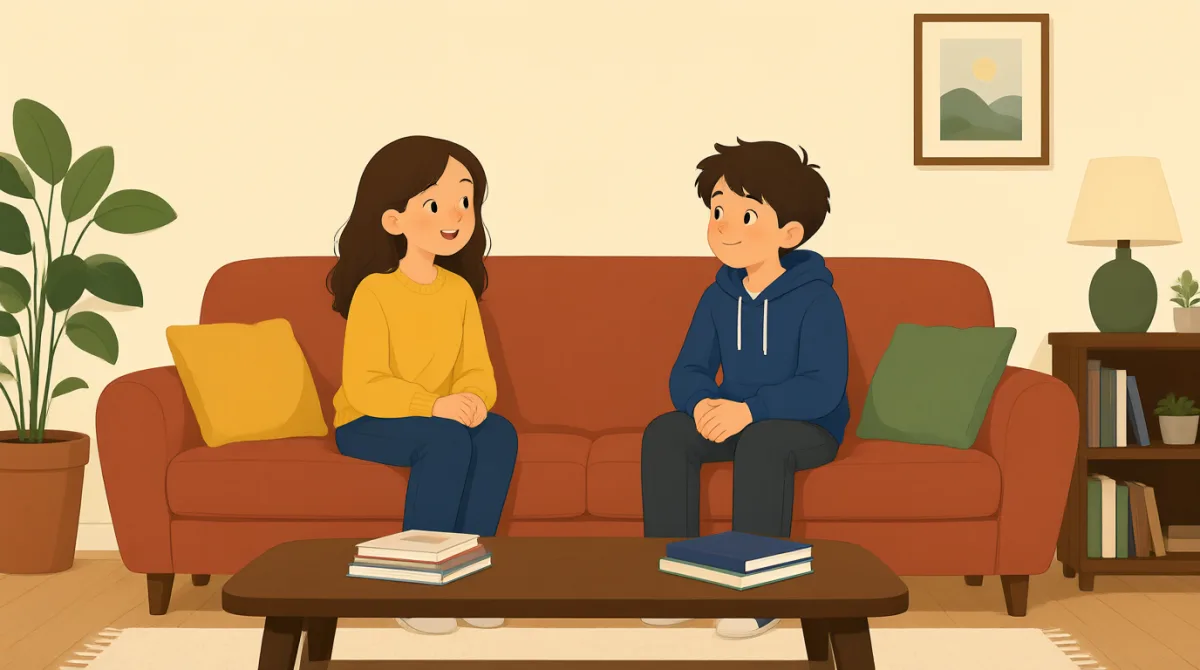

My older sister is very patient, even when I make the same mistake twice.
Mi hermana mayor es muy paciente, incluso cuando cometo el mismo error dos veces.

That’s a good quality. Does she help you when you need something?
Es una buena cualidad. ¿Te ayuda cuando necesitas algo?
Yes, she helps me with my homework and gives me good advice.
Sí, me ayuda con los deberes y me da buenos consejos.
She sounds helpful. Do you always agree with each other?
Parece muy servicial. ¿Siempre están de acuerdo?
Not always. We disagree about small things, like what to watch on TV.
No siempre. No estamos de acuerdo en cosas pequeñas, como qué ver en la tele.
And how does she handle those disagreements?
¿Y cómo maneja esos desacuerdos?
She listens to me, then explains what she thinks. She never gets angry.
Me escucha y luego me explica lo que piensa. Nunca se enfada.
You’re lucky to have a sister like that. Try listening to her, too.
Qué suerte tener una hermana así. Tú también intenta escucharla.
I will. She’s patient and helpful, and I can learn from her.
Lo haré. Es paciente y servicial, y puedo aprender de ella.
Vocabulario7
- patientpaciente
Patient describes someone who stays calm and does not get upset when something takes time or happens again.
Paciente describe a alguien que mantiene la calma y no se molesta cuando algo tarda o vuelve a ocurrir.
- make the same mistake twicecometer el mismo error dos veces
This means to do the same thing wrong two times. You can use it to talk about mistakes you repeat.
Significa hacer mal lo mismo dos veces. Puedes usar esta expresión para hablar de errores que repites.
- good advicebuenos consejos
Good advice is helpful guidance about what to do. You can say someone gives you good advice.
Un buen consejo es una orientación útil sobre qué hacer. Puedes decir que alguien te da buenos consejos.
- disagree aboutno estar de acuerdo en
To disagree about something means to have different opinions about it. Use it to say what people do not agree on.
No estar de acuerdo en algo significa tener opiniones diferentes al respecto. Usa esta expresión para decir en qué no coinciden las personas.
- handle those disagreementsmanejar esos desacuerdos
To handle disagreements means to deal with times when people have different opinions. You can use this phrase to ask how someone responds.
Manejar los desacuerdos significa lidiar con situaciones en las que las personas tienen opiniones diferentes. Puedes usar esta expresión para preguntar cómo responde alguien.
- gets angryenfadarse
To get angry means to become upset or mad. Use it to describe how someone reacts.
Enfadarse significa molestarse o ponerse de mal humor. Usa esta expresión para describir cómo reacciona alguien.
- learn from heraprender de ella
To learn from someone means to gain useful ideas or skills by listening to or watching that person.
Aprender de alguien significa adquirir ideas o habilidades útiles al escuchar o observar a esa persona.
Frases clave7
- 1
My older sister is very patient, even when I make the same mistake twice.
Mi hermana mayor es muy paciente, incluso cuando cometo el mismo error dos veces.
Use this sentence to describe a family member’s personality and give an example. You can change “older sister” to another person and describe how they stay patient.
Usa esta frase para describir la personalidad de un familiar y dar un ejemplo. Puedes cambiar “older sister” por otra persona y describir cómo mantiene la paciencia.
- 2
She helps me with my homework and gives me good advice.
Me ayuda con los deberes y me da buenos consejos.
This sentence explains how someone helps you. You can replace “homework” with another task or situation.
Esta frase explica cómo alguien te ayuda. Puedes sustituir “homework” por otra tarea o situación.
- 3
We disagree about small things, like what to watch on TV.
No estamos de acuerdo en cosas pequeñas, como qué ver en la tele.
Use this to say that you and another person have different opinions. You can change the example after “like” to name something you disagree about.
Usa esta frase para decir que otra persona y tú tienen opiniones diferentes. Puedes cambiar el ejemplo después de “like” para mencionar algo en lo que no están de acuerdo.
- 4
She listens to me, then explains what she thinks.
Me escucha y luego me explica lo que piensa.
This sentence describes a calm way to share different opinions. You can use the pattern “listens to me, then explains” to talk about someone’s response.
Esta frase describe una manera tranquila de compartir opiniones diferentes. Puedes usar el patrón “listens to me, then explains” para hablar de cómo responde alguien.
- 5
She never gets angry.
Nunca se enfada.
This is a simple way to describe how someone reacts. You can replace “She” with another person’s name or pronoun.
Esta es una manera sencilla de describir cómo reacciona alguien. Puedes sustituir “She” por el nombre o el pronombre de otra persona.
- 6
Try listening to her, too.
Intenta escucharla tú también.
Use this sentence to give someone gentle advice. You can change “her” to “him” or “them” depending on the person.
Usa esta frase para dar un consejo con delicadeza. Puedes cambiar “her” por “him” o “them”, según la persona.
- 7
She’s patient and helpful, and I can learn from her.
Es paciente y servicial, y puedo aprender de ella.
This sentence describes two good qualities and says what you can gain from the person. You can change the qualities and use “learn from” for someone you admire.
Esta frase describe dos cualidades positivas y dice qué puedes aprender de esa persona. Puedes cambiar las cualidades y usar “learn from” para hablar de alguien a quien admiras.