Talking About a Family Member
Falando sobre um familiar
Leo tells David about his older sister and shares what makes her patient and helpful, even when they disagree.
Leo conta a David sobre a irmã mais velha e explica o que a torna paciente e prestativa, mesmo quando eles discordam.
Diálogo9
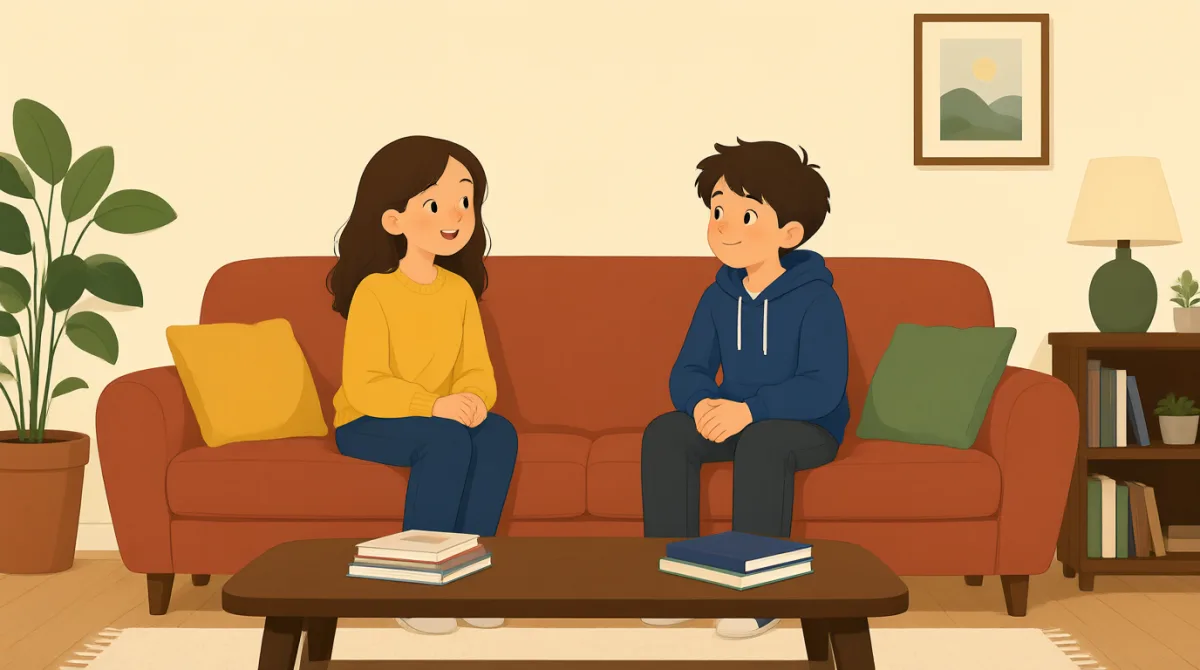

My older sister is very patient, even when I make the same mistake twice.
Minha irmã mais velha é muito paciente, mesmo quando cometo o mesmo erro duas vezes.

That’s a good quality. Does she help you when you need something?
Essa é uma qualidade e tanto. Ela te ajuda quando você precisa de alguma coisa?
Yes, she helps me with my homework and gives me good advice.
Sim, ela me ajuda com a lição de casa e me dá bons conselhos.
She sounds helpful. Do you always agree with each other?
Ela parece ser prestativa. Vocês sempre concordam um com o outro?
Not always. We disagree about small things, like what to watch on TV.
Nem sempre. A gente discorda sobre coisas pequenas, como o que assistir na TV.
And how does she handle those disagreements?
E como ela lida com essas discordâncias?
She listens to me, then explains what she thinks. She never gets angry.
Ela me escuta e depois explica o que pensa. Nunca fica brava.
You’re lucky to have a sister like that. Try listening to her, too.
Você tem sorte de ter uma irmã assim. Tente escutar o que ela tem a dizer também.
I will. She’s patient and helpful, and I can learn from her.
Vou fazer isso. Ela é paciente e prestativa, e posso aprender com ela.
Vocabulário7
- patientpaciente
Patient describes someone who stays calm and does not get upset when something takes time or happens again.
Patient descreve alguém que mantém a calma e não fica chateado quando algo demora ou acontece de novo.
- make the same mistake twicecometer o mesmo erro duas vezes
This means to do the same thing wrong two times. You can use it to talk about mistakes you repeat.
A expressão "make the same mistake twice" significa fazer a mesma coisa errada duas vezes. Você pode usá-la para falar de erros que repete.
- good advicebons conselhos
Good advice is helpful guidance about what to do. You can say someone gives you good advice.
Good advice são orientações úteis sobre o que fazer. Você pode dizer que alguém te dá bons conselhos.
- disagree aboutdiscordar sobre
To disagree about something means to have different opinions about it. Use it to say what people do not agree on.
Disagree about algo significa ter opiniões diferentes sobre esse assunto. Use essa expressão para dizer em que as pessoas não concordam.
- handle those disagreementslidar com essas discordâncias
To handle disagreements means to deal with times when people have different opinions. You can use this phrase to ask how someone responds.
Handle disagreements significa lidar com situações em que as pessoas têm opiniões diferentes. Você pode usar essa expressão para perguntar como alguém reage.
- gets angryficar bravo
To get angry means to become upset or mad. Use it to describe how someone reacts.
Get angry significa ficar chateado ou bravo. Use essa expressão para descrever como alguém reage.
- learn from heraprender com ela
To learn from someone means to gain useful ideas or skills by listening to or watching that person.
Learn from someone significa adquirir ideias úteis ou habilidades ouvindo ou observando essa pessoa.
Frases-chave7
- 1
My older sister is very patient, even when I make the same mistake twice.
Minha irmã mais velha é muito paciente, mesmo quando cometo o mesmo erro duas vezes.
Use this sentence to describe a family member’s personality and give an example. You can change “older sister” to another person and describe how they stay patient.
Use esta frase para descrever a personalidade de um familiar e dar um exemplo. Você pode trocar “older sister” (irmã mais velha) por outra pessoa e dizer como ela mantém a calma.
- 2
She helps me with my homework and gives me good advice.
Ela me ajuda com a lição de casa e me dá bons conselhos.
This sentence explains how someone helps you. You can replace “homework” with another task or situation.
Esta frase explica como alguém ajuda você. Você pode substituir “homework” (lição de casa) por outra tarefa ou situação.
- 3
We disagree about small things, like what to watch on TV.
A gente discorda sobre coisas pequenas, como o que assistir na TV.
Use this to say that you and another person have different opinions. You can change the example after “like” to name something you disagree about.
Use esta frase para dizer que você e outra pessoa têm opiniões diferentes. Você pode mudar o exemplo depois de “like” (como) para indicar algo sobre o qual vocês discordam.
- 4
She listens to me, then explains what she thinks.
Ela me escuta e depois explica o que pensa.
This sentence describes a calm way to share different opinions. You can use the pattern “listens to me, then explains” to talk about someone’s response.
Esta frase descreve uma maneira tranquila de expressar opiniões diferentes. Você pode usar o padrão “listens to me, then explains” (me escuta e depois explica) para falar da reação de alguém.
- 5
She never gets angry.
Ela nunca fica brava.
This is a simple way to describe how someone reacts. You can replace “She” with another person’s name or pronoun.
Esta é uma maneira simples de descrever como alguém reage. Você pode substituir “She” pelo nome ou pronome de outra pessoa.
- 6
Try listening to her, too.
Tente escutar o que ela tem a dizer também.
Use this sentence to give someone gentle advice. You can change “her” to “him” or “them” depending on the person.
Use esta frase para dar um conselho gentil a alguém. Você pode trocar “her” por “him” ou “them”, dependendo da pessoa.
- 7
She’s patient and helpful, and I can learn from her.
Ela é paciente e prestativa, e posso aprender com ela.
This sentence describes two good qualities and says what you can gain from the person. You can change the qualities and use “learn from” for someone you admire.
Esta frase descreve duas qualidades positivas e diz o que você pode aprender com a pessoa. Você pode mudar as qualidades e usar “learn from” para falar de alguém que admira.