Helping in the Garden
Im Garten helfen
Emma joins her grandparents in the garden and helps them pull weeds and water the plants. They talk about what to grow next.
Emma hilft ihren Großeltern im Garten. Sie zupft Unkraut und gießt die Pflanzen. Dabei sprechen sie darüber, was sie als Nächstes anbauen könnten.
Dialog8
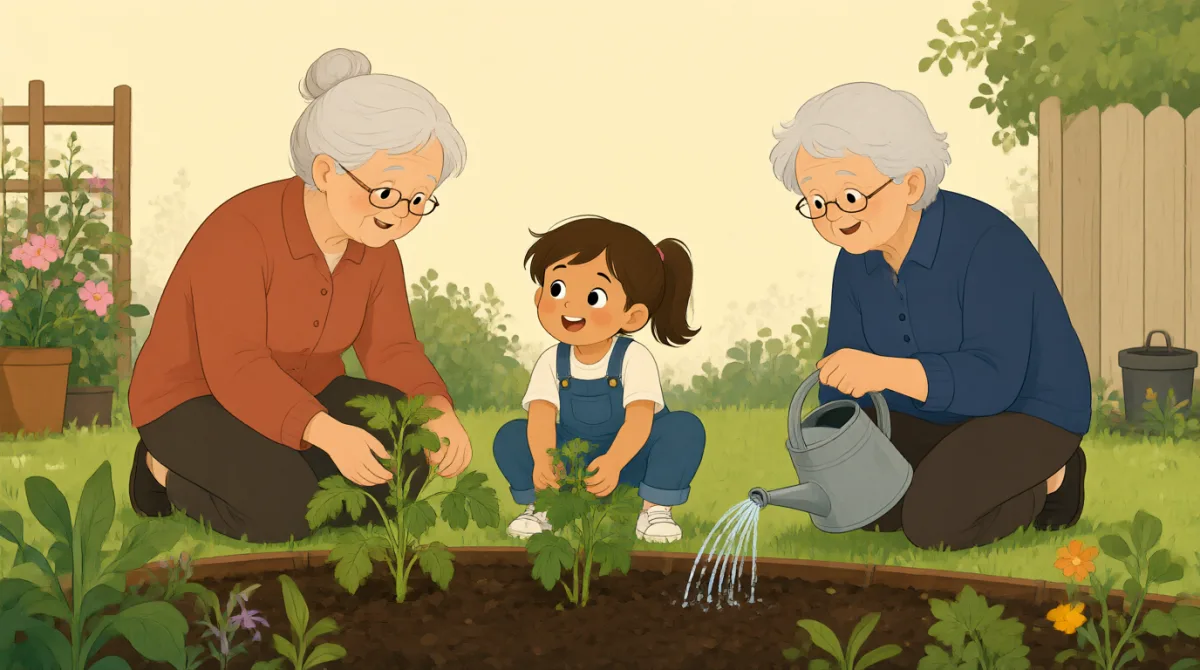

What should I do first? I can help with the garden.
Was soll ich zuerst machen? Ich kann im Garten helfen.

Thanks, Emma. Please pull the weeds near those small plants.
Danke, Emma. Zupf bitte das Unkraut bei den kleinen Pflanzen dort.

Be careful with the flowers. They’re growing well this year.
Pass bei den Blumen auf. Sie wachsen dieses Jahr richtig gut.
I’ll be careful. Should I water them after I pull the weeds?
Ich passe auf. Soll ich sie gießen, nachdem ich das Unkraut gezupft habe?
Yes, please. The soil is dry, and the plants need a good drink.
Ja, bitte. Die Erde ist trocken, und die Pflanzen brauchen ordentlich Wasser.
We could grow tomatoes next. We use them in many meals.
Wir könnten als Nächstes Tomaten anbauen. Wir verwenden sie in vielen Gerichten.
That sounds fun! Can I help you plant them next weekend?
Das klingt toll! Kann ich dir nächstes Wochenende beim Pflanzen helfen?
Of course. Bring your gardening gloves, and we’ll find a sunny spot.
Natürlich. Bring deine Gartenhandschuhe mit, dann suchen wir einen sonnigen Platz.
Wortschatz8
- pull the weedsUnkraut zupfen
To pull the weeds means to remove unwanted plants from a garden by pulling them out. You can say, “Please pull the weeds near the flowers.”
“pull the weeds” bedeutet, unerwünschte Pflanzen aus dem Garten herauszuziehen. Du kannst sagen: “Please pull the weeds near the flowers.” (Bitte zupf das Unkraut bei den Blumen.)
- Be carefulPass auf
This is a way to remind someone to act safely and avoid causing a problem. Use it before someone handles something delicate or dangerous.
Mit “Be careful” erinnerst du jemanden daran, vorsichtig zu sein und nichts kaputtzumachen oder sich nicht zu verletzen. Du sagst es, bevor jemand mit etwas Zerbrechlichem oder Gefährlichem umgeht.
- growing wellgut wachsen
This means that a plant is healthy and getting bigger. You can use it to describe plants or other things that are developing successfully.
“growing well” bedeutet, dass eine Pflanze gesund ist und größer wird. Du kannst damit Pflanzen oder andere Dinge beschreiben, die sich gut entwickeln.
- water themsie gießen
To water plants means to give them water. Use “water them” when the people you are talking about already know which plants you mean.
Pflanzen zu gießen bedeutet, ihnen Wasser zu geben. Verwende “water them”, wenn die Person, mit der du sprichst, bereits weiß, welche Pflanzen gemeint sind.
- The soil is dryDie Erde ist trocken
Soil is the earth in which plants grow. This sentence explains that the plants need water.
“soil” ist die Erde, in der Pflanzen wachsen. Dieser Satz erklärt, warum die Pflanzen Wasser brauchen.
- grow tomatoesTomaten anbauen
To grow tomatoes means to plant and care for tomato plants. You can replace “tomatoes” with another plant or vegetable.
“grow tomatoes” bedeutet, Tomatenpflanzen anzupflanzen und zu pflegen. Du kannst “tomatoes” durch eine andere Pflanze oder ein anderes Gemüse ersetzen.
- next weekendnächstes Wochenende
This means the weekend that is coming soon. Use it to talk about a plan for the near future.
“next weekend” bedeutet das bald kommende Wochenende. Mit diesem Ausdruck sprichst du über einen Plan für die nahe Zukunft.
- find a sunny spoteinen sonnigen Platz finden
A sunny spot is a place that gets a lot of sunlight. This phrase is useful when choosing a good place for plants.
“A sunny spot” ist ein Platz, an dem viel Sonne hinkommt. Der Ausdruck ist nützlich, wenn du einen guten Standort für Pflanzen auswählst.
Wichtige Sätze7
- 1
What should I do first?
Was soll ich zuerst machen?
Use this to ask what task to do before the others. You can replace “do” with another action, such as “What should I bring first?”
Mit “What should I do first?” fragst du, welche Aufgabe du zuerst erledigen sollst. Du kannst “do” durch eine andere Handlung ersetzen, zum Beispiel: “What should I bring first?” (Was soll ich zuerst mitbringen?)
- 2
I can help with the garden.
Ich kann im Garten helfen.
This is a friendly way to offer help. Replace “the garden” with another task or place, such as “I can help with dinner.”
Das ist eine freundliche Art, Hilfe anzubieten. Ersetze “the garden” durch eine andere Aufgabe oder einen anderen Ort, zum Beispiel in “I can help with dinner.” (Ich kann beim Abendessen helfen.)
- 3
Please pull the weeds near those small plants.
Zupf bitte das Unkraut bei den kleinen Pflanzen dort.
This is a polite way to ask someone to remove weeds and say where to do it. You can change the action and location to give other simple instructions.
Das ist eine höfliche Bitte, Unkraut zu entfernen, und nennt gleich den Ort. Du kannst die Handlung und den Ort ändern, um andere einfache Anweisungen zu geben.
- 4
Should I water them after I pull the weeds?
Soll ich sie gießen, nachdem ich das Unkraut gezupft habe?
Use “Should I…?” to ask if an action is the right thing to do. “After” helps you check the order of two tasks.
Mit “Should I…?” fragst du, ob eine Handlung das Richtige ist. “After” hilft dir, nach der Reihenfolge von zwei Aufgaben zu fragen.
- 5
The soil is dry, and the plants need a good drink.
Die Erde ist trocken, und die Pflanzen brauchen ordentlich Wasser.
This explains why the plants need water. “The plants need a good drink” is a friendly, everyday way to say they need watering.
Dieser Satz erklärt, warum die Pflanzen Wasser brauchen. “The plants need a good drink” ist eine freundliche, alltägliche Art zu sagen, dass die Pflanzen gegossen werden müssen.
- 6
Can I help you plant them next weekend?
Kann ich dir nächstes Wochenende beim Pflanzen helfen?
Use this to offer help with a future activity and ask for permission. You can change “plant them” and “next weekend” to fit your plans.
Mit diesem Satz bietest du Hilfe bei einer zukünftigen Aktivität an und fragst, ob das in Ordnung ist. Du kannst “plant them” und “next weekend” an deine Pläne anpassen.
- 7
Bring your gardening gloves, and we’ll find a sunny spot.
Bring deine Gartenhandschuhe mit, dann suchen wir einen sonnigen Platz.
This sentence gives a simple instruction and describes what you will do together. Use “Bring your…” to remind someone to take something they need.
Dieser Satz gibt eine einfache Anweisung und beschreibt, was ihr zusammen machen werdet. Mit “Bring your…” erinnerst du jemanden daran, etwas Notwendiges mitzubringen.