Picking Up the Glasses
Die Brille abholen
Emma returns to collect her new glasses and tries them on. Grace checks the fit and explains how to look after them.
Emma kommt zurück, um ihre neue Brille abzuholen, und probiert sie an. Grace überprüft den Sitz und erklärt ihr, wie sie die Brille pflegt.
Dialog8
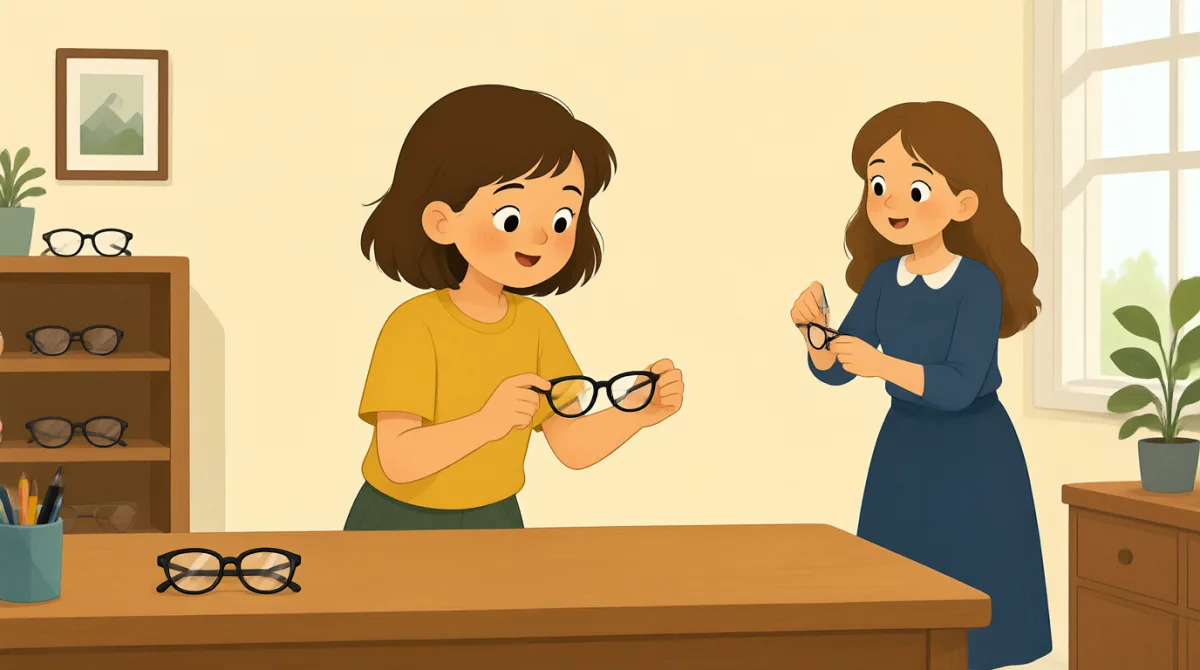

Hi, Grace. I’m here to pick up my new glasses.
Hallo, Grace. Ich bin hier, um meine neue Brille abzuholen.

Hi, Emma. They’re ready. Please try them on and tell me how they feel.
Hallo, Emma. Sie ist fertig. Probier sie bitte an und sag mir, wie sie sich anfühlt.
They feel comfortable, and everything looks much clearer now.
Sie sitzt bequem, und jetzt sehe ich alles viel schärfer.
Great. Look straight ahead. Do they slip when you move your head?
Super. Schau geradeaus. Rutscht sie, wenn du den Kopf bewegst?
No, they stay in place. Should I clean them with a cloth?
Nein, sie bleibt an Ort und Stelle. Soll ich sie mit einem Tuch reinigen?
Yes, use a soft cloth. Keep them in this case when you’re not wearing them.
Ja, nimm ein weiches Tuch. Bewahr sie in diesem Etui auf, wenn du sie nicht trägst.
Got it. Do I need to come back if they feel uncomfortable?
Alles klar. Muss ich wiederkommen, wenn sie unbequem ist?
Of course. Come back anytime, and we can adjust the frames for you.
Natürlich. Komm jederzeit wieder, dann können wir das Gestell für dich anpassen.
Wortschatz8
- pick up my new glassesmeine neue Brille abholen
To pick something up means to go and collect it. Use this phrase when an item you ordered is ready.
„pick up my new glasses“ heißt, dass du etwas abholst. Diese Wendung verwendest du, wenn ein bestellter Artikel fertig ist.
- try them onsie anprobieren
To try something on means to put it on to see how it fits or looks. You can say this about clothes, shoes, or glasses.
„try them on“ heißt, etwas anzuziehen, um zu sehen, wie es sitzt oder aussieht. Das kannst du über Kleidung, Schuhe oder eine Brille sagen.
- feel comfortablebequem sitzen
This means something feels good to wear and does not hurt or bother you. You can use it to describe glasses, shoes, or clothes.
„feel comfortable“ heißt, dass sich etwas angenehm anfühlt und nicht drückt oder stört. Du kannst damit eine Brille, Schuhe oder Kleidung beschreiben.
- sliprutschen
Here, slip means to move out of place. You can ask if glasses slip when someone moves their head.
Hier bedeutet „slip“, dass etwas aus seiner Position rutscht. Du kannst fragen, ob eine Brille rutscht, wenn jemand den Kopf bewegt.
- stay in placean Ort und Stelle bleiben
This means something does not move or fall out of position. Use it to describe glasses that fit well.
„stay in place“ heißt, dass sich etwas nicht bewegt und nicht verrutscht. Damit kannst du eine Brille beschreiben, die gut sitzt.
- soft clothweiches Tuch
A soft cloth is a gentle piece of fabric used to clean glasses. It helps avoid scratching the lenses.
Ein „soft cloth“ ist ein weiches Stück Stoff, mit dem man eine Brille vorsichtig reinigen kann. So vermeidest du Kratzer auf den Gläsern.
- come backwiederkommen
Come back means to return to a place. Use it when asking someone to return for help or another service.
„come back“ heißt, an einen Ort zurückzukehren. Verwende die Wendung, wenn du jemanden bittest, wegen Hilfe oder einer weiteren Dienstleistung wiederzukommen.
- adjust the framesdas Gestell anpassen
This means to change the shape or position of the glasses so they fit better. You can ask an optician to adjust the frames.
„adjust the frames“ heißt, die Form oder Position der Brille zu verändern, damit sie besser sitzt. Du kannst einen Optiker bitten, das Gestell anzupassen.
Wichtige Sätze8
- 1
I’m here to pick up my new glasses.
Ich bin hier, um meine neue Brille abzuholen.
This is a simple way to explain why you are visiting a shop. You can reuse “I’m here to pick up my…” with an item that is ready.
Mit diesem einfachen Satz erklärst du, warum du ein Geschäft besuchst. Du kannst „I’m here to pick up my…“ wiederverwenden und den fertigen Artikel einsetzen.
- 2
Please try them on and tell me how they feel.
Probier sie bitte an und sag mir, wie sie sich anfühlt.
Use this to ask someone to test an item and share their opinion. Replace “them” with another item, such as “the shoes.”
Mit „Please try them on and tell me how they feel.“ bittest du jemanden, etwas auszuprobieren und dir die eigene Meinung dazu zu sagen. Ersetze „them“ durch einen anderen Artikel, zum Beispiel „the shoes“.
- 3
They feel comfortable, and everything looks much clearer now.
Sie sitzt bequem, und jetzt sehe ich alles viel schärfer.
This sentence describes both how glasses feel and how well they help you see. You can use “It feels comfortable” to describe another item you are wearing.
Dieser Satz beschreibt sowohl, wie sich die Brille anfühlt, als auch, wie gut du mit ihr sehen kannst. Mit „It feels comfortable“ kannst du auch ein anderes Kleidungsstück oder einen anderen getragenen Gegenstand beschreiben.
- 4
Do they slip when you move your head?
Rutscht sie, wenn du den Kopf bewegst?
This is a useful question for checking whether glasses fit securely. You can use “Do they slip when you…” to ask whether something moves during an action.
Mit „Do they slip when you move your head?“ kannst du gut überprüfen, ob eine Brille sicher sitzt. Verwende „Do they slip when you…“, um zu fragen, ob sich etwas bei einer bestimmten Bewegung verschiebt.
- 5
Should I clean them with a cloth?
Soll ich sie mit einem Tuch reinigen?
Use “Should I…?” to ask for advice about what to do. You can replace “clean them” with another action to ask how to care for an item.
Mit „Should I…?“ fragst du um Rat, was du tun sollst. Du kannst „clean them“ durch eine andere Handlung ersetzen und so fragen, wie du einen Gegenstand pflegen sollst.
- 6
Keep them in this case when you’re not wearing them.
Bewahr sie in diesem Etui auf, wenn du sie nicht trägst.
This gives a clear instruction for storing glasses safely. You can reuse “Keep it in this…” to explain where to put other items.
Dieser Satz gibt eine klare Anweisung, wie man eine Brille sicher aufbewahrt. Mit „Keep it in this…“ kannst du auch erklären, wo andere Dinge hingehören.
- 7
Do I need to come back if they feel uncomfortable?
Muss ich wiederkommen, wenn sie unbequem ist?
This is a polite way to ask whether you should return if there is a problem. Replace “they” with another item and “uncomfortable” with a different problem.
Mit „Do I need to come back if they feel uncomfortable?“ fragst du höflich, ob du bei einem Problem zurückkommen solltest. Ersetze „they“ durch einen anderen Gegenstand und „uncomfortable“ durch ein anderes Problem.
- 8
Come back anytime, and we can adjust the frames for you.
Komm jederzeit wieder, dann können wir das Gestell für dich anpassen.
This offers help and tells the customer what the shop can do. You can reuse “Come back anytime, and we can…” when offering a service.
Damit bietest du Hilfe an und erklärst, was das Geschäft für den Kunden tun kann. Du kannst „Come back anytime, and we can…“ wiederverwenden, wenn du eine Dienstleistung anbietest.