Coming Home
回到家
Emma returns home and gets her mail and package from Mia. She thanks Mia for helping while she was away.
Emma回到家,从Mia那里拿回信件和包裹。她感谢Mia在她外出时帮忙。
对话8
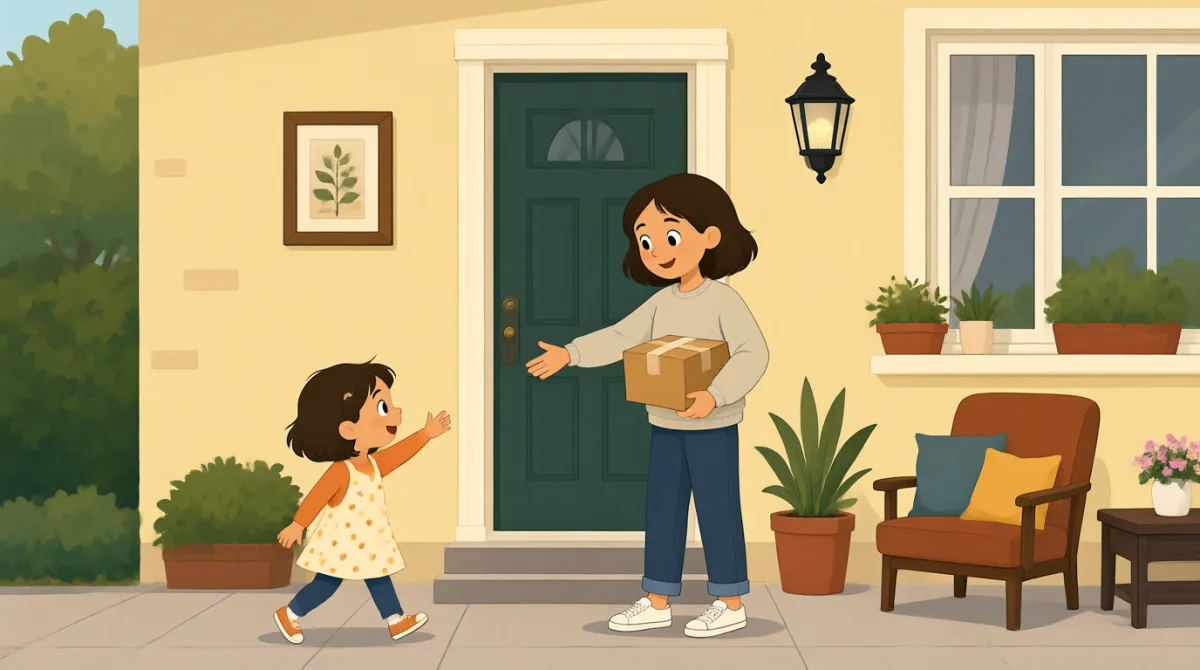

Hi, Mia! I’m back. Thanks for collecting my mail.
嗨,米娅!我回来了。谢谢你帮我收信。

You’re welcome! I put it all on your table.
不客气!我把信都放在你桌上了。
Thanks. Did you get the package, too?
谢谢。你也收到那个包裹了吗?
Yes, it came yesterday. I brought it inside.
收到了,昨天送来的。我把它拿进屋了。
That’s great. I saw your message while I was away.
太好了。我不在的时候看到了你的消息。
I’m glad. I didn’t want it to sit outside.
那就好。我不想让它一直放在外面。
I really appreciate your help. It made my trip easier.
真的很感谢你帮忙。这让我旅行轻松多了。
Happy to help! I hope you had a nice trip.
很乐意帮忙!希望你这趟旅行玩得开心。
词汇8
- I’m back我回来了
This means you have returned. Use it to tell someone you are home or back at a place.
这表示你已经回来了。可以用它告诉别人你到家了,或回到了某个地方。
- collecting my mail帮我收信
This means picking up and keeping someone’s letters while they are away. You can say, “Thanks for collecting my mail.”
这表示在某人外出时,帮忙取走并保管他们的信件。你可以说:“Thanks for collecting my mail.”(谢谢你帮我收信。)
- put it all on your table把东西都放在你的桌上
This means placing everything on a table. You can change “it all” to name other things someone put somewhere.
这表示把所有东西都放在桌子上。你可以把“it all”换成别人放到某个地方的其他东西。
- package包裹
A package is a box or parcel that is delivered to someone. Use it when asking about something that was sent to you.
“package”指送到某人手里的箱子或包裹。询问寄给你的东西时可以用这个词。
- brought it inside把它拿进屋
This means carried something into a house or building. You can use “brought” to talk about carrying something to a place in the past.
这表示把某样东西拿进房子或建筑物里。谈到过去把东西拿到某个地方时,可以用“brought”。
- while I was away我不在的时候
This means during the time when I was not at home or in a place. Use it to explain when something happened.
这表示我不在家或不在某个地方的那段时间。可以用它说明某件事是什么时候发生的。
- sit outside放在外面
Here, this means to be left outdoors for some time. You can use it when talking about a delivery or another item left outside.
这里指某样东西被留在户外一段时间。谈到放在外面的快递或其他物品时,可以这样说。
- Happy to help!很乐意帮忙!
This is a friendly way to say you were glad to help someone. You can use it when replying to thanks.
这是表示很高兴能帮上忙的一种友好说法。别人向你道谢时可以这样回答。
重点句子8
- 1
Thanks for collecting my mail.
谢谢你帮我收信。
Use this sentence to thank someone for picking up your mail. You can replace “collecting my mail” with another helpful action.
用这句话感谢别人帮你收信。你可以把“collecting my mail”换成其他帮忙做的事。
- 2
I put it all on your table.
我把东西都放在你的桌上了。
This tells someone where you left their things. Change “your table” to another place, such as “your desk” or “the kitchen counter.”
这句话告诉别人你把他们的东西放在哪里了。你可以把“your table”换成其他地点,比如“your desk”或“the kitchen counter”。
- 3
Did you get the package, too?
你也收到那个包裹了吗?
Use this question to check whether someone received or picked up a delivery. You can replace “the package” with another item.
用这个问题确认别人是否收到了或取到了快递。你可以把“the package”换成其他物品。
- 4
Yes, it came yesterday.
收到了,昨天送来的。
This is a simple way to say that something arrived the day before today. Replace “it” with the item you are talking about.
这是一种简单的说法,表示某样东西是昨天到的。可以把“it”换成你正在说的物品。
- 5
I brought it inside.
我把它拿进屋了。
Use this sentence to say you carried something indoors. You can replace “it” with a specific item, such as “the box.”
用这句话表示你把某样东西拿进了室内。你可以把“it”换成具体物品,比如“the box”。
- 6
I saw your message while I was away.
我不在的时候看到了你的消息。
This explains when you read someone’s message. Replace “your message” with another thing you saw or did while you were away.
这句话说明你是什么时候看到别人消息的。可以把“your message”换成你外出时看到或做的其他事情。
- 7
I really appreciate your help.
我真的很感谢你的帮助。
This is a warm way to show that you are very thankful. You can use it after someone has done something kind for you.
这是一种温暖的表达方式,用来表示你非常感激。别人为你做了好事之后可以这样说。
- 8
I hope you had a nice trip.
希望你这趟旅行玩得开心。
Use this friendly sentence to show interest in someone’s past trip. You can replace “trip” with another event, such as “weekend.”
用这句友好的话表达你关心别人之前的旅行。你可以把“trip”换成其他活动,比如“weekend”。