The Printer Is Not Working
Drukarka nie działa
Emma tries to print a report, but the office printer does not respond. She asks Jack for help.
Emma próbuje wydrukować raport, ale drukarka biurowa nie reaguje. Prosi Jacka o pomoc.
Dialog8
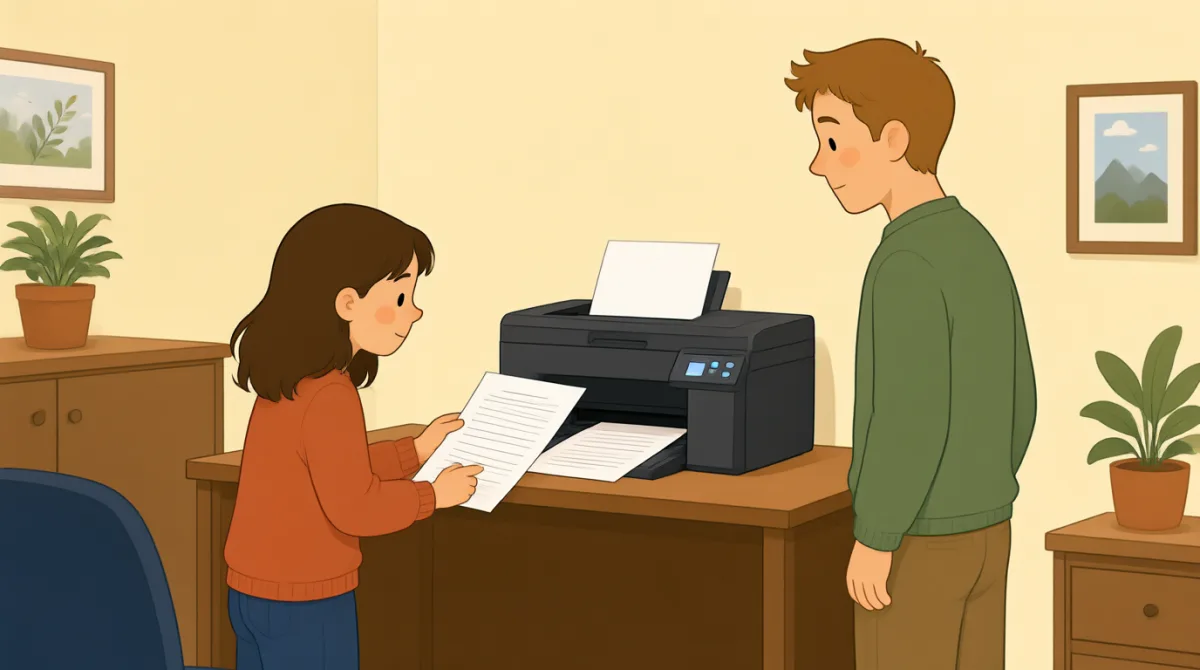

Jack, can you help me? I’m trying to print a report.
Jack, możesz mi pomóc? Próbuję wydrukować raport.

Sure. What’s wrong with the printer?
Jasne. Co jest nie tak z drukarką?
I sent the file, but nothing happened.
Wysłałam plik, ale nic się nie stało.
Did you choose the right printer on your computer?
Czy na komputerze wybrałaś właściwą drukarkę?
I think so. It says “Office Printer” on the screen.
Chyba tak. Na ekranie widnieje „Drukarka biurowa”.
Okay. Is the printer turned on?
Dobrze. Drukarka jest włączona?
Yes, but there’s no paper coming out.
Tak, ale papier nie wychodzi.
Let’s check the screen and see if there’s an error message.
Sprawdźmy ekran i zobaczmy, czy pojawił się jakiś komunikat o błędzie.
Słownictwo7
- print a reportwydrukować raport
This means to make a paper copy of a report using a printer. You can say, “I need to print a report.”
To znaczy zrobić papierową kopię raportu za pomocą drukarki. Możesz powiedzieć: „I need to print a report.”
- What’s wrong with the printer?Co jest nie tak z drukarką?
Use this question to ask what problem a printer or another machine has. Replace “the printer” with the thing that is not working.
Tego pytania używa się, by zapytać, jaki problem ma drukarka lub inne urządzenie. Zamiast „the printer” wstaw nazwę rzeczy, która nie działa.
- sent the filewysłać plik
This means you sent a document from your computer to a printer or another person. You can say, “I sent the file, but it didn’t arrive.”
Oznacza to wysłać dokument z komputera do drukarki lub innej osoby. Możesz powiedzieć: „I sent the file, but it didn’t arrive.”
- choose the right printerwybrać właściwą drukarkę
This means to select the correct printer on your computer. You can use “choose the right” when selecting something you need.
Oznacza to wybrać właściwą drukarkę na komputerze. Wyrażenia „choose the right” możesz użyć, gdy wybierasz coś, czego potrzebujesz.
- turned onwłączony
This means that a machine has power and is working or ready to work. For example, you can ask, “Is the computer turned on?”
Oznacza to, że urządzenie jest podłączone do zasilania i działa lub jest gotowe do pracy. Możesz na przykład zapytać: „Is the computer turned on?”
- paper coming outpapier wychodzący z drukarki
This describes paper being printed and coming out of a printer. You can say, “There’s no paper coming out” when a print job does not work.
To określenie opisuje papier, który został zadrukowany i wychodzi z drukarki. Gdy drukowanie nie działa, możesz powiedzieć: „There’s no paper coming out”.
- error messagekomunikat o błędzie
An error message is a notice on a screen that tells you there is a problem. You can ask, “Do you see an error message?”
Komunikat o błędzie to informacja na ekranie, która mówi, że wystąpił problem. Możesz zapytać: „Do you see an error message?”
Kluczowe zdania7
- 1
Jack, can you help me?
Jack, możesz mi pomóc?
Use this polite question when you need help. You can replace “help me” with a specific request, such as “check this.”
Użyj tego uprzejmego pytania, gdy potrzebujesz pomocy. Możesz zastąpić „help me” konkretną prośbą, na przykład „check this”.
- 2
I’m trying to print a report.
Próbuję wydrukować raport.
Use this sentence to explain what you are doing right now. Replace “print a report” with another action, such as “send an email.”
Użyj tego zdania, by wyjaśnić, co właśnie robisz. Zastąp „print a report” inną czynnością, na przykład „send an email”.
- 3
I sent the file, but nothing happened.
Wysłałam plik, ale nic się nie stało.
This is useful for explaining that you tried something, but it did not work. Use “I [past action], but nothing happened” to describe similar problems.
To przydatne zdanie, gdy chcesz wyjaśnić, że coś zostało zrobione, ale nie zadziałało. Użyj wzoru „I [past action], but nothing happened”, by opisać podobne problemy.
- 4
Did you choose the right printer on your computer?
Czy na komputerze wybrałaś właściwą drukarkę?
Use this question to check whether someone selected the correct printer. Replace “printer” with another option or item they needed to choose.
Użyj tego pytania, by sprawdzić, czy ktoś wybrał właściwą drukarkę. Zastąp „printer” inną opcją lub rzeczą, którą trzeba było wybrać.
- 5
I think so.
Chyba tak.
Use this short reply when you believe something is true but are not completely sure. It can answer questions such as “Did you save the file?”
Użyj tej krótkiej odpowiedzi, gdy sądzisz, że coś jest prawdą, ale nie masz całkowitej pewności. Możesz tak odpowiedzieć na pytanie, takie jak „Did you save the file?”
- 6
Is the printer turned on?
Czy drukarka jest włączona?
Use this question to check whether a machine has power. Replace “the printer” with another machine, such as “the computer.”
Użyj tego pytania, by sprawdzić, czy urządzenie jest podłączone do zasilania. Zastąp „the printer” innym urządzeniem, na przykład „the computer”.
- 7
Let’s check the screen and see if there’s an error message.
Sprawdźmy ekran i zobaczmy, czy pojawił się jakiś komunikat o błędzie.
Use “Let’s check…” to suggest looking at something together. You can change “the screen” to another place or item you want to check.
Użyj „Let’s check…”, by zaproponować wspólne sprawdzenie czegoś. Możesz zastąpić „the screen” innym miejscem lub rzeczą, którą chcesz sprawdzić.