Finding the Platform
Znajdowanie peronu
Emma asks which platform her train leaves from. Grace gives her simple directions.
Emma pyta, z którego peronu odjeżdża jej pociąg. Grace podaje jej proste wskazówki.
Dialog8
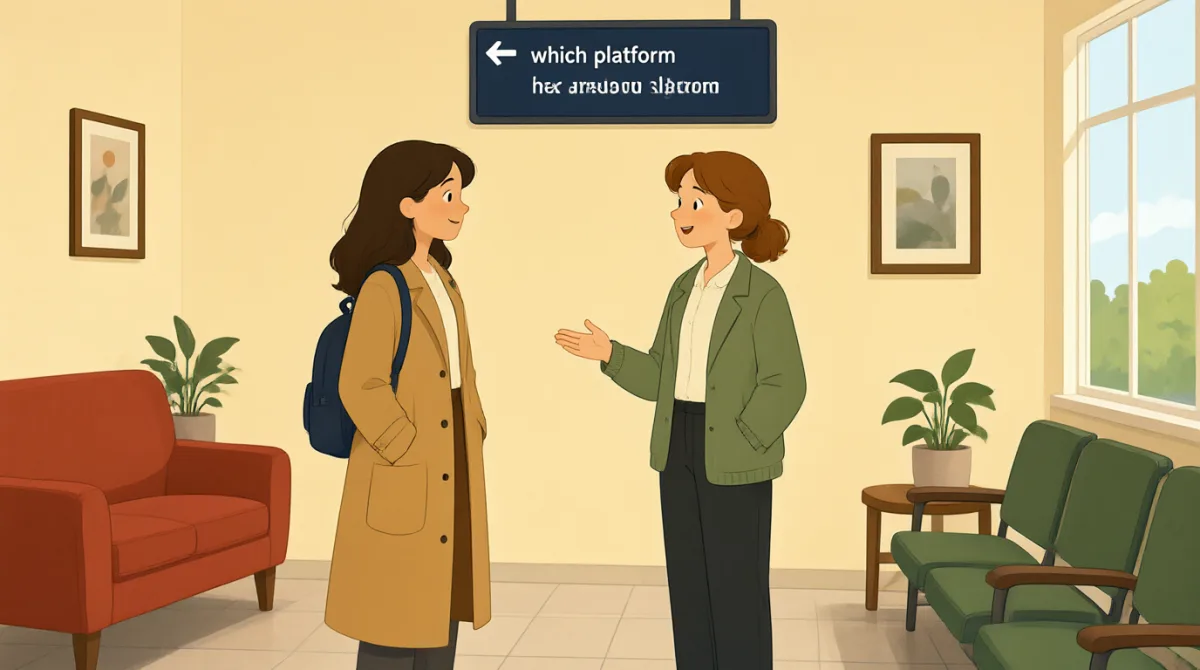

Excuse me, which platform is my train on?
Przepraszam, z którego peronu odjeżdża mój pociąg?

Where are you going?
Dokąd jedziesz?
I'm going to Boston. My train leaves at ten.
Jadę do Bostonu. Mój pociąg odjeżdża o dziesiątej.
Your train leaves from platform three.
Twój pociąg odjeżdża z peronu trzeciego.
How do I get there?
Jak tam dojść?
Go straight, then turn left. It's on your right.
Idź prosto, a potem skręć w lewo. Jest po prawej stronie.
Thank you. Is it far?
Dziękuję. Czy to daleko?
No, it's close. You have time.
Nie, blisko. Masz czas.
Słownictwo8
- Excuse mePrzepraszam
A polite way to get someone's attention or ask for help.
Uprzejmy sposób, by zwrócić czyjąś uwagę lub poprosić o pomoc.
- platformperon
The place at a train station where you get on a train.
Miejsce na stacji kolejowej, z którego wsiada się do pociągu.
- leaves at tenodjeżdża o dziesiątej
Means the train starts its trip at ten o’clock. Use “leaves at” with a time.
Oznacza, że pociąg rozpoczyna podróż o dziesiątej. Konstrukcji “leaves at” używamy, podając godzinę.
- platform threeperon trzeci
The number of the place where Emma’s train leaves. You can use “platform” with another number.
Numer peronu, z którego odjeżdża pociąg Emmy. Słowa “platform” możesz użyć z innym numerem.
- Go straightIdź prosto
Means to keep walking forward. It is a simple direction.
Oznacza, żeby iść przed siebie. To prosta wskazówka.
- turn leftskręć w lewo
Means to change direction to the left. Use it when giving or following directions.
Oznacza, żeby zmienić kierunek na lewy. Używaj tego zwrotu, gdy podajesz wskazówki lub według nich idziesz.
- on your rightpo prawej stronie
Means something is to the right as you walk. You can use “on your left” for the other side.
Oznacza, że coś znajduje się po prawej stronie, gdy idziesz. Po drugiej stronie możesz powiedzieć “on your left”.
- It's closeJest blisko
Means the place is not far away. You can use this phrase to describe distance.
Oznacza, że dane miejsce nie jest daleko. Tego zwrotu możesz użyć, opisując odległość.
Kluczowe zdania8
- 1
Excuse me, which platform is my train on?
Przepraszam, z którego peronu odjeżdża mój pociąg?
Use this polite question to find out where your train leaves from. Change “my train” to “the bus” or another form of transport.
Użyj tego uprzejmego pytania, by dowiedzieć się, z którego peronu odjeżdża twój pociąg. Zamiast “my train” możesz powiedzieć “the bus” lub podać inny środek transportu.
- 2
Where are you going?
Dokąd jedziesz?
Use this question to ask someone about their destination. You can answer with “I'm going to” and a place.
Użyj tego pytania, by zapytać kogoś o cel podróży. Możesz odpowiedzieć, używając “I'm going to” i nazwy miejsca.
- 3
I'm going to Boston.
Jadę do Bostonu.
This is a simple way to say your destination. Replace “Boston” with the name of another place.
To prosty sposób, by powiedzieć, dokąd jedziesz. Zastąp “Boston” nazwą innego miejsca.
- 4
My train leaves at ten.
Mój pociąg odjeżdża o dziesiątej.
Use this sentence to say what time your train departs. Change “ten” to the correct time.
Użyj tego zdania, by powiedzieć, o której odjeżdża twój pociąg. Zastąp “ten” właściwą godziną.
- 5
Your train leaves from platform three.
Twój pociąg odjeżdża z peronu trzeciego.
This tells someone which platform to go to. Replace “platform three” with the correct platform number.
To informacja, na który peron należy się udać. Zastąp “platform three” właściwym numerem peronu.
- 6
How do I get there?
Jak tam dojść?
Use this question when you need directions to a place. Replace “there” with a place, such as “the station exit.”
Użyj tego pytania, gdy potrzebujesz wskazówek, jak dotrzeć do jakiegoś miejsca. Zamiast “there” możesz podać nazwę miejsca, na przykład “the station exit.”
- 7
Go straight, then turn left.
Idź prosto, a potem skręć w lewo.
This gives two simple directions in order. You can change “turn left” to “turn right.”
To dwie proste wskazówki podane we właściwej kolejności. Możesz zastąpić “turn left” zwrotem “turn right.”
- 8
No, it's close.
Nie, jest blisko.
Use this reply to say a place is not far away. You can replace “close” with “far” to describe a longer distance.
Użyj tej odpowiedzi, by powiedzieć, że dane miejsce nie jest daleko. Możesz zastąpić “close” słowem “far”, jeśli chcesz opisać większą odległość.