Talking About the Show
Hablar del concierto
After the concert, Emma and Jack talk about their favorite songs and the singer’s performance. They share what they enjoyed most.
Después del concierto, Emma y Jack hablan de sus canciones favoritas y de la actuación del cantante. Comparten lo que más les gustó.
Diálogo8
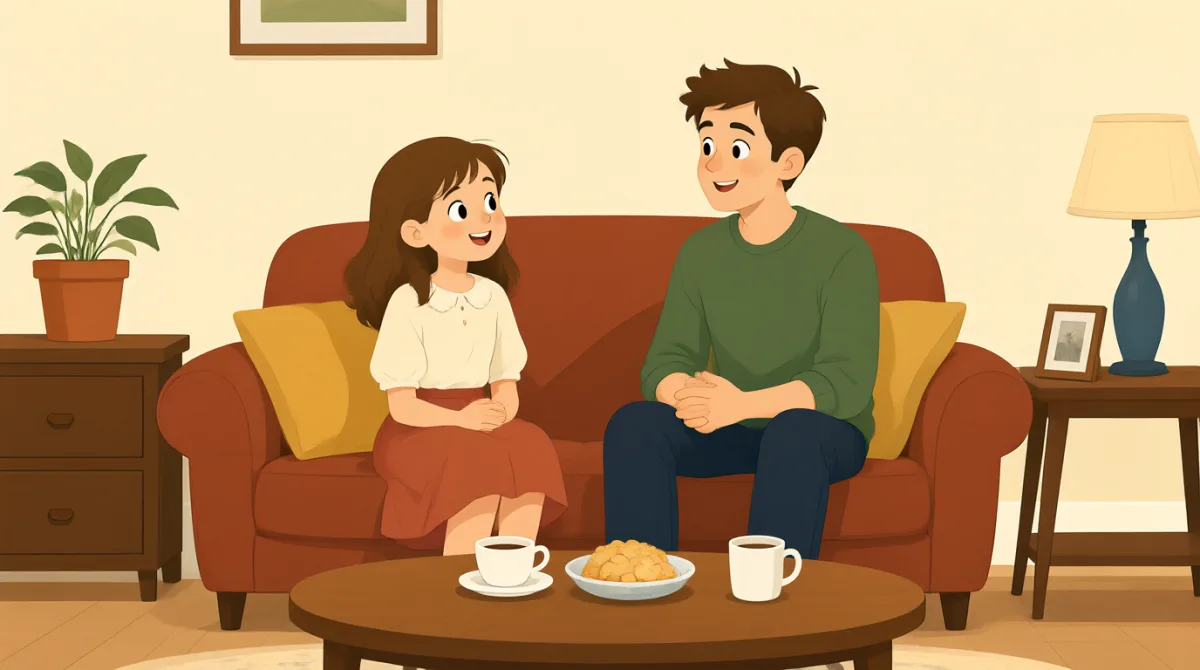

That was such a great show! The singer sounded even better live.
¡Qué buen concierto! El cantante sonó aún mejor en vivo.

I agree. The band was great, too. I loved the last song.
Estoy de acuerdo. La banda también estuvo genial. Me encantó la última canción.
Me too! The lights during that song were beautiful.
¡A mí también! Las luces durante esa canción eran preciosas.
I liked how the singer talked with the crowd between songs.
Me gustó cómo el cantante hablaba con el público entre canción y canción.
Yes, it made the whole show feel friendly and fun.
Sí, hizo que todo el concierto se sintiera cercano y divertido.
I’m glad we got seats near the stage. We could see everything.
Me alegra que consiguiéramos asientos cerca del escenario. Podíamos verlo todo.
Let’s look up the singer’s next concert when we get home.
Busquemos el próximo concierto del cantante cuando lleguemos a casa.
Good idea. I’d definitely go again.
Buena idea. Sin duda volvería.
Vocabulario8
- liveen vivo
Here, “live” means performed in front of an audience, not recorded. You can say, “The band sounds great live.”
Aquí, “live” significa que algo se interpreta frente a un público, no que está grabado. Puedes decir: “The band sounds great live.” (La banda suena genial en vivo).
- I agree.Estoy de acuerdo.
Use this phrase to show that you have the same opinion as someone. You can follow it with a reason or an example.
Usa esta frase para mostrar que tienes la misma opinión que otra persona. Puedes añadir una razón o un ejemplo.
- the last songla última canción
This means the final song in a show or event. You can use “the last” to talk about the final item in a series.
Se refiere a la canción final de un espectáculo o evento. Puedes usar “the last” para hablar del último elemento de una serie.
- the crowdel público
“The crowd” means the people watching or listening to an event. You can say, “The singer waved to the crowd.”
“The crowd” se refiere a las personas que ven o escuchan un evento. Puedes decir: “The singer waved to the crowd.” (El cantante saludó al público con la mano).
- between songsentre canción y canción
This means during the short breaks from one song to the next. You can use “between” to describe the time separating two events.
Se refiere a las pausas breves entre una canción y la siguiente. Puedes usar “between” para describir el tiempo que separa dos eventos.
- near the stagecerca del escenario
This means close to the raised area where performers play. You can use “near” to describe where something or someone is.
Significa que algo o alguien está cerca de la plataforma elevada donde actúan los artistas. Puedes usar “near” para describir dónde está algo o alguien.
- look upbuscar
Here, “look up” means search for information, often online. You can say, “I’ll look up the concert time.”
Aquí, “look up” significa buscar información, a menudo en internet. Puedes decir: “I’ll look up the concert time.” (Buscaré la hora del concierto).
- go againvolver
This means return to an event or place another time. You can say, “I enjoyed the show, so I’d go again.”
Significa volver a asistir a un evento o regresar a un lugar en otra ocasión. Puedes decir: “I enjoyed the show, so I’d go again.” (Me gustó el concierto, así que volvería).
Frases clave7
- 1
That was such a great show!
¡Qué buen concierto!
Use this to share a positive opinion after an event. You can replace “show” with another event, such as “game” or “concert.”
Usa esta frase para expresar una opinión positiva después de un evento. Puedes sustituir “show” por otro evento, como “game” o “concert”.
- 2
The singer sounded even better live.
El cantante sonó aún mejor en vivo.
Use this to say someone performed better in person than you expected. You can use “sounded” to talk about music or a person’s voice.
Usa esta frase para decir que alguien actuó mejor en persona de lo que esperabas. Puedes usar “sounded” para hablar de la música o de la voz de alguien.
- 3
I loved the last song.
Me encantó la última canción.
This is a simple way to say which song you enjoyed most. You can replace “the last song” with another part of a performance.
Esta es una forma sencilla de decir qué canción te gustó más. Puedes sustituir “the last song” por otra parte de una actuación.
- 4
I liked how the singer talked with the crowd between songs.
Me gustó cómo el cantante hablaba con el público entre canción y canción.
Use “I liked how…” to describe something someone did that you enjoyed. You can use the same pattern to talk about a person’s actions.
Usa “I liked how…” para describir algo que hizo alguien y que te gustó. Puedes usar el mismo patrón para hablar de las acciones de una persona.
- 5
We could see everything.
Podíamos verlo todo.
This is useful for describing a good view at an event. You can use “could” to talk about what you were able to do in the past.
Esta frase sirve para describir que tenías una buena vista en un evento. Puedes usar “could” para hablar de algo que podías hacer en el pasado.
- 6
Let’s look up the singer’s next concert when we get home.
Busquemos el próximo concierto del cantante cuando lleguemos a casa.
Use “Let’s…” to suggest doing something together. “Look up” means search for information, and “when we get home” says when to do it.
Usa “Let’s…” para proponer hacer algo juntos. “Look up” significa buscar información, y “when we get home” indica cuándo hacerlo.
- 7
Good idea. I’d definitely go again.
Buena idea. Sin duda volvería.
Use this to agree with a suggestion and say you would do something another time. “I’d” means “I would,” and “definitely” makes your answer stronger.
Usa esta frase para aceptar una sugerencia y decir que harías algo otra vez. “I’d” significa “I would” y “definitely” le da más fuerza a tu respuesta.