Bringing the Food
Apporter le repas
Grace asks Mia to bring the food to the table. Mia checks that everything is ready.
Grace demande à Mia d’apporter le repas à table. Mia vérifie que tout est prêt.
Dialogue7
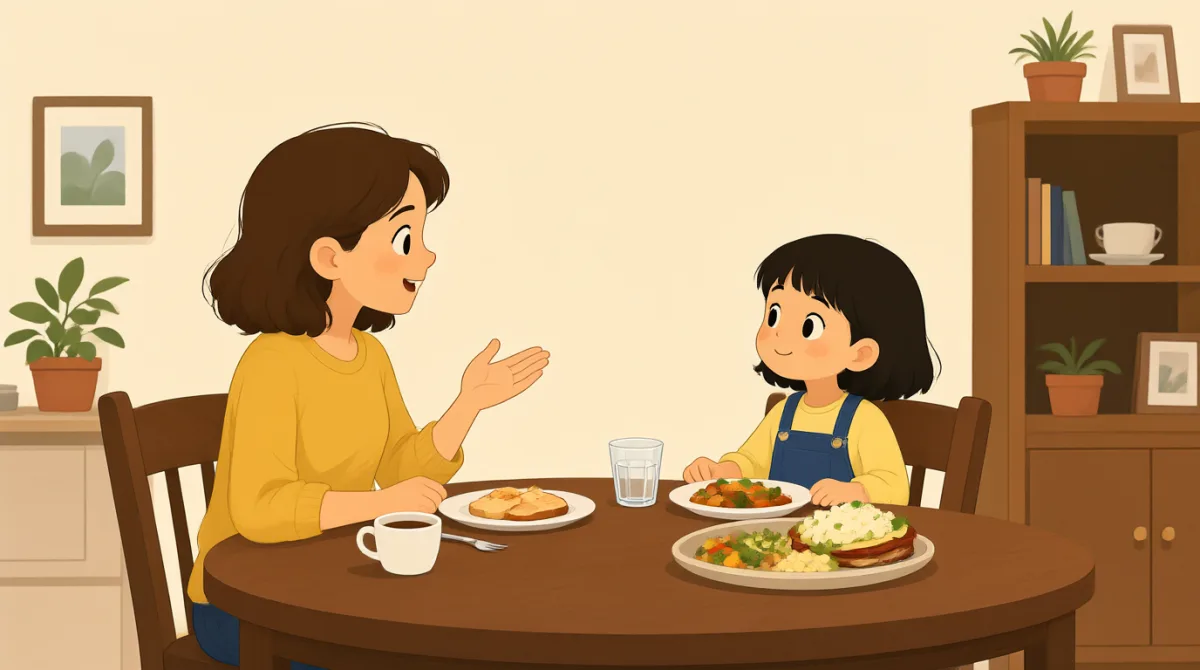

Mia, can you bring the food to the table?
Mia, tu peux apporter le repas à table ?

Sure. Is dinner ready?
Bien sûr. Le dîner est prêt ?
Yes, the soup and bread are ready.
Oui, la soupe et le pain sont prêts.
Great. Are the plates and forks on the table?
Super. Les assiettes et les fourchettes sont sur la table ?
Yes, and there is a glass by each plate.
Oui, et il y a un verre à côté de chaque assiette.
Good. I’ll bring the soup first.
Parfait. Je vais apporter la soupe d’abord.
Thanks, Mia. I’ll bring the bread.
Merci, Mia. Je vais apporter le pain.
Vocabulaire7
- bring the food to the tableapporter le repas à table
To carry the food to the place where people will eat. You can use this phrase when asking someone to serve a meal.
Apporter la nourriture à l’endroit où les gens vont manger. Cette expression peut servir à demander à quelqu’un de mettre le repas sur la table.
- Is dinner ready?Le dîner est prêt ?
A way to ask if the meal is prepared. You can replace “dinner” with another meal, such as “lunch.”
Une façon de demander si le repas est préparé. Tu peux remplacer “dinner” par un autre repas, comme “lunch”.
- soupsoupe
A hot or cold liquid food, often eaten from a bowl. Here, it is part of the dinner.
Un plat liquide, chaud ou froid, qu’on mange souvent dans un bol. Ici, elle fait partie du dîner.
- breadpain
A common food made from flour. It is served with the soup in this conversation.
Un aliment courant préparé avec de la farine. Dans cette conversation, il est servi avec la soupe.
- plates and forksassiettes et fourchettes
Plates hold the food, and forks help people eat it. These are common things to prepare before a meal.
Les assiettes contiennent la nourriture et les fourchettes servent à la manger. Ce sont des choses qu’on prépare généralement avant un repas.
- by each plateà côté de chaque assiette
This means next to every plate. Use “by” to say that something is beside another thing.
Cela signifie que l’objet se trouve à côté de toutes les assiettes. Utilise “by” pour indiquer qu’une chose se trouve à côté d’une autre.
- bring the soup firstapporter la soupe d’abord
This means to carry the soup before bringing anything else. “First” tells the order of actions.
Cela signifie apporter la soupe avant toute autre chose. “First” indique l’ordre des actions.
Phrases clés8
- 1
Mia, can you bring the food to the table?
Mia, tu peux apporter le repas à table ?
This is a polite way to ask someone to carry food to the table. You can reuse “Can you bring the [item] to the [place]?” for simple requests.
C’est une façon polie de demander à quelqu’un d’apporter de la nourriture à table. Tu peux réutiliser “Can you bring the [item] to the [place]?” pour formuler des demandes simples.
- 2
Sure.
Bien sûr.
This is a short, friendly way to agree to do something. You can use it when someone asks you for help.
Une réponse courte et amicale pour accepter de faire quelque chose. Tu peux l’utiliser quand quelqu’un te demande de l’aide.
- 3
Is dinner ready?
Le dîner est prêt ?
This is a simple way to ask whether a meal is prepared. Replace “dinner” with “breakfast” or “lunch” to ask about another meal.
Une façon simple de demander si un repas est préparé. Remplace “dinner” par “breakfast” ou “lunch” pour parler d’un autre repas.
- 4
Yes, the soup and bread are ready.
Oui, la soupe et le pain sont prêts.
This sentence says that two foods are prepared. Use “X and Y are ready” to talk about more than one thing.
Cette phrase indique que deux aliments sont prêts. Utilise “X and Y are ready” pour parler de plusieurs choses.
- 5
Are the plates and forks on the table?
Les assiettes et les fourchettes sont sur la table ?
This asks whether two items are in the right place. You can use “Are the [items] on the [surface]?” to check where things are.
Cette question permet de vérifier si deux objets sont au bon endroit. Tu peux utiliser “Are the [items] on the [surface]?” pour vérifier où se trouvent les choses.
- 6
Yes, and there is a glass by each plate.
Oui, et il y a un verre à côté de chaque assiette.
This tells someone that every plate has a glass beside it. Use “there is a [thing] by each [item]” to describe one thing next to every item.
Cette phrase indique qu’il y a un verre à côté de chaque assiette. Utilise “there is a [thing] by each [item]” pour décrire une chose placée à côté de chaque objet.
- 7
I’ll bring the soup first.
Je vais apporter la soupe d’abord.
This says what the speaker plans to carry and when. Use “I’ll bring the [item] first” to say what you will carry before other things.
Cette phrase indique ce que la personne prévoit d’apporter et quand. Utilise “I’ll bring the [item] first” pour dire ce que tu apporteras avant le reste.
- 8
Thanks, Mia. I’ll bring the bread.
Merci, Mia. Je vais apporter le pain.
This thanks someone and says what the speaker will do. You can use “I’ll bring the [item]” to offer to carry something.
Cette phrase remercie quelqu’un et indique ce que la personne va faire. Tu peux utiliser “I’ll bring the [item]” pour proposer d’apporter quelque chose.