Bringing the Food
Yemekleri Getirmek
Grace asks Mia to bring the food to the table. Mia checks that everything is ready.
Grace, Mia’dan yemekleri masaya getirmesini ister. Mia her şeyin hazır olup olmadığını kontrol eder.
Diyalog7
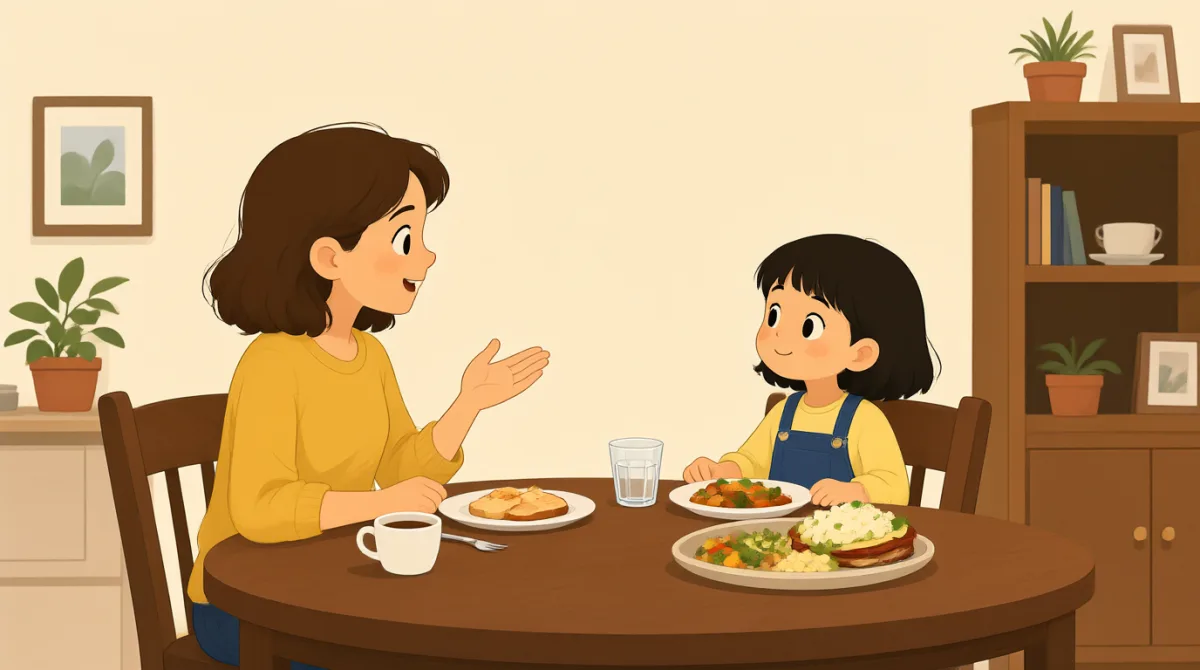

Mia, can you bring the food to the table?
Mia, yemekleri masaya getirebilir misin?

Sure. Is dinner ready?
Tabii. Akşam yemeği hazır mı?
Yes, the soup and bread are ready.
Evet, çorba ve ekmek hazır.
Great. Are the plates and forks on the table?
Harika. Tabaklar ve çatallar masada mı?
Yes, and there is a glass by each plate.
Evet, her tabağın yanında bir bardak da var.
Good. I’ll bring the soup first.
Güzel. Önce çorbayı getireyim.
Thanks, Mia. I’ll bring the bread.
Teşekkürler, Mia. Ekmeği ben getireyim.
Kelime Bilgisi7
- bring the food to the tableyemekleri masaya getirmek
To carry the food to the place where people will eat. You can use this phrase when asking someone to serve a meal.
Yemekleri insanların yemek yiyeceği yere taşımak demektir. Birinden yemeği servis etmesini isterken bu ifadeyi kullanabilirsin.
- Is dinner ready?Akşam yemeği hazır mı?
A way to ask if the meal is prepared. You can replace “dinner” with another meal, such as “lunch.”
Yemeğin hazırlanıp hazırlanmadığını sormanın bir yoludur. “dinner” yerine “lunch” gibi başka bir öğün adı kullanabilirsin.
- soupçorba
A hot or cold liquid food, often eaten from a bowl. Here, it is part of the dinner.
Genellikle kâsede içilen, sıcak ya da soğuk, sıvı bir yiyecektir. Burada akşam yemeğinin bir parçasıdır.
- breadekmek
A common food made from flour. It is served with the soup in this conversation.
Undan yapılan yaygın bir yiyecektir. Bu konuşmada çorbanın yanında servis edilir.
- plates and forkstabaklar ve çatallar
Plates hold the food, and forks help people eat it. These are common things to prepare before a meal.
Tabaklara yemek konur, çatallarla da yemek yenir. Bunlar yemek öncesinde hazırlanan yaygın sofra gereçleridir.
- by each plateher tabağın yanında
This means next to every plate. Use “by” to say that something is beside another thing.
Her tabağın yakınında demektir. Bir şeyin başka bir şeyin yanında olduğunu söylemek için “by” kullanılır.
- bring the soup firstönce çorbayı getirmek
This means to carry the soup before bringing anything else. “First” tells the order of actions.
Başka bir şey getirmeden önce çorbayı taşımak demektir. “First”, yapılan işlerin sırasını belirtir.
Önemli Cümleler8
- 1
Mia, can you bring the food to the table?
Mia, yemekleri masaya getirebilir misin?
This is a polite way to ask someone to carry food to the table. You can reuse “Can you bring the [item] to the [place]?” for simple requests.
Bu, birinden yemekleri masaya taşımasını istemenin nazik bir yoludur. Basit ricalarda “Can you bring the [item] to the [place]?” kalıbını yeniden kullanabilirsin.
- 2
Sure.
Tabii.
This is a short, friendly way to agree to do something. You can use it when someone asks you for help.
Bir şeyi yapmayı kabul etmenin kısa ve samimi bir yoludur. Birisi senden yardım istediğinde kullanabilirsin.
- 3
Is dinner ready?
Akşam yemeği hazır mı?
This is a simple way to ask whether a meal is prepared. Replace “dinner” with “breakfast” or “lunch” to ask about another meal.
Bir yemeğin hazırlanıp hazırlanmadığını sormanın basit bir yoludur. Başka bir öğünü sormak için “dinner” yerine “breakfast” ya da “lunch” kullanabilirsin.
- 4
Yes, the soup and bread are ready.
Evet, çorba ve ekmek hazır.
This sentence says that two foods are prepared. Use “X and Y are ready” to talk about more than one thing.
Bu cümle iki yiyeceğin hazır olduğunu söyler. Birden fazla şeyden bahsederken “X and Y are ready” kalıbını kullanabilirsin.
- 5
Are the plates and forks on the table?
Tabaklar ve çatallar masada mı?
This asks whether two items are in the right place. You can use “Are the [items] on the [surface]?” to check where things are.
Bu soru, iki eşyanın doğru yerde olup olmadığını sorar. Eşyaların nerede olduğunu kontrol etmek için “Are the [items] on the [surface]?” kalıbını kullanabilirsin.
- 6
Yes, and there is a glass by each plate.
Evet, her tabağın yanında bir bardak da var.
This tells someone that every plate has a glass beside it. Use “there is a [thing] by each [item]” to describe one thing next to every item.
Bu cümle, her tabağın yanında bir bardak olduğunu söyler. Her eşyanın yanında bir şey bulunduğunu anlatmak için “there is a [thing] by each [item]” kalıbını kullanabilirsin.
- 7
I’ll bring the soup first.
Önce çorbayı getireyim.
This says what the speaker plans to carry and when. Use “I’ll bring the [item] first” to say what you will carry before other things.
Bu cümle, konuşanın neyi ve ne zaman taşımayı planladığını söyler. Başka şeylerden önce ne getireceğini söylemek için “I’ll bring the [item] first” kalıbını kullanabilirsin.
- 8
Thanks, Mia. I’ll bring the bread.
Teşekkürler, Mia. Ekmeği ben getireyim.
This thanks someone and says what the speaker will do. You can use “I’ll bring the [item]” to offer to carry something.
Bu cümlede konuşan hem teşekkür eder hem de ne yapacağını söyler. Bir şeyi taşımayı teklif etmek için “I’ll bring the [item]” kalıbını kullanabilirsin.