Bringing the Food
端上食物
Grace asks Mia to bring the food to the table. Mia checks that everything is ready.
Grace請Mia把食物端到餐桌上。Mia確認一切都準備好了。
對話7
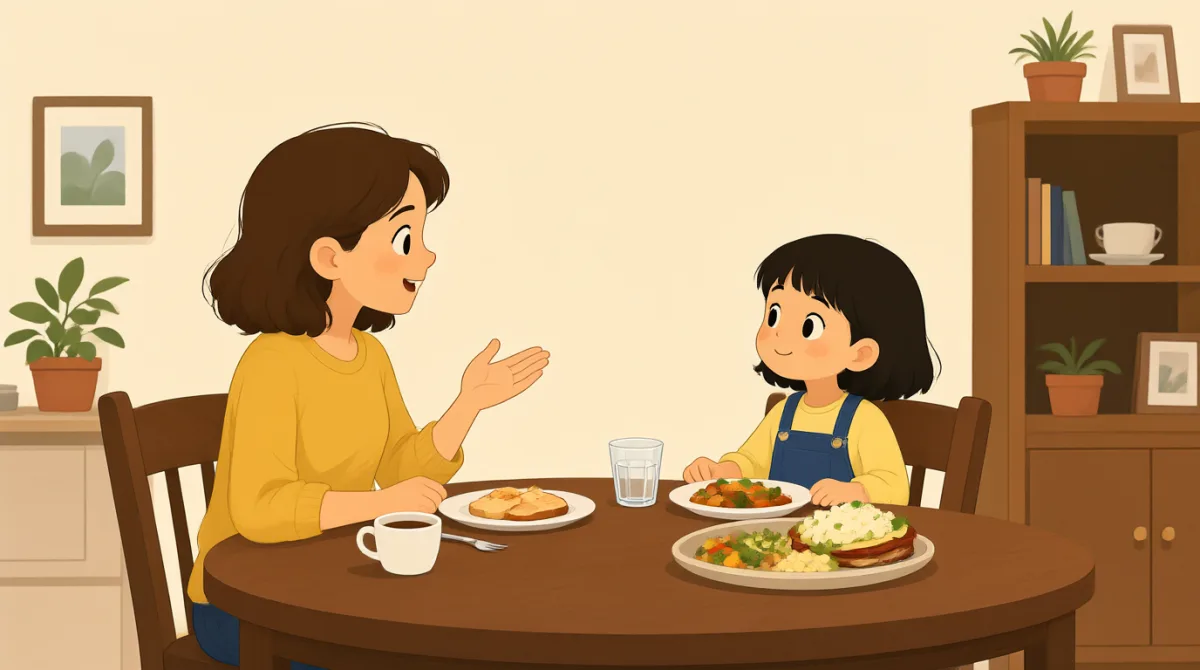

Mia, can you bring the food to the table?
米婭,你能把食物端到餐桌上嗎?

Sure. Is dinner ready?
當然。晚飯準備好了嗎?
Yes, the soup and bread are ready.
準備好了,湯和麵包都好了。
Great. Are the plates and forks on the table?
太好了。盤子和叉子都在桌上了嗎?
Yes, and there is a glass by each plate.
是的,每個盤子旁邊都有一個杯子。
Good. I’ll bring the soup first.
好。我先把湯端過去。
Thanks, Mia. I’ll bring the bread.
謝謝你,米婭。我來拿麵包。
詞彙7
- bring the food to the table把食物端到餐桌上
To carry the food to the place where people will eat. You can use this phrase when asking someone to serve a meal.
把食物端到大家吃飯的地方。請別人幫忙上菜時,可以用這個短語。
- Is dinner ready?晚飯準備好了嗎?
A way to ask if the meal is prepared. You can replace “dinner” with another meal, such as “lunch.”
用來詢問飯菜是否已經準備好了。你可以把“dinner”換成其他餐食,比如“lunch”。
- soup湯
A hot or cold liquid food, often eaten from a bowl. Here, it is part of the dinner.
一種冷熱皆可的流質食物,通常用碗盛著吃。這裡指晚飯的一部分。
- bread麵包
A common food made from flour. It is served with the soup in this conversation.
一種用麵粉製成的常見食物。在這段對話中,麵包和湯一起上桌。
- plates and forks盤子和叉子
Plates hold the food, and forks help people eat it. These are common things to prepare before a meal.
盤子用來盛食物,叉子可以用來吃東西。這些都是飯前常要準備的餐具。
- by each plate每個盤子旁邊
This means next to every plate. Use “by” to say that something is beside another thing.
意思是每個盤子旁邊都有。用“by”來表示某物在另一物旁邊。
- bring the soup first先把湯端過去
This means to carry the soup before bringing anything else. “First” tells the order of actions.
意思是先把湯端過去,再拿其他東西。“First”表示動作的先後順序。
關鍵句8
- 1
Mia, can you bring the food to the table?
米婭,你能把食物端到餐桌上嗎?
This is a polite way to ask someone to carry food to the table. You can reuse “Can you bring the [item] to the [place]?” for simple requests.
這是請別人把食物端到餐桌上的一種禮貌說法。簡單地提出請求時,可以套用“Can you bring the [item] to the [place]?”。
- 2
Sure.
當然。
This is a short, friendly way to agree to do something. You can use it when someone asks you for help.
這是簡短又友好的答應方式。別人請你幫忙時可以這樣說。
- 3
Is dinner ready?
晚飯準備好了嗎?
This is a simple way to ask whether a meal is prepared. Replace “dinner” with “breakfast” or “lunch” to ask about another meal.
這是詢問飯菜是否準備好的一種簡單說法。把“dinner”換成“breakfast”或“lunch”,就可以詢問其他餐食。
- 4
Yes, the soup and bread are ready.
是的,湯和麵包都準備好了。
This sentence says that two foods are prepared. Use “X and Y are ready” to talk about more than one thing.
這句話表示兩種食物都準備好了。談論不止一樣東西時,可以用“X and Y are ready”。
- 5
Are the plates and forks on the table?
盤子和叉子都在桌上了嗎?
This asks whether two items are in the right place. You can use “Are the [items] on the [surface]?” to check where things are.
這是在詢問兩樣東西是否放在了合適的位置。想確認物品的位置時,可以用“Are the [items] on the [surface]?”。
- 6
Yes, and there is a glass by each plate.
是的,而且每個盤子旁邊都有一個杯子。
This tells someone that every plate has a glass beside it. Use “there is a [thing] by each [item]” to describe one thing next to every item.
這句話告訴對方,每個盤子旁邊都放了一個杯子。要描述每件物品旁邊都有一樣東西,可以用“there is a [thing] by each [item]”。
- 7
I’ll bring the soup first.
我先把湯端過去。
This says what the speaker plans to carry and when. Use “I’ll bring the [item] first” to say what you will carry before other things.
這句話說的是說話人打算端什麼,以及先後順序。想說自己會先端某樣東西,可以用“I’ll bring the [item] first”。
- 8
Thanks, Mia. I’ll bring the bread.
謝謝你,米婭。我來拿麵包。
This thanks someone and says what the speaker will do. You can use “I’ll bring the [item]” to offer to carry something.
這句話先感謝對方,再說自己要做什麼。主動提出幫忙拿東西時,可以用“I’ll bring the [item]”。