Bringing the Food
Das Essen bringen
Grace asks Mia to bring the food to the table. Mia checks that everything is ready.
Grace bittet Mia, das Essen zum Tisch zu bringen. Mia fragt nach, ob alles fertig ist.
Dialog7
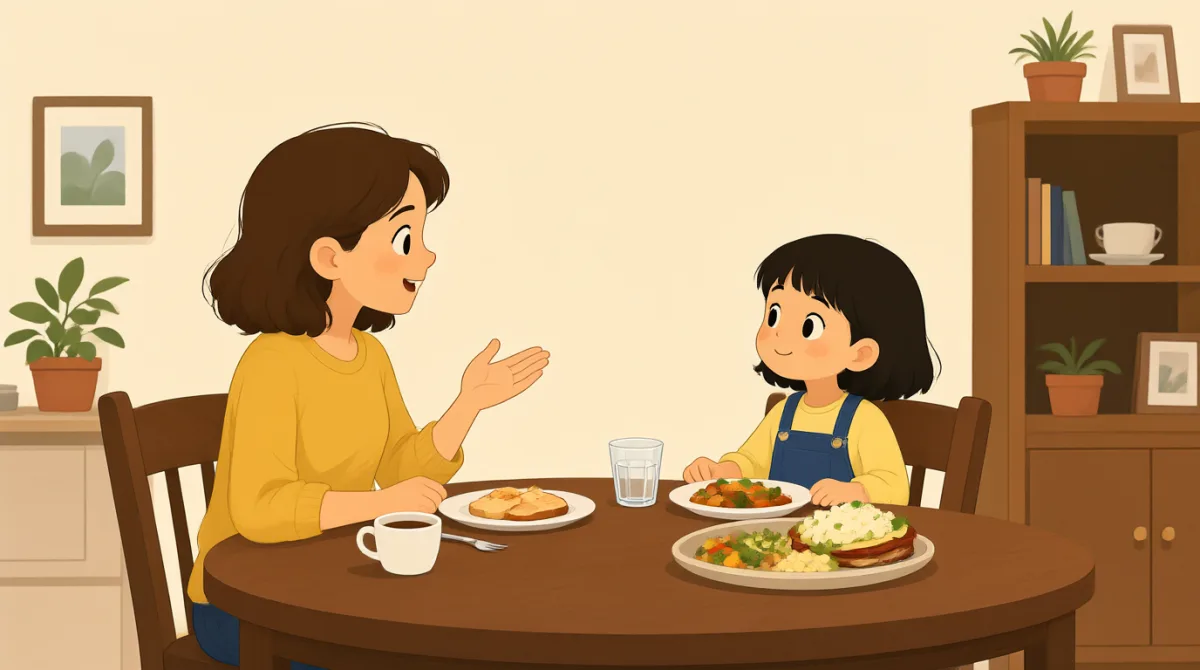

Mia, can you bring the food to the table?
Mia, kannst du das Essen zum Tisch bringen?

Sure. Is dinner ready?
Klar. Ist das Abendessen fertig?
Yes, the soup and bread are ready.
Ja, die Suppe und das Brot sind fertig.
Great. Are the plates and forks on the table?
Super. Stehen die Teller und Gabeln auf dem Tisch?
Yes, and there is a glass by each plate.
Ja, und neben jedem Teller steht ein Glas.
Good. I’ll bring the soup first.
Gut. Ich bringe zuerst die Suppe.
Thanks, Mia. I’ll bring the bread.
Danke, Mia. Ich bringe das Brot.
Wortschatz7
- bring the food to the tabledas Essen zum Tisch bringen
To carry the food to the place where people will eat. You can use this phrase when asking someone to serve a meal.
Das bedeutet, das Essen dorthin zu tragen, wo die Leute essen werden. Mit dieser Wendung kannst du jemanden bitten, das Essen aufzutragen.
- Is dinner ready?Ist das Abendessen fertig?
A way to ask if the meal is prepared. You can replace “dinner” with another meal, such as “lunch.”
So fragst du, ob das Essen zubereitet ist. Du kannst „dinner“ durch eine andere Mahlzeit ersetzen, zum Beispiel durch „lunch“.
- soupSuppe
A hot or cold liquid food, often eaten from a bowl. Here, it is part of the dinner.
Ein flüssiges Gericht, das heiß oder kalt serviert und oft aus einer Schüssel gegessen wird. Hier gehört die Suppe zum Abendessen.
- breadBrot
A common food made from flour. It is served with the soup in this conversation.
Ein verbreitetes Lebensmittel aus Mehl. In diesem Gespräch wird es zur Suppe serviert.
- plates and forksTeller und Gabeln
Plates hold the food, and forks help people eat it. These are common things to prepare before a meal.
Auf Tellern liegt das Essen, und mit Gabeln isst man es. Das sind typische Dinge, die man vor dem Essen bereitstellt.
- by each plateneben jedem Teller
This means next to every plate. Use “by” to say that something is beside another thing.
Das bedeutet, dass etwas neben jedem einzelnen Teller steht. Mit „by“ sagst du, dass sich etwas neben einer anderen Sache befindet.
- bring the soup firstzuerst die Suppe bringen
This means to carry the soup before bringing anything else. “First” tells the order of actions.
Das bedeutet, die Suppe zu bringen, bevor man etwas anderes bringt. „First“ gibt die Reihenfolge der Handlungen an.
Wichtige Sätze8
- 1
Mia, can you bring the food to the table?
Mia, kannst du das Essen zum Tisch bringen?
This is a polite way to ask someone to carry food to the table. You can reuse “Can you bring the [item] to the [place]?” for simple requests.
So bittest du jemanden freundlich, Essen zum Tisch zu bringen. Für einfache Bitten kannst du das Muster „Can you bring the [item] to the [place]?“ wiederverwenden.
- 2
Sure.
Klar.
This is a short, friendly way to agree to do something. You can use it when someone asks you for help.
Das ist eine kurze, freundliche Art, einer Bitte zuzustimmen. Du kannst es sagen, wenn dich jemand um Hilfe bittet.
- 3
Is dinner ready?
Ist das Abendessen fertig?
This is a simple way to ask whether a meal is prepared. Replace “dinner” with “breakfast” or “lunch” to ask about another meal.
So fragst du einfach, ob eine Mahlzeit zubereitet ist. Ersetze „dinner“ durch „breakfast“ oder „lunch“, wenn du nach einer anderen Mahlzeit fragen möchtest.
- 4
Yes, the soup and bread are ready.
Ja, die Suppe und das Brot sind fertig.
This sentence says that two foods are prepared. Use “X and Y are ready” to talk about more than one thing.
Dieser Satz sagt, dass zwei Speisen fertig sind. Mit „X and Y are ready“ sprichst du über mehr als eine Sache.
- 5
Are the plates and forks on the table?
Stehen die Teller und Gabeln auf dem Tisch?
This asks whether two items are in the right place. You can use “Are the [items] on the [surface]?” to check where things are.
Damit fragst du, ob zwei Dinge am richtigen Platz stehen. Mit „Are the [items] on the [surface]?“ kannst du nach dem Standort von Dingen fragen.
- 6
Yes, and there is a glass by each plate.
Ja, und neben jedem Teller steht ein Glas.
This tells someone that every plate has a glass beside it. Use “there is a [thing] by each [item]” to describe one thing next to every item.
Damit sagst du jemandem, dass neben jedem Teller ein Glas steht. Mit „there is a [thing] by each [item]“ beschreibst du eine Sache neben jedem einzelnen Gegenstand.
- 7
I’ll bring the soup first.
Ich bringe zuerst die Suppe.
This says what the speaker plans to carry and when. Use “I’ll bring the [item] first” to say what you will carry before other things.
Damit sagt die Sprecherin, was sie zuerst tragen möchte. Mit „I’ll bring the [item] first“ sagst du, was du vor den anderen Dingen bringen wirst.
- 8
Thanks, Mia. I’ll bring the bread.
Danke, Mia. Ich bringe das Brot.
This thanks someone and says what the speaker will do. You can use “I’ll bring the [item]” to offer to carry something.
Damit bedankst du dich bei jemandem und sagst, was du selbst tun wirst. Mit „I’ll bring the [item]“ kannst du anbieten, etwas zu tragen.