Cleaning Up
Ranger
After breakfast, they clear the table and wash the dishes together.
Après le petit-déjeuner, ils débarrassent la table et font la vaisselle ensemble.
Dialogue8
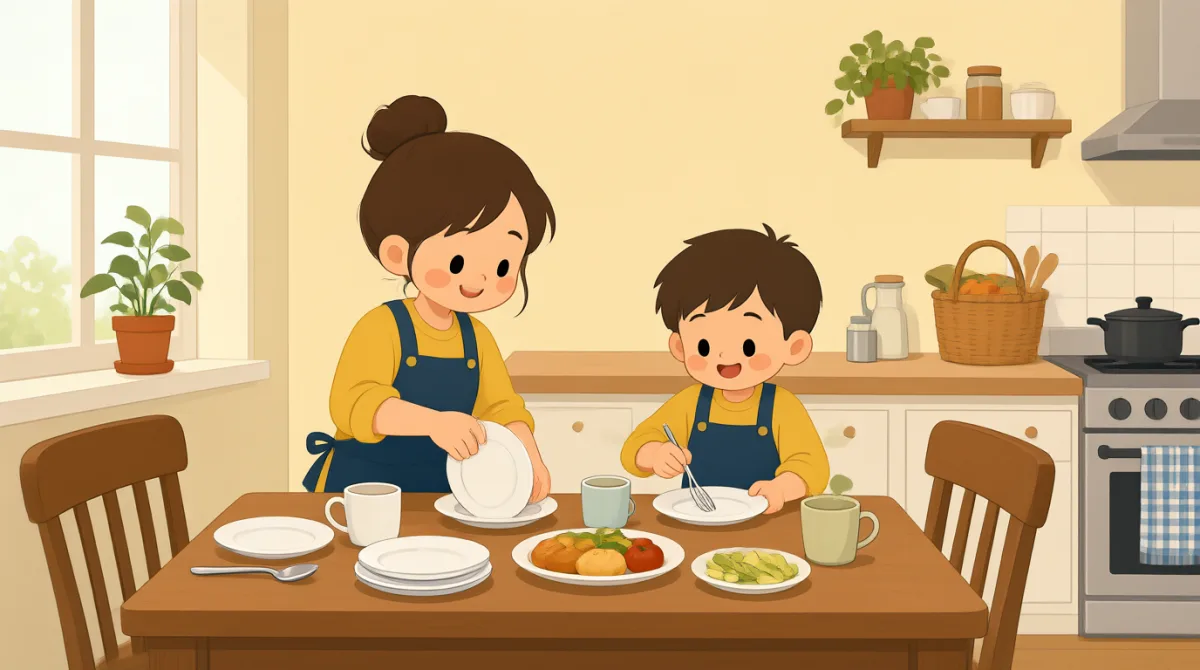

Breakfast was good. Let’s clear the table.
Le petit-déjeuner était bon. On débarrasse la table ?

I’ll take the plates to the sink.
Je vais apporter les assiettes à l’évier.

Thanks. Put the cups there, too.
Merci. Mets aussi les tasses là-bas.
Where do the forks go?
Où est-ce qu’on met les fourchettes ?
Put them in the sink. I’ll wash them.
Mets-les dans l’évier. Je vais les laver.
Here’s the soap. The water is warm.
Voilà le liquide vaisselle. L’eau est tiède.
I’ll dry the dishes with this towel.
Je vais essuyer la vaisselle avec cette serviette.
Great. The kitchen is clean now.
Super. La cuisine est propre, maintenant.
Vocabulaire8
- clear the tabledébarrasser la table
To take the dishes and other things off the table after a meal. You can say, “Let’s clear the table” to suggest doing it together.
Enlever les assiettes et les autres choses de la table après un repas. Tu peux dire « Let’s clear the table » pour proposer de le faire ensemble.
- take the plates to the sinkapporter les assiettes à l’évier
To carry the plates to the place where you wash dishes. You can use this phrase to say where you are taking something.
Porter les assiettes jusqu’à l’endroit où l’on fait la vaisselle. Cette expression te permet de dire où tu apportes quelque chose.
- cupstasses
Small dishes that you drink from. You can ask someone to put the cups with the other dishes.
De petits récipients dans lesquels on boit. Tu peux demander à quelqu’un de mettre les tasses avec les autres assiettes.
- forksfourchettes
Tools with points that you use to eat food. You can ask where the forks go when you are cleaning up.
Des ustensiles avec des dents dont on se sert pour manger. Quand tu ranges après le repas, tu peux demander où mettre les fourchettes.
- soapliquide vaisselle
A cleaning product used with water to wash dishes. You can offer someone soap by saying, “Here’s the soap.”
Un produit nettoyant qu’on utilise avec de l’eau pour laver la vaisselle. Tu peux proposer du produit à quelqu’un en disant « Here’s the soap ».
- warmtiède
A little hot, but not very hot. You can use it to describe water that feels comfortable for washing.
Un peu chaud, mais pas très chaud. Tu peux employer ce mot pour décrire une eau à une température agréable pour faire la vaisselle.
- dry the dishesessuyer la vaisselle
To remove water from clean dishes, often with a towel. You can say, “I’ll dry the dishes” to offer help.
Enlever l’eau de la vaisselle propre, souvent avec un torchon. Tu peux dire « I’ll dry the dishes » pour proposer ton aide.
- toweltorchon
A piece of cloth used to dry things. In this conversation, Emma uses a towel to dry the dishes.
Un morceau de tissu dont on se sert pour sécher des choses. Dans cette conversation, Emma se sert d’un torchon pour essuyer la vaisselle.
Phrases clés8
- 1
Let’s clear the table.
On débarrasse la table ?
This is a simple way to suggest doing a task together. Use “Let’s” plus a verb to invite someone to do something with you.
C’est une façon simple de proposer de faire quelque chose ensemble. Utilise « Let’s » suivi d’un verbe pour inviter quelqu’un à faire quelque chose avec toi.
- 2
I’ll take the plates to the sink.
Je vais apporter les assiettes à l’évier.
Use “I’ll” to offer to do something. You can replace “the plates” with another item and “the sink” with another place.
Utilise « I’ll » pour proposer de faire quelque chose. Tu peux remplacer « the plates » par un autre objet et « the sink » par un autre endroit.
- 3
Put the cups there, too.
Mets aussi les tasses là-bas.
This is a direct, simple instruction. Use “Put [thing] there, too” to ask someone to add another item to the same place.
C’est une consigne directe et simple. Utilise « Put [thing] there, too » pour demander à quelqu’un d’ajouter un autre objet au même endroit.
- 4
Where do the forks go?
Où est-ce qu’on met les fourchettes ?
Use this question to ask where something belongs. Replace “the forks” with another item, such as “the cups.”
Utilise cette question pour demander où va quelque chose. Remplace « the forks » par un autre objet, comme « the cups ».
- 5
I’ll wash them.
Je vais les laver.
This is a short way to offer to clean something. “Them” refers to things already mentioned, such as dishes or forks.
C’est une façon courte de proposer de laver quelque chose. « Them » désigne des choses déjà mentionnées, comme de la vaisselle ou des fourchettes.
- 6
The water is warm.
L’eau est tiède.
Use “The water is [adjective]” to describe its temperature. You can replace “warm” with “cold” or “hot.”
Utilise « The water is [adjective] » pour décrire la température de l’eau. Tu peux remplacer « warm » par « cold » ou « hot ».
- 7
I’ll dry the dishes with this towel.
Je vais essuyer la vaisselle avec ce torchon.
This sentence offers help and explains what you will use. Replace “the dishes” and “this towel” with other things you will dry and use.
Cette phrase propose de l’aide et précise ce que tu vas utiliser. Remplace « the dishes » et « this towel » par d’autres choses que tu vas sécher et utiliser.
- 8
The kitchen is clean now.
La cuisine est propre, maintenant.
Use this sentence to say that a place is clean after a task. “Now” shows that it is clean at this time.
Utilise cette phrase pour dire qu’un endroit est propre après une tâche. « Now » indique que l’endroit est propre à présent.