Cleaning Up
Arrumando a cozinha
After breakfast, they clear the table and wash the dishes together.
Depois do café da manhã, eles tiram a mesa e lavam a louça juntos.
Diálogo8
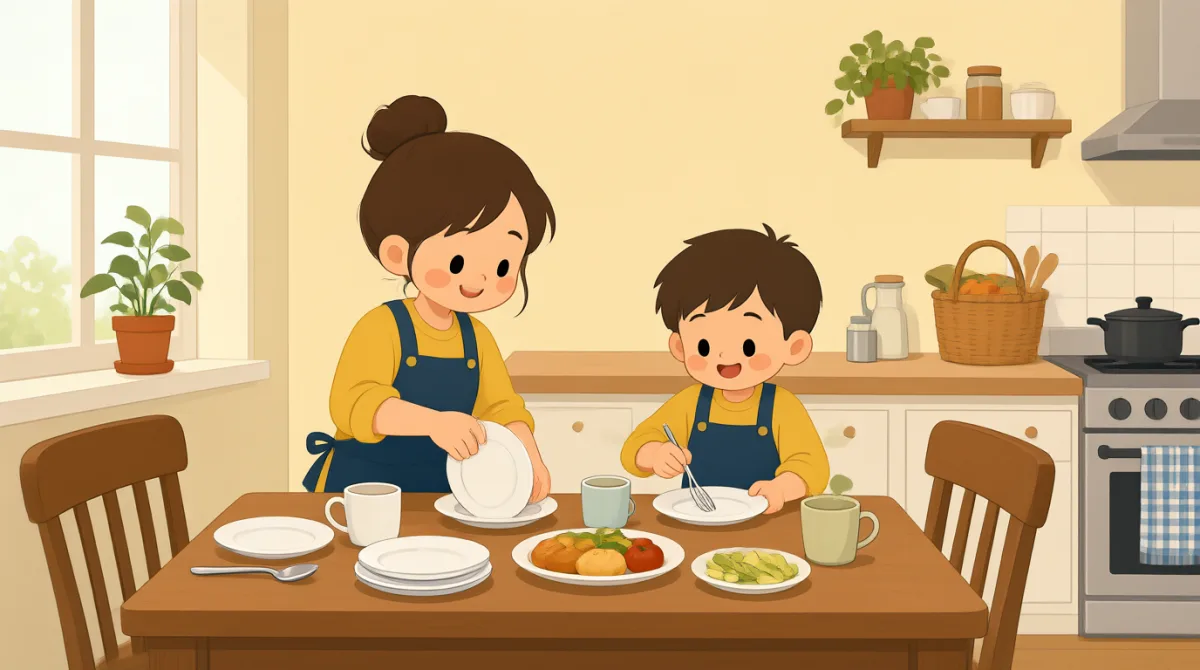

Breakfast was good. Let’s clear the table.
O café da manhã estava gostoso. Vamos tirar a mesa.

I’ll take the plates to the sink.
Vou levar os pratos para a pia.

Thanks. Put the cups there, too.
Obrigada. Coloque as xícaras lá também.
Where do the forks go?
Onde vão os garfos?
Put them in the sink. I’ll wash them.
Coloque-os na pia. Eu vou lavá-los.
Here’s the soap. The water is warm.
Aqui está o detergente. A água está morna.
I’ll dry the dishes with this towel.
Vou secar a louça com este pano.
Great. The kitchen is clean now.
Ótimo. A cozinha está limpa agora.
Vocabulário8
- clear the tabletirar a mesa
To take the dishes and other things off the table after a meal. You can say, “Let’s clear the table” to suggest doing it together.
Tirar da mesa os pratos e outras coisas depois de uma refeição. Você pode dizer “Let’s clear the table” (Vamos tirar a mesa) para sugerir que façam isso juntos.
- take the plates to the sinklevar os pratos para a pia
To carry the plates to the place where you wash dishes. You can use this phrase to say where you are taking something.
Carregar os pratos até o lugar onde se lava a louça. Você pode usar essa expressão para dizer para onde está levando alguma coisa.
- cupsxícaras
Small dishes that you drink from. You can ask someone to put the cups with the other dishes.
Recipientes pequenos dos quais você bebe. Você pode pedir a alguém que coloque as xícaras junto com a outra louça.
- forksgarfos
Tools with points that you use to eat food. You can ask where the forks go when you are cleaning up.
Talheres com pontas usados para comer. Você pode perguntar onde vão os garfos enquanto arruma a cozinha.
- soapdetergente
A cleaning product used with water to wash dishes. You can offer someone soap by saying, “Here’s the soap.”
Produto de limpeza usado com água para lavar a louça. Você pode oferecer detergente a alguém dizendo “Here’s the soap” (Aqui está o detergente).
- warmmorno
A little hot, but not very hot. You can use it to describe water that feels comfortable for washing.
Um pouco quente, mas não muito. Você pode usar essa palavra para descrever uma água que está agradável para lavar a louça.
- dry the dishessecar a louça
To remove water from clean dishes, often with a towel. You can say, “I’ll dry the dishes” to offer help.
Tirar a água da louça limpa, geralmente usando um pano. Você pode dizer “I’ll dry the dishes” (Eu vou secar a louça) para se oferecer para ajudar.
- towelpano de prato
A piece of cloth used to dry things. In this conversation, Emma uses a towel to dry the dishes.
Pedaço de tecido usado para secar coisas. Nesta conversa, Emma usa um pano de prato para secar a louça.
Frases-chave8
- 1
Let’s clear the table.
Vamos tirar a mesa.
This is a simple way to suggest doing a task together. Use “Let’s” plus a verb to invite someone to do something with you.
Esta é uma maneira simples de sugerir que façam uma tarefa juntos. Use “Let’s” seguido de um verbo para convidar alguém a fazer algo com você.
- 2
I’ll take the plates to the sink.
Vou levar os pratos para a pia.
Use “I’ll” to offer to do something. You can replace “the plates” with another item and “the sink” with another place.
Use “I’ll” para se oferecer para fazer algo. Você pode trocar “the plates” por outro item e “the sink” por outro lugar.
- 3
Put the cups there, too.
Coloque as xícaras lá também.
This is a direct, simple instruction. Use “Put [thing] there, too” to ask someone to add another item to the same place.
Esta é uma instrução direta e simples. Use “Put [thing] there, too” para pedir a alguém que coloque mais um item no mesmo lugar.
- 4
Where do the forks go?
Onde vão os garfos?
Use this question to ask where something belongs. Replace “the forks” with another item, such as “the cups.”
Use esta pergunta para saber onde alguma coisa deve ficar. Troque “the forks” por outro item, como “the cups”.
- 5
I’ll wash them.
Eu vou lavá-los.
This is a short way to offer to clean something. “Them” refers to things already mentioned, such as dishes or forks.
Esta é uma forma curta de se oferecer para lavar alguma coisa. “Them” se refere a coisas já mencionadas, como pratos ou garfos.
- 6
The water is warm.
A água está morna.
Use “The water is [adjective]” to describe its temperature. You can replace “warm” with “cold” or “hot.”
Use “The water is [adjective]” para descrever a temperatura da água. Você pode trocar “warm” por “cold” ou “hot.”
- 7
I’ll dry the dishes with this towel.
Vou secar a louça com este pano.
This sentence offers help and explains what you will use. Replace “the dishes” and “this towel” with other things you will dry and use.
Esta frase oferece ajuda e explica o que você vai usar. Troque “the dishes” e “this towel” por outras coisas que você vai secar e usar.
- 8
The kitchen is clean now.
A cozinha está limpa agora.
Use this sentence to say that a place is clean after a task. “Now” shows that it is clean at this time.
Use esta frase para dizer que um lugar está limpo depois de uma tarefa. “Now” mostra que o lugar está limpo neste momento.