Cleaning Up
收拾廚房
After breakfast, they clear the table and wash the dishes together.
早餐後,他們一起收拾桌子並洗碗。
對話8
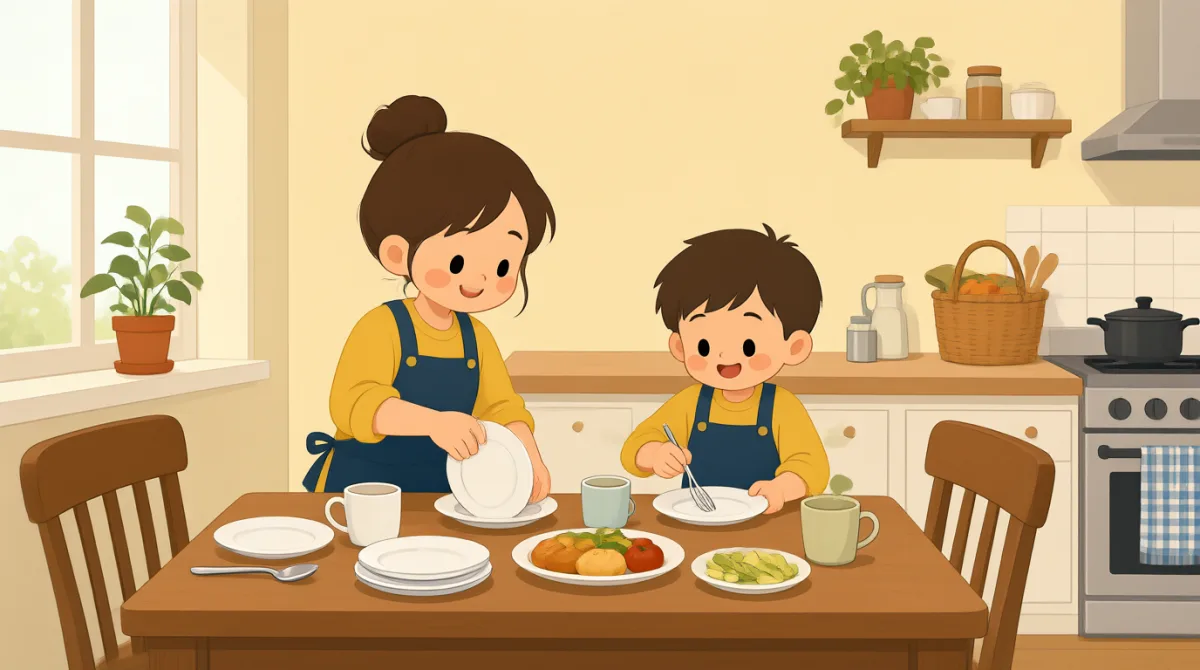

Breakfast was good. Let’s clear the table.
早餐真好吃。我們來收拾桌子吧。

I’ll take the plates to the sink.
我把盤子拿到水槽邊。

Thanks. Put the cups there, too.
謝謝。杯子也放在那裡吧。
Where do the forks go?
叉子放在哪裡?
Put them in the sink. I’ll wash them.
把它們放進水槽裡。我來洗。
Here’s the soap. The water is warm.
洗潔精在這兒。水是溫的。
I’ll dry the dishes with this towel.
我用這條毛巾把碗碟擦乾。
Great. The kitchen is clean now.
很好。廚房現在乾淨了。
詞彙8
- clear the table收拾桌子
To take the dishes and other things off the table after a meal. You can say, “Let’s clear the table” to suggest doing it together.
指飯後把桌上的餐具和其他東西收走。你可以說“Let’s clear the table”,表示提議一起收拾桌子。
- take the plates to the sink把盤子拿到水槽邊
To carry the plates to the place where you wash dishes. You can use this phrase to say where you are taking something.
指把盤子拿到洗碗的地方。你可以用這個短語說明要把東西拿到哪裡。
- cups杯子
Small dishes that you drink from. You can ask someone to put the cups with the other dishes.
用來喝東西的小容器。你可以請別人把杯子也放到其他餐具旁邊。
- forks叉子
Tools with points that you use to eat food. You can ask where the forks go when you are cleaning up.
用來吃東西、有尖齒的餐具。收拾的時候,你可以問叉子放在哪裡。
- soap洗潔精
A cleaning product used with water to wash dishes. You can offer someone soap by saying, “Here’s the soap.”
用水洗碗時用的清潔用品。你可以說“Here’s the soap”,把洗潔精遞給別人。
- warm溫的
A little hot, but not very hot. You can use it to describe water that feels comfortable for washing.
有點熱,但不燙。你可以用它來形容洗碗時摸起來很舒服的水。
- dry the dishes把碗碟擦乾
To remove water from clean dishes, often with a towel. You can say, “I’ll dry the dishes” to offer help.
把洗乾淨的碗碟上的水擦掉,通常會用毛巾。你可以說“I’ll dry the dishes”,表示願意幫忙擦乾碗碟。
- towel毛巾
A piece of cloth used to dry things. In this conversation, Emma uses a towel to dry the dishes.
用來擦乾東西的一塊布。在這段對話中,艾瑪用毛巾把碗碟擦乾。
關鍵句8
- 1
Let’s clear the table.
我們來收拾桌子吧。
This is a simple way to suggest doing a task together. Use “Let’s” plus a verb to invite someone to do something with you.
這是提議一起做某件事的簡單說法。用“Let’s”加動詞,可以邀請別人和你一起做某事。
- 2
I’ll take the plates to the sink.
我把盤子拿到水槽邊。
Use “I’ll” to offer to do something. You can replace “the plates” with another item and “the sink” with another place.
用“I’ll”表示主動提出做某事。你可以把“the plates”換成其他物品,把“the sink”換成其他地點。
- 3
Put the cups there, too.
杯子也放在那裡吧。
This is a direct, simple instruction. Use “Put [thing] there, too” to ask someone to add another item to the same place.
這是直接又簡單的指示。用“Put [thing] there, too”可以請別人把另一件東西也放到同一個地方。
- 4
Where do the forks go?
叉子放在哪裡?
Use this question to ask where something belongs. Replace “the forks” with another item, such as “the cups.”
用這個問句詢問某樣東西應該放在哪裡。你可以把“the forks”換成其他物品,比如“the cups”。
- 5
I’ll wash them.
我來洗。
This is a short way to offer to clean something. “Them” refers to things already mentioned, such as dishes or forks.
這是主動提出幫忙清洗東西的簡短說法。“Them”指前面提到的東西,比如餐具或叉子。
- 6
The water is warm.
水是溫的。
Use “The water is [adjective]” to describe its temperature. You can replace “warm” with “cold” or “hot.”
用“The water is [adjective]”來描述水的溫度。你可以把“warm”換成“cold”或“hot”。
- 7
I’ll dry the dishes with this towel.
我用這條毛巾把碗碟擦乾。
This sentence offers help and explains what you will use. Replace “the dishes” and “this towel” with other things you will dry and use.
這句話既表示願意幫忙,也說明會用什麼東西。你可以把“the dishes”和“this towel”換成其他要擦乾的東西和要用的物品。
- 8
The kitchen is clean now.
廚房現在乾淨了。
Use this sentence to say that a place is clean after a task. “Now” shows that it is clean at this time.
用這句話表示做完一件事後,某個地方已經乾淨了。“Now”表示這個地方現在很乾淨。