Cleaning Up
After breakfast, they clear the table and wash the dishes together.
Dialogue8
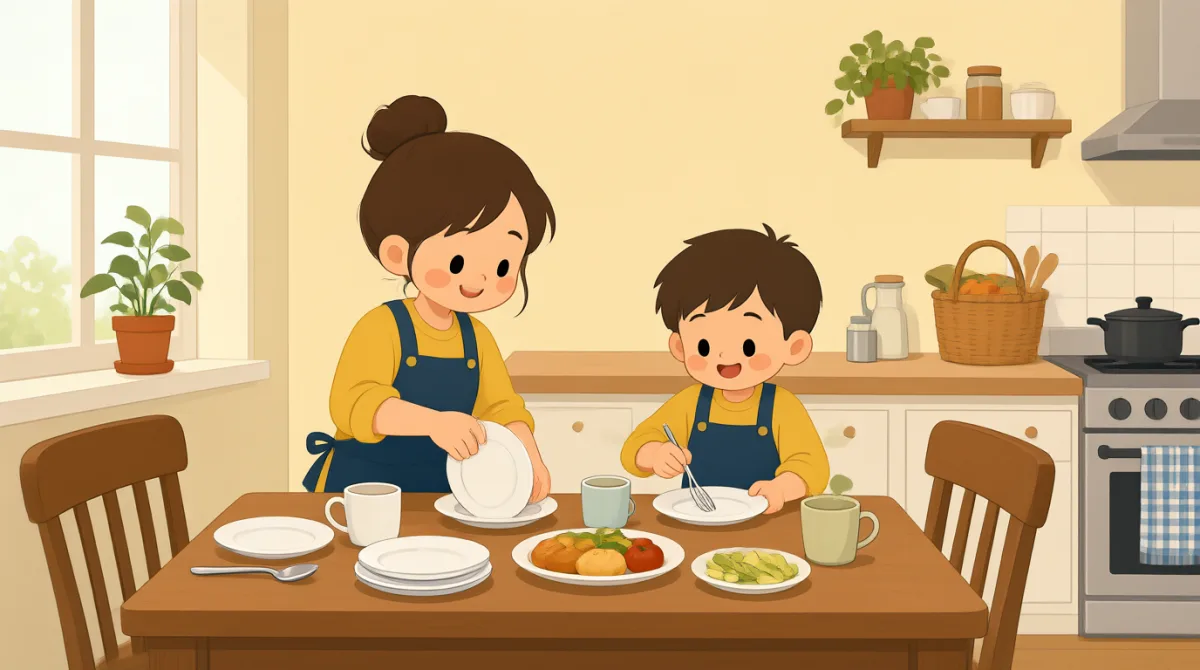

Breakfast was good. Let’s clear the table.

I’ll take the plates to the sink.

Thanks. Put the cups there, too.
Where do the forks go?
Put them in the sink. I’ll wash them.
Here’s the soap. The water is warm.
I’ll dry the dishes with this towel.
Great. The kitchen is clean now.
Vocabulary8
- clear the table
To take the dishes and other things off the table after a meal. You can say, “Let’s clear the table” to suggest doing it together.
- take the plates to the sink
To carry the plates to the place where you wash dishes. You can use this phrase to say where you are taking something.
- cups
Small dishes that you drink from. You can ask someone to put the cups with the other dishes.
- forks
Tools with points that you use to eat food. You can ask where the forks go when you are cleaning up.
- soap
A cleaning product used with water to wash dishes. You can offer someone soap by saying, “Here’s the soap.”
- warm
A little hot, but not very hot. You can use it to describe water that feels comfortable for washing.
- dry the dishes
To remove water from clean dishes, often with a towel. You can say, “I’ll dry the dishes” to offer help.
- towel
A piece of cloth used to dry things. In this conversation, Emma uses a towel to dry the dishes.
Key Sentences8
- 1
Let’s clear the table.
This is a simple way to suggest doing a task together. Use “Let’s” plus a verb to invite someone to do something with you.
- 2
I’ll take the plates to the sink.
Use “I’ll” to offer to do something. You can replace “the plates” with another item and “the sink” with another place.
- 3
Put the cups there, too.
This is a direct, simple instruction. Use “Put [thing] there, too” to ask someone to add another item to the same place.
- 4
Where do the forks go?
Use this question to ask where something belongs. Replace “the forks” with another item, such as “the cups.”
- 5
I’ll wash them.
This is a short way to offer to clean something. “Them” refers to things already mentioned, such as dishes or forks.
- 6
The water is warm.
Use “The water is [adjective]” to describe its temperature. You can replace “warm” with “cold” or “hot.”
- 7
I’ll dry the dishes with this towel.
This sentence offers help and explains what you will use. Replace “the dishes” and “this towel” with other things you will dry and use.
- 8
The kitchen is clean now.
Use this sentence to say that a place is clean after a task. “Now” shows that it is clean at this time.