Cleaning Up
Limpiar después de comer
After breakfast, they clear the table and wash the dishes together.
Después del desayuno, recogen la mesa y lavan los platos juntos.
Diálogo8
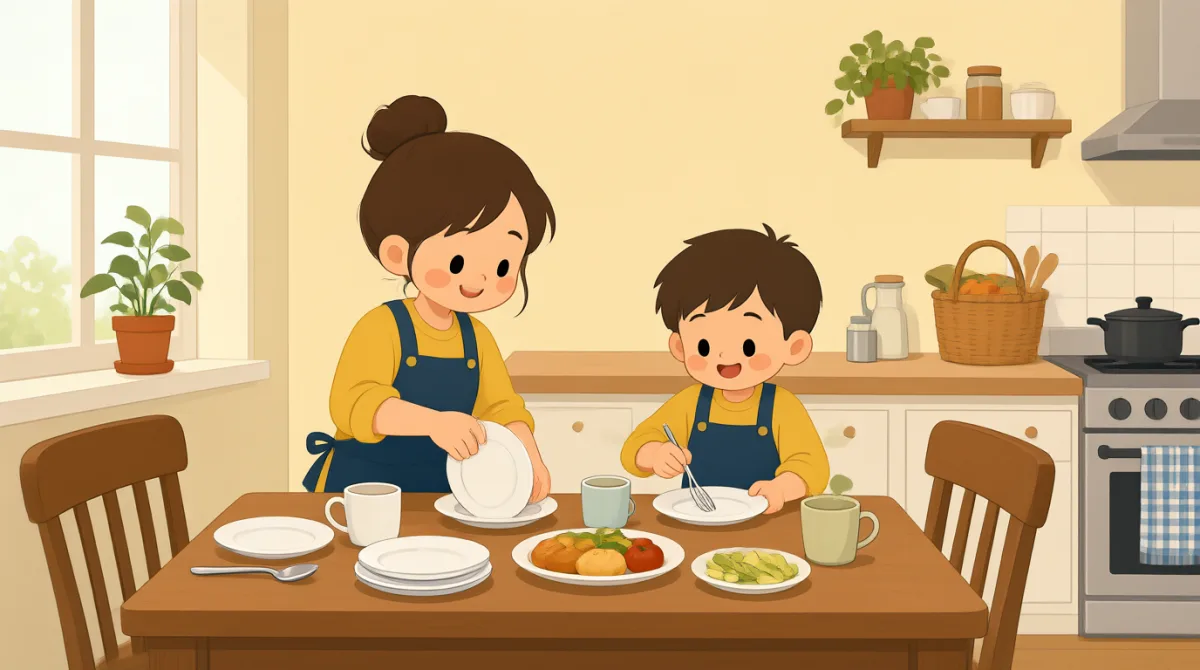

Breakfast was good. Let’s clear the table.
El desayuno estuvo rico. Vamos a recoger la mesa.

I’ll take the plates to the sink.
Llevo los platos al fregadero.

Thanks. Put the cups there, too.
Gracias. Pon las tazas ahí también.
Where do the forks go?
¿Dónde van los tenedores?
Put them in the sink. I’ll wash them.
Ponlos en el fregadero. Yo los lavo.
Here’s the soap. The water is warm.
Aquí está el jabón. El agua está tibia.
I’ll dry the dishes with this towel.
Voy a secar los platos con este paño.
Great. The kitchen is clean now.
Genial. La cocina ya está limpia.
Vocabulario8
- clear the tablerecoger la mesa
To take the dishes and other things off the table after a meal. You can say, “Let’s clear the table” to suggest doing it together.
Retirar los platos y las demás cosas de la mesa después de comer. Puedes decir “Let’s clear the table” («Vamos a recoger la mesa») para proponer hacerlo juntos.
- take the plates to the sinkllevar los platos al fregadero
To carry the plates to the place where you wash dishes. You can use this phrase to say where you are taking something.
Llevar los platos al lugar donde se lavan. Puedes usar esta frase para decir adónde llevas algo.
- cupstazas
Small dishes that you drink from. You can ask someone to put the cups with the other dishes.
Recipientes pequeños de los que se bebe. Puedes pedirle a alguien que ponga las tazas con los demás platos.
- forkstenedores
Tools with points that you use to eat food. You can ask where the forks go when you are cleaning up.
Utensilios con puntas que se usan para comer. Puedes preguntar dónde van los tenedores cuando estás recogiendo.
- soapjabón
A cleaning product used with water to wash dishes. You can offer someone soap by saying, “Here’s the soap.”
Producto de limpieza que se usa con agua para lavar los platos. Puedes ofrecerle jabón a alguien diciendo “Here’s the soap” («Aquí está el jabón»).
- warmtibio
A little hot, but not very hot. You can use it to describe water that feels comfortable for washing.
Algo caliente, pero no mucho. Puedes usar esta palabra para describir el agua cuando está a una temperatura agradable para lavar.
- dry the dishessecar los platos
To remove water from clean dishes, often with a towel. You can say, “I’ll dry the dishes” to offer help.
Quitarles el agua a los platos limpios, a menudo con un paño. Puedes decir “I’ll dry the dishes” («Yo seco los platos») para ofrecer ayuda.
- towelpaño
A piece of cloth used to dry things. In this conversation, Emma uses a towel to dry the dishes.
Un trozo de tela que se usa para secar cosas. En esta conversación, Emma usa un paño para secar los platos.
Frases clave8
- 1
Let’s clear the table.
Vamos a recoger la mesa.
This is a simple way to suggest doing a task together. Use “Let’s” plus a verb to invite someone to do something with you.
Esta es una manera sencilla de proponer hacer algo juntos. Usa “Let’s” seguido de un verbo para invitar a alguien a hacer algo contigo.
- 2
I’ll take the plates to the sink.
Llevo los platos al fregadero.
Use “I’ll” to offer to do something. You can replace “the plates” with another item and “the sink” with another place.
Usa “I’ll” para ofrecerte a hacer algo. Puedes sustituir “the plates” por otro objeto y “the sink” por otro lugar.
- 3
Put the cups there, too.
Pon las tazas ahí también.
This is a direct, simple instruction. Use “Put [thing] there, too” to ask someone to add another item to the same place.
Esta es una instrucción directa y sencilla. Usa “Put [thing] there, too” para pedirle a alguien que ponga otra cosa en el mismo lugar.
- 4
Where do the forks go?
¿Dónde van los tenedores?
Use this question to ask where something belongs. Replace “the forks” with another item, such as “the cups.”
Usa esta pregunta para preguntar dónde se pone algo. Sustituye “the forks” por otro objeto, como “the cups”.
- 5
I’ll wash them.
Yo los lavo.
This is a short way to offer to clean something. “Them” refers to things already mentioned, such as dishes or forks.
Esta es una forma breve de ofrecerte a lavar algo. “Them” se refiere a cosas que ya se han mencionado, como platos o tenedores.
- 6
The water is warm.
El agua está tibia.
Use “The water is [adjective]” to describe its temperature. You can replace “warm” with “cold” or “hot.”
Usa “The water is [adjective]” para describir la temperatura del agua. Puedes sustituir “warm” por “cold” o “hot”.
- 7
I’ll dry the dishes with this towel.
Voy a secar los platos con este paño.
This sentence offers help and explains what you will use. Replace “the dishes” and “this towel” with other things you will dry and use.
Esta frase ofrece ayuda y explica qué vas a usar. Sustituye “the dishes” y “this towel” por otras cosas que vayas a secar y usar.
- 8
The kitchen is clean now.
La cocina ya está limpia.
Use this sentence to say that a place is clean after a task. “Now” shows that it is clean at this time.
Usa esta frase para decir que un lugar está limpio después de hacer una tarea. “Now” indica que está limpio en este momento.