Cleaning Up
Temizlik
After breakfast, they clear the table and wash the dishes together.
Kahvaltıdan sonra masayı toplar ve bulaşıkları birlikte yıkarlar.
Diyalog8
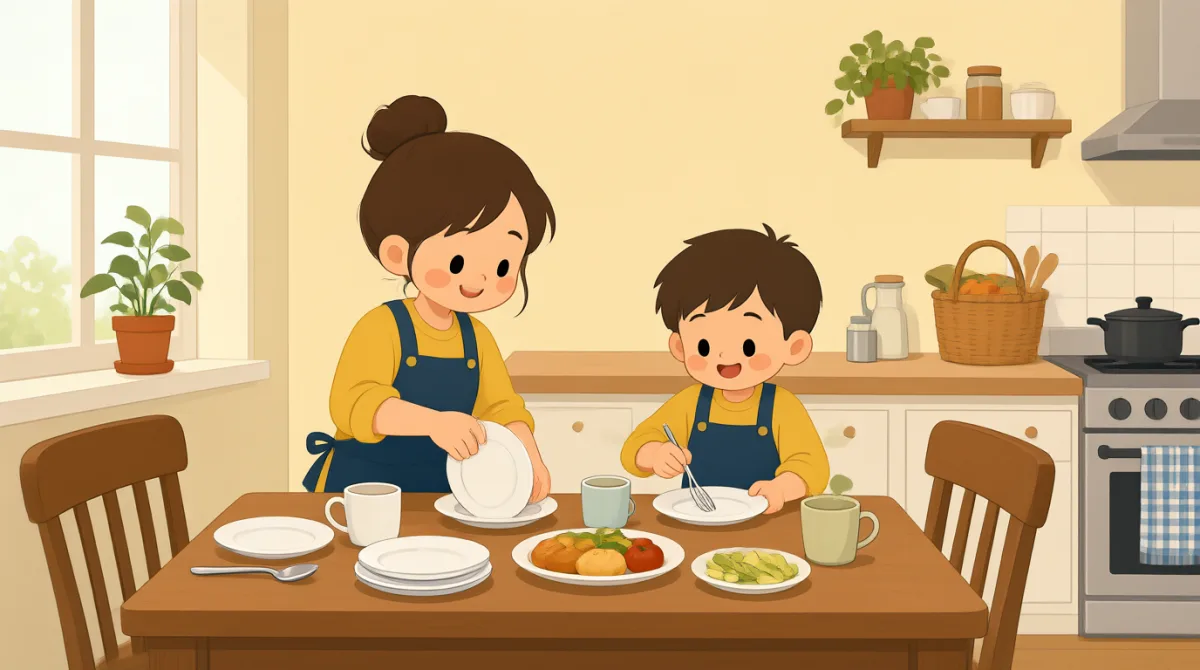

Breakfast was good. Let’s clear the table.
Kahvaltı güzeldi. Hadi masayı toplayalım.

I’ll take the plates to the sink.
Tabakları lavaboya götüreyim.

Thanks. Put the cups there, too.
Sağ ol. Bardakları da oraya koy.
Where do the forks go?
Çatallar nereye konuyor?
Put them in the sink. I’ll wash them.
Onları lavaboya koy. Ben yıkarım.
Here’s the soap. The water is warm.
Sabun burada. Su ılık.
I’ll dry the dishes with this towel.
Bulaşıkları bu havluyla kurulayacağım.
Great. The kitchen is clean now.
Harika. Mutfak şimdi temiz.
Kelime Bilgisi8
- clear the tablemasayı toplamak
To take the dishes and other things off the table after a meal. You can say, “Let’s clear the table” to suggest doing it together.
Yemekten sonra tabakları ve diğer eşyaları masadan kaldırmak demektir. Birlikte yapmayı önermek için “Let’s clear the table” (Hadi masayı toplayalım) diyebilirsin.
- take the plates to the sinktabakları lavaboya götürmek
To carry the plates to the place where you wash dishes. You can use this phrase to say where you are taking something.
Tabakları bulaşık yıkanan yere taşımak demektir. Bir şeyi nereye götürdüğünü söylemek için bu ifadeyi kullanabilirsin.
- cupsbardaklar
Small dishes that you drink from. You can ask someone to put the cups with the other dishes.
İçmek için kullanılan küçük kaplardır. Birinden bardakları diğer bulaşıkların yanına koymasını isteyebilirsin.
- forksçatallar
Tools with points that you use to eat food. You can ask where the forks go when you are cleaning up.
Yemek yemek için kullanılan, uçları sivri araçlardır. Ortalığı toplarken çatalların nereye konacağını sorabilirsin.
- soapbulaşık deterjanı
A cleaning product used with water to wash dishes. You can offer someone soap by saying, “Here’s the soap.”
Bulaşıkları yıkamak için suyla birlikte kullanılan temizlik ürünüdür. Birine “Here’s the soap” (Sabun burada) diyerek deterjanı verebilirsin.
- warmılık
A little hot, but not very hot. You can use it to describe water that feels comfortable for washing.
Biraz sıcak ama çok sıcak olmayan demektir. Yıkarken rahat hissettiren suyu tarif etmek için kullanabilirsin.
- dry the dishesbulaşıkları kurulamak
To remove water from clean dishes, often with a towel. You can say, “I’ll dry the dishes” to offer help.
Temiz bulaşıkların üzerindeki suyu, genellikle bir havluyla almak demektir. Yardım teklif etmek için “I’ll dry the dishes” (Bulaşıkları ben kurularım) diyebilirsin.
- towelhavlu
A piece of cloth used to dry things. In this conversation, Emma uses a towel to dry the dishes.
Bir şeyleri kurulamak için kullanılan kumaş parçasıdır. Bu konuşmada Emma bulaşıkları kurulamak için havlu kullanıyor.
Önemli Cümleler8
- 1
Let’s clear the table.
Hadi masayı toplayalım.
This is a simple way to suggest doing a task together. Use “Let’s” plus a verb to invite someone to do something with you.
Bu, bir işi birlikte yapmayı önermenin basit bir yoludur. Birini seninle bir şey yapmaya davet etmek için “Let’s” ifadesini bir fiille birlikte kullan.
- 2
I’ll take the plates to the sink.
Tabakları lavaboya götüreyim.
Use “I’ll” to offer to do something. You can replace “the plates” with another item and “the sink” with another place.
Bir şeyi yapmayı teklif etmek için “I’ll” kullanılır. “the plates” yerine başka bir eşya, “the sink” yerine de başka bir yer söyleyebilirsin.
- 3
Put the cups there, too.
Bardakları da oraya koy.
This is a direct, simple instruction. Use “Put [thing] there, too” to ask someone to add another item to the same place.
Bu, doğrudan ve basit bir yönergedir. Birinden aynı yere başka bir eşya eklemesini istemek için “Put [thing] there, too” kalıbını kullan.
- 4
Where do the forks go?
Çatallar nereye konuyor?
Use this question to ask where something belongs. Replace “the forks” with another item, such as “the cups.”
Bir şeyin nereye ait olduğunu sormak için bu soruyu kullan. “the forks” yerine “the cups” gibi başka bir eşya söyleyebilirsin.
- 5
I’ll wash them.
Onları yıkarım.
This is a short way to offer to clean something. “Them” refers to things already mentioned, such as dishes or forks.
Bu, bir şeyi temizlemeyi teklif etmenin kısa bir yoludur. “Them”, daha önce sözü edilen tabaklar veya çatallar gibi şeyleri ifade eder.
- 6
The water is warm.
Su ılık.
Use “The water is [adjective]” to describe its temperature. You can replace “warm” with “cold” or “hot.”
Suyun sıcaklığını tarif etmek için “The water is [adjective]” kalıbını kullan. “warm” yerine “cold” veya “hot” diyebilirsin.
- 7
I’ll dry the dishes with this towel.
Bulaşıkları bu havluyla kurulayacağım.
This sentence offers help and explains what you will use. Replace “the dishes” and “this towel” with other things you will dry and use.
Bu cümle hem yardım teklif eder hem de ne kullanacağını söyler. Kurulayacağın şeyleri ve kullanacağın eşyayı belirtmek için “the dishes” ve “this towel” yerine başka ifadeler koyabilirsin.
- 8
The kitchen is clean now.
Mutfak şimdi temiz.
Use this sentence to say that a place is clean after a task. “Now” shows that it is clean at this time.
Bir iş bittikten sonra bir yerin temiz olduğunu söylemek için bu cümleyi kullan. “Now”, o yerin şu anda temiz olduğunu belirtir.