Making Toast and Eggs
Préparer des tartines et des œufs
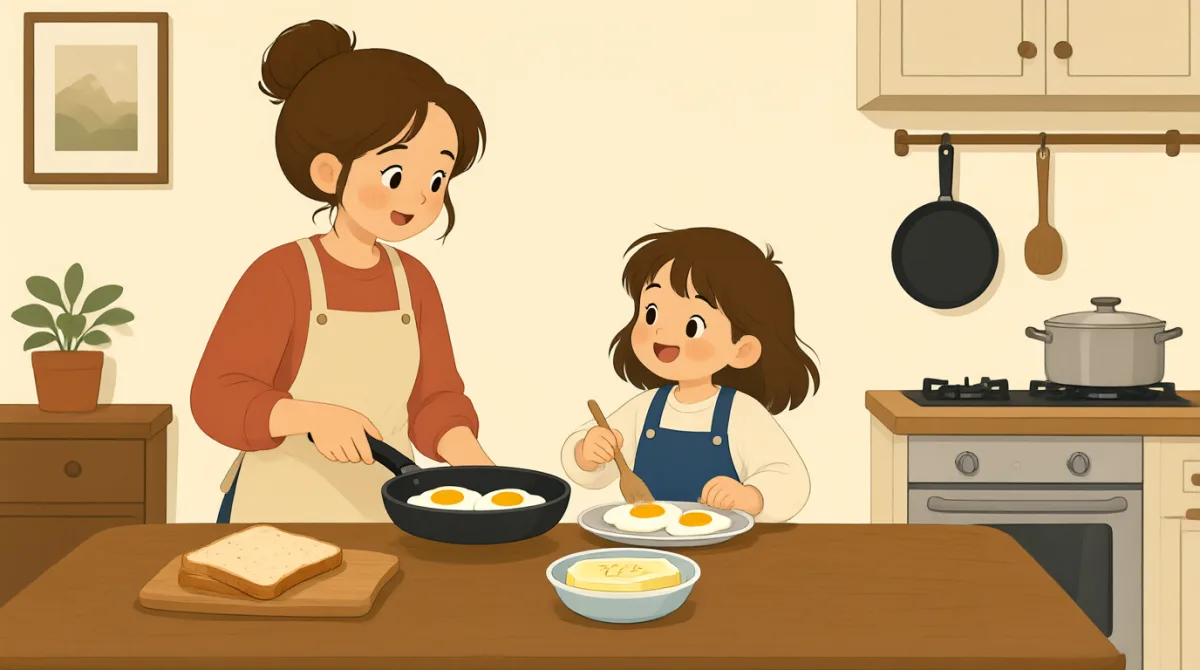
They make toast and cook eggs together. Emma asks Mia where to find the butter and a pan.
Elles préparent des tartines et font cuire des œufs ensemble. Emma demande à Mia où trouver le beurre et une poêle.
Dialogue8

Where is the butter, Mia?
Où est le beurre, Mia ?

It’s in the fridge, next to the milk.
Il est dans le frigo, à côté du lait.
Thanks. Where is the pan?
Merci. Où est la poêle ?
It’s on the shelf. I’ll get it.
Elle est sur l’étagère. Je vais la chercher.
I’ll put the bread in the toaster.
Je vais mettre le pain dans le grille-pain.
Great. I’ll cook the eggs in the pan.
Super. Je vais faire cuire les œufs dans la poêle.
Do you need some butter?
Tu veux du beurre ?
Yes, please. Then our breakfast is ready.
Oui, s’il te plaît. Après, le petit-déjeuner sera prêt.
Vocabulaire8
- in the fridgedans le frigo
This means inside the refrigerator. Use it to say where food is kept.
Cela signifie qu’un aliment se trouve à l’intérieur du réfrigérateur. Utilise cette expression pour dire où se trouve un aliment.
- next toà côté de
This means beside something. Use it to describe where one thing is in relation to another.
Cela signifie qu’une chose se trouve près d’une autre, juste à côté. Utilise cette expression pour préciser où se trouve une chose par rapport à une autre.
- on the shelfsur l’étagère
This means resting on a shelf. Use it to say where an item is.
Cela signifie qu’une chose est posée sur une étagère. Utilise cette expression pour dire où se trouve un objet.
- I’ll get it.I’ll get it.
This means “I will go and bring it.” Use it when you offer to fetch something.
Cela signifie « Je vais aller le chercher et te l’apporter. » Utilise cette phrase quand tu proposes d’aller chercher quelque chose.
- put the bread in the toasterput the bread in the toaster
This means to place bread inside a toaster so it can become toast. You can use “put [something] in [place]” to describe where you place things.
Cela signifie mettre du pain dans un grille-pain pour le faire griller. Tu peux utiliser “put [something] in [place]” pour expliquer où tu poses quelque chose.
- cook the eggscook the eggs
This means to prepare the eggs with heat. Use “cook” with the name of a food you are preparing.
Cela signifie faire cuire les œufs. Utilise “cook” avec le nom de l’aliment que tu prépares.
- some buttersome butter
This means an unspecified amount of butter. Use “some” when asking for or offering an amount of food.
Cela signifie une certaine quantité de beurre, sans préciser laquelle. Utilise “some” pour demander ou proposer une quantité d’un aliment.
- breakfast is readybreakfast is ready
This means breakfast is prepared and ready to eat. Use “[meal] is ready” when food is finished.
Cela signifie que le petit-déjeuner est préparé et qu’on peut le manger. Utilise “[meal] is ready” pour dire qu’un repas est prêt.
Phrases clés8
- 1
Where is the butter, Mia?
Où est le beurre, Mia ?
Use this simple question to ask where something is. Replace “the butter” with another item, such as “the pan.”
Utilise cette question simple pour demander où se trouve quelque chose. Remplace “the butter” par un autre objet, comme “the pan”.
- 2
It’s in the fridge, next to the milk.
Il est dans le frigo, à côté du lait.
This sentence gives an item’s location. Use “It’s in…” and “next to…” to explain where something is.
Cette phrase indique où se trouve quelque chose. Utilise “It’s in…” et “next to…” pour expliquer où se trouve un objet.
- 3
Where is the pan?
Où est la poêle ?
Use “Where is the…?” to ask where a single item is. Replace “the pan” with the thing you are looking for.
Utilise “Where is the…?” pour demander où se trouve un objet. Remplace “the pan” par ce que tu cherches.
- 4
I’ll put the bread in the toaster.
Je vais mettre le pain dans le grille-pain.
Use “I’ll put…” to say what you will place somewhere. Replace “the bread” and “the toaster” with other items and places.
Utilise “I’ll put…” pour dire ce que tu vas poser quelque part. Remplace “the bread” et “the toaster” par d’autres objets et endroits.
- 5
I’ll cook the eggs in the pan.
Je vais faire cuire les œufs dans la poêle.
Use “I’ll cook…” to say what you plan to prepare and where you will cook it. Replace “the eggs” and “the pan” as needed.
Utilise “I’ll cook…” pour dire ce que tu prévois de préparer et où tu vas le faire cuire. Remplace “the eggs” et “the pan” si nécessaire.
- 6
Do you need some butter?
Tu veux du beurre ?
Use this question to offer something someone may need. Replace “some butter” with another food or item.
Utilise cette question pour proposer quelque chose dont une personne pourrait avoir besoin. Remplace “some butter” par un autre aliment ou objet.
- 7
Yes, please.
Oui, s’il te plaît.
This is a polite way to accept an offer. You can use it when someone asks if you would like or need something.
C’est une façon polie d’accepter une proposition. Tu peux utiliser cette expression quand quelqu’un te demande si tu veux quelque chose ou si tu en as besoin.
- 8
Then our breakfast is ready.
Après, le petit-déjeuner sera prêt.
Use “Then…” to describe what happens next, and “is ready” to say something is prepared. Replace “our breakfast” with another meal or activity.
Utilise “Then…” pour dire ce qui va se passer ensuite, et “is ready” pour dire que quelque chose est préparé. Remplace “our breakfast” par un autre repas ou une autre activité.