Buying Plates and Cups
Teller und Becher kaufen
Emma and Jack look for plates, cups, and napkins at the store. They choose enough for the guests without buying too much.
Emma und Jack suchen im Laden Teller, Becher und Servietten. Sie wählen genug für die Gäste aus, ohne zu viel zu kaufen.
Dialog8
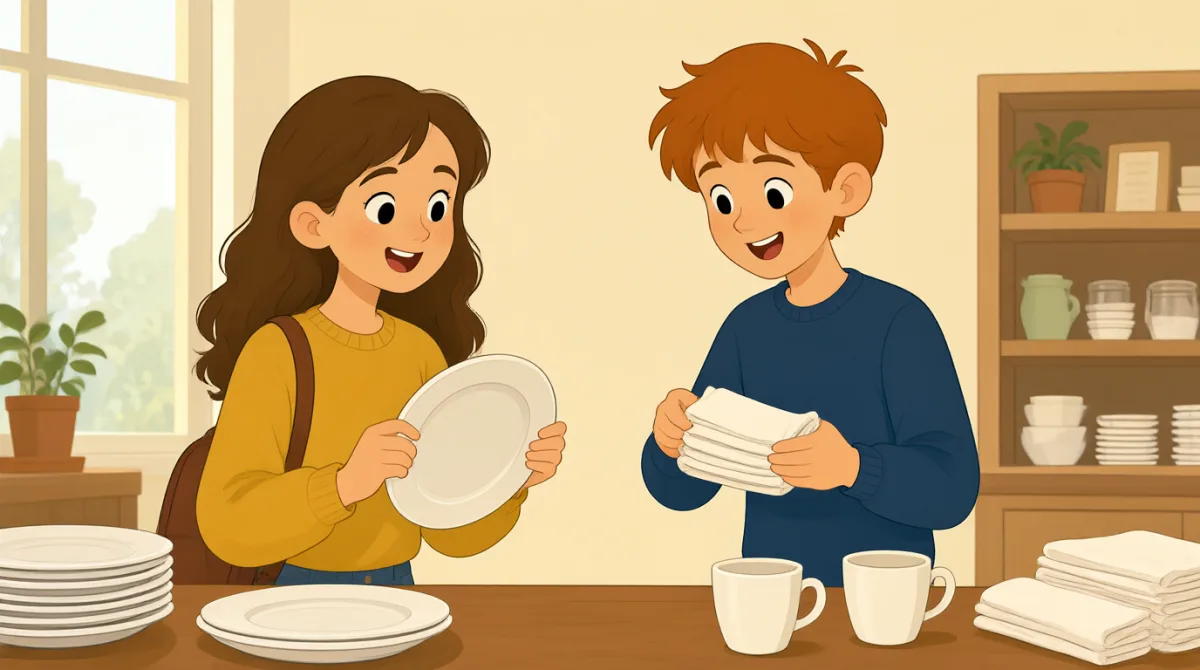

We still need plates, cups, and napkins for the party.
Für die Party brauchen wir noch Teller, Becher und Servietten.

The paper plates are over here. How many guests are coming?
Die Pappteller sind hier drüben. Wie viele Gäste kommen?
About twenty. Let's get one plate for each person, plus a few extra.
Ungefähr zwanzig. Lass uns für jede Person einen Teller nehmen und noch ein paar extra.
These cups come in a pack of twenty-four. That should be enough.
Diese Becher gibt es im 24er-Pack. Das sollte reichen.
Good. Do we need small cups too, or are these fine for every drink?
Gut. Brauchen wir auch kleine Becher, oder eignen sich diese für jedes Getränk?
These are fine. Let's get one pack and two packs of napkins.
Die hier reichen. Lass uns eine Packung davon und zwei Packungen Servietten nehmen.
There are two kinds of plates. The stronger ones cost a little more.
Es gibt zwei Sorten Teller. Die stabileren kosten ein bisschen mehr.
Let's take those. They won't bend when people put food on them.
Nehmen wir die. Sie knicken nicht, wenn jemand Essen darauflegt.
Wortschatz8
- How many guests are coming?Wie viele Gäste kommen?
This asks how many people will attend an event. Use “How many guests are coming?” to plan food, seats, or supplies.
Damit fragst du, wie viele Personen an einer Veranstaltung teilnehmen. Mit “How many guests are coming?” kannst du planen, wie viel Essen, wie viele Sitzplätze oder welche Materialien du brauchst.
- one plate for each personein Teller für jede Person
This means every person gets one plate. You can use “one [thing] for each person” when planning supplies for a group.
Das bedeutet, dass jede Person einen Teller bekommt. Mit “one [thing] for each person” kannst du planen, wie viele Dinge du für eine Gruppe brauchst.
- a few extraein paar extra
This means a small number more than you need. Use it when you want to have some spares.
Das bedeutet, dass du ein paar mehr nimmst, als du brauchst. So hast du einige als Reserve.
- come in a pack of twenty-fourgibt es im 24er-Pack
This means there are twenty-four items in one package. Use “come in a pack of [number]” to describe how products are sold.
Das bedeutet, dass 24 Stück in einer Packung sind. Mit “come in a pack of [number]” kannst du beschreiben, in welcher Packungsgröße ein Produkt verkauft wird.
- That should be enough.Das sollte reichen.
This means you think there is enough of something. Use it when deciding how much to buy or bring.
Damit sagst du, dass du glaubst, dass etwas in ausreichender Menge vorhanden ist. Du kannst das sagen, wenn du entscheidest, wie viel du kaufen oder mitbringen solltest.
- are these fine for every drink?eignen sich diese für jedes Getränk?
This asks whether the cups are suitable for all kinds of drinks. You can use “Are these fine for…?” to check if something will work for a purpose.
Damit fragst du, ob die Becher für alle Arten von Getränken geeignet sind. Mit “Are these fine for…?” kannst du prüfen, ob etwas für einen bestimmten Zweck passt.
- Let's take those.Nehmen wir die.
This is a simple way to decide to buy or choose something. Use “Let's take those” when you and another person agree on an option.
Das ist eine einfache Möglichkeit, sich dafür zu entscheiden, etwas zu kaufen oder auszuwählen. Mit “Let's take those” kannst du dich für eine Möglichkeit entscheiden, mit der ihr beide einverstanden seid.
- They won't bendSie knicken nicht
This means the plates will stay firm and not fold under pressure. Use “won't” to say that something will not happen in the future.
Das bedeutet, dass die Teller stabil bleiben und unter Druck nicht einknicken. Mit “won't” sagst du, dass etwas in Zukunft nicht passieren wird.
Wichtige Sätze8
- 1
We still need plates, cups, and napkins for the party.
Für die Party brauchen wir noch Teller, Becher und Servietten.
This sentence says what items are still needed. Reuse “We still need…” to list things you have not bought or prepared yet.
Dieser Satz nennt Dinge, die noch gebraucht werden. Mit “We still need…” kannst du weitere Dinge aufzählen, die du noch nicht gekauft oder vorbereitet hast.
- 2
How many guests are coming?
Wie viele Gäste kommen?
This is a useful question when planning for an event. Replace “guests” with another plural noun to ask how many people or items there will be.
Diese Frage ist nützlich, wenn du eine Veranstaltung planst. Ersetze “guests” durch ein anderes Substantiv im Plural, um nach der Anzahl von Personen oder Dingen zu fragen.
- 3
Let's get one plate for each person, plus a few extra.
Lass uns für jede Person einen Teller nehmen und noch ein paar extra.
This explains how many plates to buy, including some spares. Reuse “one [item] for each person, plus a few extra” when planning supplies.
Hier wird erklärt, wie viele Teller gekauft werden sollen, einschließlich einiger zusätzlicher Teller. Mit “one [item] for each person, plus a few extra” kannst du planen, welche Materialien du brauchst.
- 4
These cups come in a pack of twenty-four.
Diese Becher gibt es im 24er-Pack.
This gives the number of cups in one package. Replace “twenty-four” with the number shown on another product.
Hier wird angegeben, wie viele Becher in einer Packung sind. Ersetze “twenty-four” durch die Zahl, die auf einem anderen Produkt steht.
- 5
That should be enough.
Das sollte reichen.
This is a short way to say that you think the amount is sufficient. Use it when agreeing that a quantity will meet your needs.
So kannst du kurz sagen, dass du die Menge für ausreichend hältst. Verwende den Satz, wenn du zustimmst, dass eine bestimmte Menge euren Bedarf deckt.
- 6
Do we need small cups too, or are these fine for every drink?
Brauchen wir auch kleine Becher, oder eignen sich diese für jedes Getränk?
This asks whether another type is needed or if the current cups will work. Reuse “Do we need… too, or are these fine for…?” to compare options.
Damit fragst du, ob eine andere Sorte nötig ist oder ob die vorhandenen Becher passen. Mit “Do we need… too, or are these fine for…?” kannst du verschiedene Möglichkeiten vergleichen.
- 7
Let's take those.
Nehmen wir die.
This expresses a decision to choose or buy something. Use “Let's take…” to suggest an option you both prefer.
Damit sagst du, dass du dich entschieden hast, etwas auszuwählen oder zu kaufen. Mit “Let's take…” kannst du eine Möglichkeit vorschlagen, die euch beiden gefällt.
- 8
They won't bend when people put food on them.
Sie knicken nicht ein, wenn jemand Essen darauflegt.
This explains why the stronger plates are a good choice. Use “They won't…” to describe a useful result you expect in the future.
Hier wird erklärt, warum die stabileren Teller eine gute Wahl sind. Mit “They won't…” kannst du ein nützliches Ergebnis beschreiben, das du für die Zukunft erwartest.