Buying Plates and Cups
Emma and Jack look for plates, cups, and napkins at the store. They choose enough for the guests without buying too much.
Dialogue8
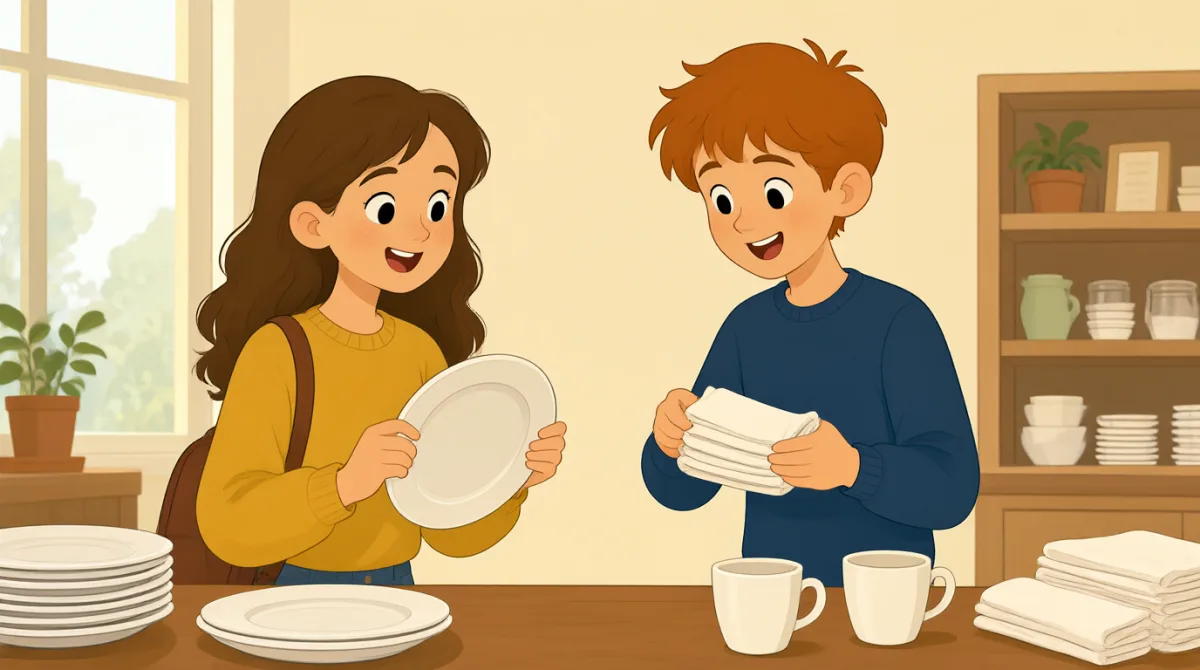

We still need plates, cups, and napkins for the party.

The paper plates are over here. How many guests are coming?
About twenty. Let's get one plate for each person, plus a few extra.
These cups come in a pack of twenty-four. That should be enough.
Good. Do we need small cups too, or are these fine for every drink?
These are fine. Let's get one pack and two packs of napkins.
There are two kinds of plates. The stronger ones cost a little more.
Let's take those. They won't bend when people put food on them.
Vocabulary8
- How many guests are coming?
This asks how many people will attend an event. Use “How many guests are coming?” to plan food, seats, or supplies.
- one plate for each person
This means every person gets one plate. You can use “one [thing] for each person” when planning supplies for a group.
- a few extra
This means a small number more than you need. Use it when you want to have some spares.
- come in a pack of twenty-four
This means there are twenty-four items in one package. Use “come in a pack of [number]” to describe how products are sold.
- That should be enough.
This means you think there is enough of something. Use it when deciding how much to buy or bring.
- are these fine for every drink?
This asks whether the cups are suitable for all kinds of drinks. You can use “Are these fine for…?” to check if something will work for a purpose.
- Let's take those.
This is a simple way to decide to buy or choose something. Use “Let's take those” when you and another person agree on an option.
- They won't bend
This means the plates will stay firm and not fold under pressure. Use “won't” to say that something will not happen in the future.
Key Sentences8
- 1
We still need plates, cups, and napkins for the party.
This sentence says what items are still needed. Reuse “We still need…” to list things you have not bought or prepared yet.
- 2
How many guests are coming?
This is a useful question when planning for an event. Replace “guests” with another plural noun to ask how many people or items there will be.
- 3
Let's get one plate for each person, plus a few extra.
This explains how many plates to buy, including some spares. Reuse “one [item] for each person, plus a few extra” when planning supplies.
- 4
These cups come in a pack of twenty-four.
This gives the number of cups in one package. Replace “twenty-four” with the number shown on another product.
- 5
That should be enough.
This is a short way to say that you think the amount is sufficient. Use it when agreeing that a quantity will meet your needs.
- 6
Do we need small cups too, or are these fine for every drink?
This asks whether another type is needed or if the current cups will work. Reuse “Do we need… too, or are these fine for…?” to compare options.
- 7
Let's take those.
This expresses a decision to choose or buy something. Use “Let's take…” to suggest an option you both prefer.
- 8
They won't bend when people put food on them.
This explains why the stronger plates are a good choice. Use “They won't…” to describe a useful result you expect in the future.