A Day by the Sea
Mia tells Emma about the things she did on vacation, from walking along the beach to trying local food.
Dialogue8
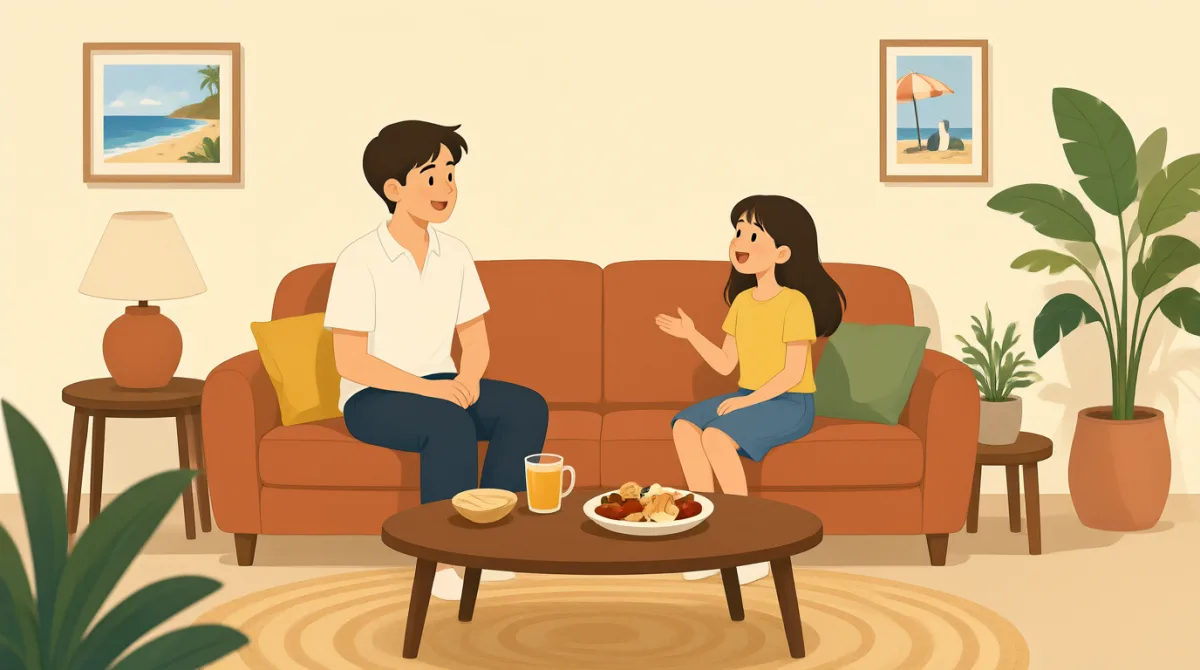

What did you do on your first day at the coast?

I walked along the beach and watched the waves.
That sounds lovely. Did you go swimming, too?
No, the water was too cold, so I just put my feet in.
What else did you do during your trip?
I visited a small market and bought a few snacks.
Did you try any local food while you were there?
Yes, I had fresh fish and a bowl of seafood soup.
Vocabulary8
- walked along the beach
This means you walked beside the sea on the sand. Use “walked along” to say you moved beside something.
- watched the waves
This means you looked at the water as it moved toward the shore. You can use “watched” for something you looked at for a while.
- put my feet in
This means Mia put her feet into the water but did not go swimming. Use this phrase when you dip just part of your body into water.
- a small market
This is a little place where people buy and sell food or other things. You can use “a small” before a singular noun to describe its size.
- bought a few snacks
This means Mia purchased some small foods to eat between meals. Use “a few” with plural things when you mean a small number.
- local food
This means food that is common in the place you are visiting. You can ask about it when you travel.
- fresh fish
This means fish that is recently caught or prepared. You can use “fresh” to describe food that is not old.
- seafood soup
This is soup made with seafood, such as fish or shellfish. You can use this phrase to name a kind of soup.
Key Sentences8
- 1
What did you do on your first day at the coast?
This is a useful question for asking about someone's activities during a trip. Change “your first day” to another time, such as “your last day.”
- 2
I walked along the beach and watched the waves.
This describes two past activities in one sentence. Use “I [past activity] and [past activity]” to talk about things you did.
- 3
Did you go swimming, too?
This is a simple way to ask if someone did an activity as well. Replace “go swimming” with another activity, such as “go shopping.”
- 4
No, the water was too cold, so I just put my feet in.
This explains why Mia did not swim and what she did instead. Use “too [adjective], so…” to give a reason and result.
- 5
What else did you do during your trip?
Use this question to ask about more activities someone did. “What else” is a helpful way to continue a conversation.
- 6
I visited a small market and bought a few snacks.
This sentence gives two examples of things Mia did on her trip. Use the simple past to describe completed activities.
- 7
Did you try any local food while you were there?
This is a useful question about food someone tried during a visit. Replace “local food” with a dish or drink to ask about something specific.
- 8
Yes, I had fresh fish and a bowl of seafood soup.
This is a natural way to say what you ate. Use “I had” followed by foods or drinks when talking about a meal.