Checking Your Suitcase
スーツケースを預ける
Emma puts her suitcase on the scale. The agent checks the bag and sends it away.
エマはスーツケースをはかりに載せます。係員が荷物を確認して、預けます。
会話7
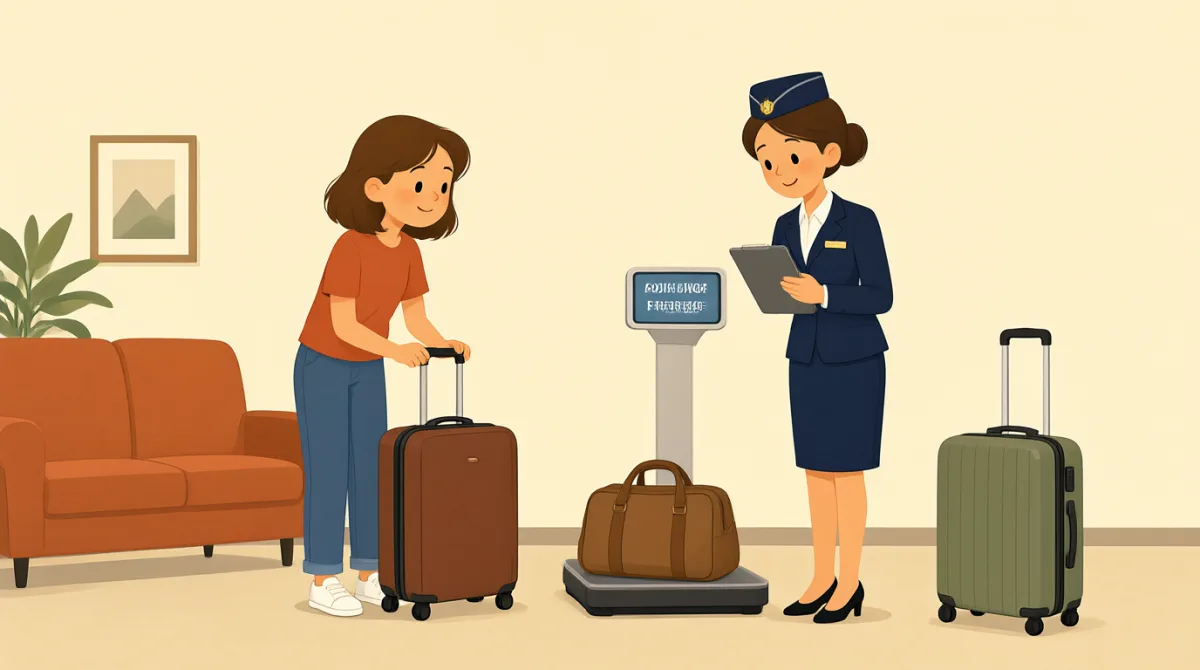

Please put your suitcase on the scale.
スーツケースをはかりに載せてください。

Okay. Is it too heavy?
わかりました。重すぎますか?
No, it’s fine. I’ll tag your bag.
いいえ、大丈夫です。荷物にタグを付けますね。
Thank you. Can I take this bag now?
ありがとうございます。このバッグは今、持っていってもいいですか?
Please take your small bag with you.
小さいバッグはお手元にお持ちください。
Okay. Where does my suitcase go?
わかりました。スーツケースはどこに行くんですか?
It goes on the plane. You’re all set.
飛行機に載せます。これで手続きは完了です。
語彙7
- suitcaseスーツケース
A large bag for clothes and things you take when you travel.
旅行のときに、服や持ち物を入れて持っていく大きなかばんです。
- scaleはかり
A machine that shows how heavy something is.
物の重さを表示する機械です。
- too heavy重すぎる
Heavier than the allowed weight. You can ask, “Is it too heavy?”
決められた重量を超えて重いことです。“Is it too heavy?”(重すぎますか?)と尋ねることができます。
- tag your bag荷物にタグを付ける
Put a label on your bag so it can be sent to the right place.
荷物が正しい場所に送られるように、荷物に札を付けることです。
- take this bagこのバッグを持っていく
Carry or bring this bag with you.
このバッグを携帯したり、持参したりすることです。
- small bag小さいバッグ
A little bag you can keep with you when you travel.
旅行中、自分で持っておける小さなバッグです。
- all set準備完了
Ready to go or finished with what you need to do.
出発の準備ができている、または必要なことが終わっている状態です。
重要な文8
- 1
Please put your suitcase on the scale.
スーツケースをはかりに載せてください。
Use this polite sentence to ask someone to place a bag or another item on a scale.
荷物などをはかりに載せてもらうときに使う、丁寧な表現です。
- 2
Is it too heavy?
重すぎますか?
Use this question to check if something weighs more than allowed. You can also ask, “Is my bag too heavy?”
物の重さが規定を超えているか確認するときに使う質問です。“Is my bag too heavy?”(私のバッグは重すぎますか?)と聞くこともできます。
- 3
No, it’s fine.
いいえ、大丈夫です。
Use this short reply to say there is no problem. You can also say, “Yes, it’s fine.”
問題ないことを伝える短い返事です。“Yes, it’s fine.”(はい、大丈夫です。)と言うこともできます。
- 4
I’ll tag your bag.
荷物にタグを付けますね。
Use “I’ll” plus an action to say what you will do next. For example, “I’ll check your ticket.”
“I’ll” の後に行動を表す言葉を続けると、これから何をするか伝えられます。たとえば、“I’ll check your ticket.”(チケットを確認しますね。)と言えます。
- 5
Can I take this bag now?
このバッグは今、持っていってもいいですか?
Use this polite question to ask if you can take something with you now. Change “this bag” to another item.
今、何かを持っていってもよいか尋ねる丁寧な表現です。“this bag” を別の持ち物に置き換えて使えます。
- 6
Please take your small bag with you.
小さいバッグはお手元にお持ちください。
Use this polite instruction to tell someone to bring an item along. You can change “small bag” to another thing.
物を持っていくよう伝える丁寧な表現です。“small bag” を別の物に置き換えられます。
- 7
Where does my suitcase go?
スーツケースはどこに行くんですか?
Use this question to ask where something should go. You can replace “my suitcase” with another item.
物をどこに置くのか尋ねるときに使う質問です。“my suitcase” を別の物に置き換えられます。
- 8
It goes on the plane.
飛行機に載せます。
Use this sentence to say where something goes. Replace “the plane” with another place, such as “the table.”
物がどこに行くのかを伝える文です。“the plane” を “the table”(テーブル)など、別の場所に置き換えられます。