Looking at Vacation Photos
Urlaubsfotos anschauen
Mia shows Emma photos from her vacation and describes a few of them. Emma asks questions about the places and people in the pictures.
Mia zeigt Emma Fotos von ihrem Urlaub und beschreibt einige davon. Emma stellt Fragen zu den Orten und Menschen auf den Bildern.
Dialog9
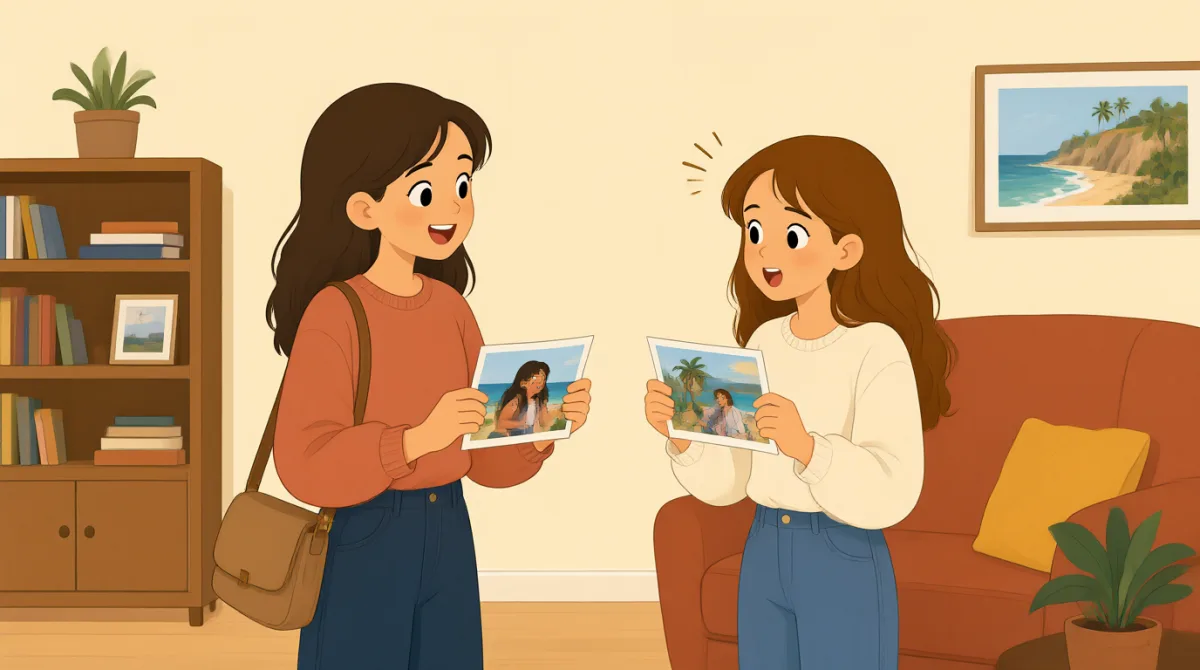

Look at these vacation photos! I took them on the coast.
Schau dir diese Urlaubsfotos an! Ich habe sie an der Küste gemacht.

This one is beautiful. Is that the beach you walked along?
Das hier ist wunderschön. Ist das der Strand, an dem du entlanggelaufen bist?
Yes, it is. The water was so blue, and the beach was quiet.
Ja, genau. Das Wasser war so blau und der Strand war ruhig.
And what’s that little building behind you?
Und was ist das für ein kleines Gebäude hinter dir?
It’s a small café near the beach. I had lunch there one day.
Das ist ein kleines Café in der Nähe des Strands. Ich habe dort eines Tages zu Mittag gegessen.
Did you take this photo in the town square?
Hast du dieses Foto auf dem Marktplatz gemacht?
Yes. I liked the colorful houses and the little market there.
Ja. Mir haben die bunten Häuser und der kleine Markt dort gefallen.
Who’s in this last picture with you?
Wer ist auf diesem letzten Foto mit dir?
That’s a local shop owner. She helped me find a nice souvenir.
Das ist eine Ladenbesitzerin aus der Gegend. Sie hat mir geholfen, ein schönes Souvenir zu finden.
Wortschatz7
- on the coastan der Küste
This means in an area next to the sea. Use it to say where a place or vacation was.
Das bedeutet, dass etwas in einem Gebiet am Meer liegt. Verwende den Ausdruck, um zu sagen, wo ein Ort liegt oder wo du Urlaub gemacht hast.
- walked alongentlanggelaufen
This means moved on foot beside something, such as a beach. Use it to describe a walk in the past.
Das bedeutet, zu Fuß an etwas entlanggegangen zu sein, zum Beispiel an einem Strand. Verwende den Ausdruck, um einen Spaziergang in der Vergangenheit zu beschreiben.
- behind youhinter dir
This means at the back of you. Use it to ask about or describe where something is in a photo.
Das bedeutet, dass sich etwas hinter deinem Rücken befindet. Verwende den Ausdruck, um zu fragen oder zu beschreiben, wo etwas auf einem Foto ist.
- near the beachin der Nähe des Strands
This means close to the beach. Use it to describe where a place is.
Das bedeutet, dass etwas nicht weit vom Strand entfernt ist. Verwende den Ausdruck, um zu beschreiben, wo sich ein Ort befindet.
- town squareMarktplatz
This is an open public area in the center of a town. Use it when talking about a place you visited.
Das ist ein öffentlicher, offener Platz im Zentrum eines Ortes. Verwende das Wort, wenn du über einen Ort sprichst, den du besucht hast.
- local shop ownerLadenbesitzerin aus der Gegend
This means a person who owns a shop in the area. Use it to describe someone you met while traveling.
Damit ist eine Person gemeint, der ein Geschäft in der Gegend gehört. Verwende den Ausdruck, um jemanden zu beschreiben, den du auf einer Reise kennengelernt hast.
- find a nice souvenirein schönes Souvenir finden
This means locate a good item to remember a trip by. Use it when talking about shopping for a travel keepsake.
Das bedeutet, einen passenden Gegenstand zu finden, der dich an eine Reise erinnert. Verwende den Ausdruck, wenn du davon erzählst, dass du nach einem Andenken gesucht hast.
Wichtige Sätze7
- 1
Look at these vacation photos!
Schau dir diese Urlaubsfotos an!
Use this to show someone pictures from a trip. You can replace “vacation photos” with another thing you want someone to look at.
Damit zeigst du jemandem Bilder von einer Reise. Du kannst “vacation photos” durch etwas anderes ersetzen, das sich die Person ansehen soll.
- 2
Is that the beach you walked along?
Ist das der Strand, an dem du entlanggelaufen bist?
This is a useful way to ask if you recognize a place in a photo. You can change “the beach” to another place.
Mit dieser Frage kannst du herausfinden, ob du einen Ort auf einem Foto richtig erkennst. Du kannst “the beach” durch einen anderen Ort ersetzen.
- 3
The water was so blue, and the beach was quiet.
Das Wasser war so blau und der Strand war ruhig.
This sentence describes what a place was like in the past. You can use the pattern “It was so [adjective], and it was [adjective]” to describe a trip.
Dieser Satz beschreibt, wie ein Ort früher war. Mit dem Muster “It was so [adjective], and it was [adjective]” kannst du beschreiben, wie eine Reise war.
- 4
It’s a small café near the beach.
Das ist ein kleines Café in der Nähe des Strands.
Use this to identify a place and say where it is. You can replace “a small café” and “near the beach” with other details.
Verwende diesen Satz, um einen Ort zu benennen und zu sagen, wo er liegt. Du kannst “a small café” und “near the beach” durch andere Angaben ersetzen.
- 5
I had lunch there one day.
Ich habe dort eines Tages zu Mittag gegessen.
This is a simple way to say what you did at a place during a trip. Replace “lunch” with another activity or meal.
So kannst du einfach sagen, was du während einer Reise an einem bestimmten Ort gemacht hast. Ersetze “lunch” durch eine andere Aktivität oder Mahlzeit.
- 6
Did you take this photo in the town square?
Hast du dieses Foto auf dem Marktplatz gemacht?
Use this question to ask where someone took a photo. Change “the town square” to another possible location.
Mit dieser Frage kannst du fragen, wo jemand ein Foto gemacht hat. Ersetze “the town square” durch einen anderen möglichen Ort.
- 7
She helped me find a nice souvenir.
Sie hat mir geholfen, ein schönes Souvenir zu finden.
This explains how someone helped you during a trip. You can reuse “helped me find” with other things, such as a café or a bus stop.
Damit erklärst du, wie dir jemand während einer Reise geholfen hat. Du kannst “helped me find” auch mit anderen Dingen verwenden, zum Beispiel einem Café oder einer Bushaltestelle.