Taking the Card and Cash
Karte und Bargeld nehmen
Emma takes her cash and card from the ATM. Grace reminds her to check that she has both.
Emma nimmt ihr Bargeld und ihre Karte aus dem Geldautomaten. Grace erinnert sie daran, zu prüfen, ob sie beides hat.
Dialog7
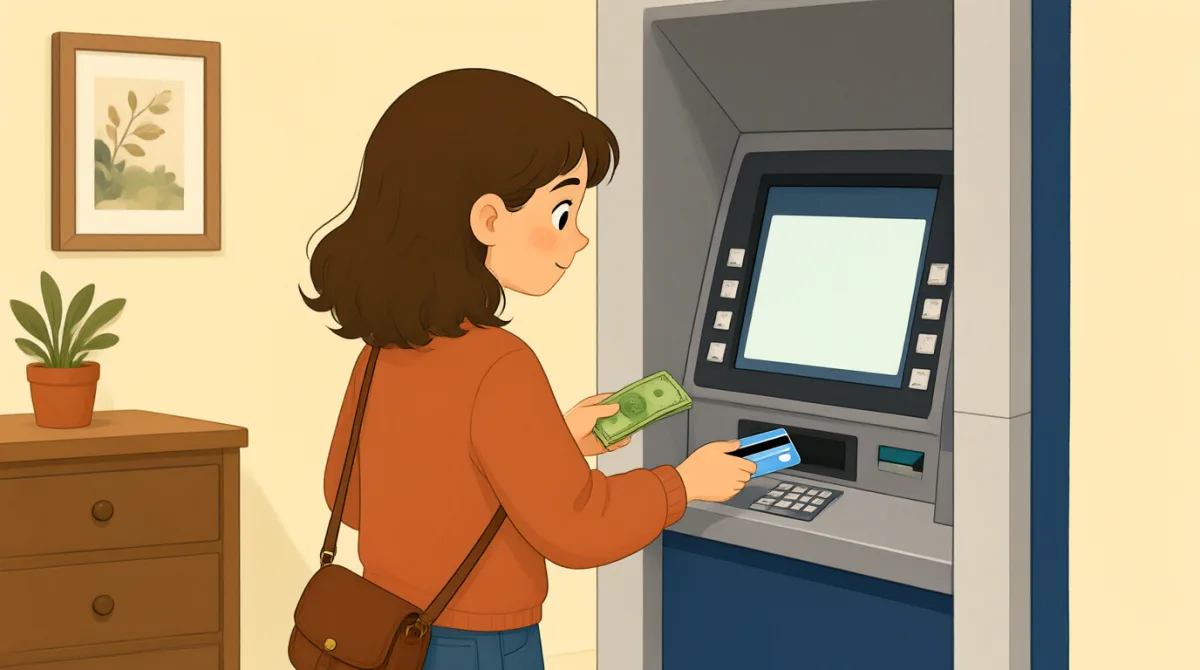

The screen says, “Take your card.”
Auf dem Bildschirm steht: „Nehmen Sie Ihre Karte.“

Take your card from the slot first.
Nimm zuerst deine Karte aus dem Schlitz.
Okay. Now I hear the cash.
Okay. Jetzt höre ich das Geld.
Take the cash from the lower slot.
Nimm das Geld aus dem unteren Schlitz.
I have my cash. Is that all?
Ich habe mein Geld. Ist das alles?
Check your card and cash before you go.
Überprüf deine Karte und dein Geld, bevor du gehst.
I have both. Thank you for your help!
Ich habe beides. Danke für deine Hilfe!
Wortschatz8
- Take your cardNimm deine Karte
This means remove your card from the ATM. Use “Take your [thing]” to tell someone to pick something up.
Das bedeutet, dass du deine Karte aus dem Geldautomaten nehmen sollst. Mit „Take your [thing]“ sagst du jemandem, er soll etwas nehmen.
- from the slotaus dem Schlitz
The slot is the narrow opening where the ATM gives you your card or cash. Use “from the slot” to say where to take something from.
Der Schlitz ist die schmale Öffnung, aus der der Geldautomat deine Karte oder dein Geld ausgibt. Mit „from the slot“ sagst du, woher etwas genommen werden soll.
- the cashdas Geld
Cash means money in notes or coins. Here, it means the money the ATM gives Emma.
„Cash“ bedeutet Bargeld, also Geldscheine oder Münzen. Hier ist damit das Geld gemeint, das der Geldautomat Emma ausgibt.
- lower slotunterer Schlitz
The lower slot is the opening near the bottom of the ATM. Use “lower” to describe something that is below another thing.
Der untere Schlitz ist die Öffnung weiter unten am Geldautomaten. Mit „lower“ beschreibst du etwas, das sich unter etwas anderem befindet.
- Is that all?Ist das alles?
This is a way to ask if there is anything more to do or take. You can use it when you think a task may be finished.
So fragst du, ob es noch etwas zu tun oder mitzunehmen gibt. Du kannst das sagen, wenn du denkst, dass eine Aufgabe vielleicht erledigt ist.
- check your card and cashÜberprüf deine Karte und dein Geld
This means make sure you have both your card and your money. Use “check your [things]” to remind someone to make sure they have them.
Das bedeutet, dass du sicherstellen sollst, dass du sowohl deine Karte als auch dein Geld hast. Mit „check your [things]“ erinnerst du jemanden daran, sich zu vergewissern, dass er die genannten Dinge dabeihat.
- I have both.Ich habe beides.
This means Emma has her card and her cash. Use “I have both” when you have two things that someone mentioned.
Das bedeutet, dass Emma ihre Karte und ihr Geld hat. „I have both“ kannst du sagen, wenn du zwei Dinge hast, die gerade erwähnt wurden.
- Thank you for your help!Danke für deine Hilfe!
This is a polite way to thank someone who helped you. You can use it after someone gives you advice or assistance.
Das ist eine höfliche Art, jemandem für seine Hilfe zu danken. Du kannst es sagen, nachdem dir jemand einen Rat gegeben oder geholfen hat.
Wichtige Sätze8
- 1
The screen says, “Take your card.”
Auf dem Bildschirm steht: „Nehmen Sie Ihre Karte.“
Use this sentence to report what a screen or sign tells you. You can replace “Take your card” with another short message.
Mit diesem Satz gibst du wieder, was auf einem Bildschirm oder Schild steht. „Take your card“ kannst du durch eine andere kurze Nachricht ersetzen.
- 2
Take your card from the slot first.
Nimm zuerst deine Karte aus dem Schlitz.
This is a simple instruction that tells someone what to do and where to do it. Use “Take your [thing] from [place] first” to give a first step.
Das ist eine einfache Anweisung, die sagt, was jemand tun und wo er es tun soll. Mit „Take your [thing] from [place] first“ gibst du den ersten Schritt an.
- 3
Now I hear the cash.
Jetzt höre ich das Geld.
Use “Now I hear…” to say what sound you notice at this moment. You can replace “the cash” with another sound or thing you hear.
Mit „Now I hear…“ sagst du, welches Geräusch du gerade wahrnimmst. „The cash“ kannst du durch ein anderes Geräusch oder etwas anderes ersetzen, das du hörst.
- 4
Take the cash from the lower slot.
Nimm das Geld aus dem unteren Schlitz.
This gives a clear instruction about what to take and where to find it. You can replace “the cash” and “the lower slot” with other items and places.
Diese Anweisung sagt klar, was du nehmen und wo du es finden sollst. „The cash“ und „the lower slot“ kannst du durch andere Dinge und Orte ersetzen.
- 5
I have my cash.
Ich habe mein Geld.
Use this sentence to say that you have your money. You can replace “my cash” with another thing you have.
Mit diesem Satz sagst du, dass du dein Geld dabeihast. „My cash“ kannst du durch etwas anderes ersetzen, das du hast.
- 6
Is that all?
Ist das alles?
This short question checks whether there is anything more to do. Use it when you want to know if a task is complete.
Mit dieser kurzen Frage prüfst du, ob noch etwas zu tun ist. Verwende sie, wenn du wissen möchtest, ob eine Aufgabe erledigt ist.
- 7
Check your card and cash before you go.
Überprüf deine Karte und dein Geld, bevor du gehst.
This is a useful reminder to make sure you have important things before leaving. Replace “your card and cash” with other things you need to check.
Das ist eine hilfreiche Erinnerung, vor dem Weggehen sicherzustellen, dass du wichtige Dinge dabeihast. „Your card and cash“ kannst du durch andere Dinge ersetzen, die du überprüfen musst.
- 8
I have both.
Ich habe beides.
Use this sentence to say that you have two things that were just mentioned. It is a short, natural answer when someone asks you to check for both.
Mit diesem Satz sagst du, dass du zwei Dinge hast, die gerade erwähnt wurden. Das ist eine kurze, natürliche Antwort, wenn dich jemand bittet, beides zu überprüfen.