Taking the Card and Cash
Recoger la tarjeta y el dinero
Emma takes her cash and card from the ATM. Grace reminds her to check that she has both.
Emma recoge el dinero y la tarjeta del cajero automático. Grace le recuerda que compruebe que tiene las dos cosas.
Diálogo7
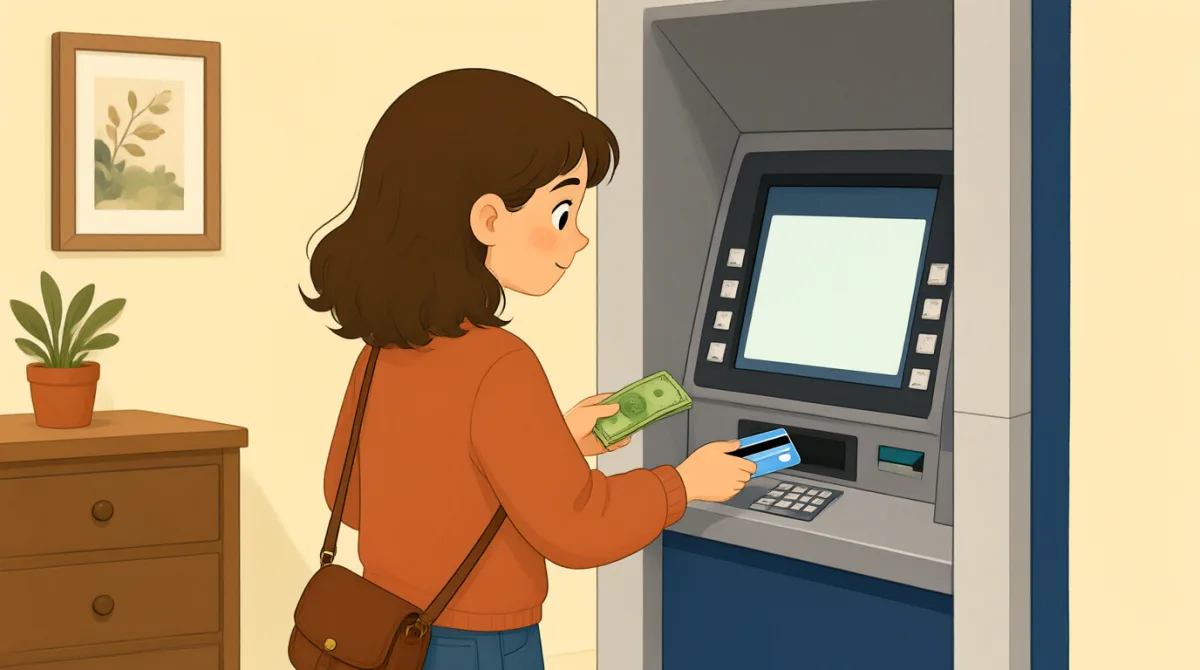

The screen says, “Take your card.”
La pantalla dice: «Retire su tarjeta».

Take your card from the slot first.
Primero, saca la tarjeta de la ranura.
Okay. Now I hear the cash.
Vale. Ahora oigo el dinero.
Take the cash from the lower slot.
Saca el dinero de la ranura de abajo.
I have my cash. Is that all?
Ya tengo el dinero. ¿Eso es todo?
Check your card and cash before you go.
Comprueba que tienes la tarjeta y el dinero antes de irte.
I have both. Thank you for your help!
Tengo las dos cosas. ¡Gracias por ayudarme!
Vocabulario8
- Take your cardTake your card (retira tu tarjeta)
This means remove your card from the ATM. Use “Take your [thing]” to tell someone to pick something up.
Significa sacar la tarjeta del cajero automático. Usa “Take your [thing]” para decirle a alguien que recoja algo.
- from the slotfrom the slot (de la ranura)
The slot is the narrow opening where the ATM gives you your card or cash. Use “from the slot” to say where to take something from.
La ranura es la abertura estrecha por donde el cajero automático te da la tarjeta o el dinero. Usa “from the slot” para indicar de dónde hay que sacar algo.
- the cashthe cash (el dinero en efectivo)
Cash means money in notes or coins. Here, it means the money the ATM gives Emma.
“Cash” significa dinero en billetes o monedas. Aquí se refiere al dinero que el cajero automático le da a Emma.
- lower slotlower slot (ranura de abajo)
The lower slot is the opening near the bottom of the ATM. Use “lower” to describe something that is below another thing.
La ranura de abajo es la abertura que está cerca de la parte inferior del cajero automático. Usa “lower” para describir algo que está más abajo que otra cosa.
- Is that all?Is that all? (¿Eso es todo?)
This is a way to ask if there is anything more to do or take. You can use it when you think a task may be finished.
Es una forma de preguntar si queda algo más por hacer o recoger. Puedes usarla cuando crees que una tarea quizá ya ha terminado.
- check your card and cashcheck your card and cash (comprueba que tienes la tarjeta y el dinero)
This means make sure you have both your card and your money. Use “check your [things]” to remind someone to make sure they have them.
Significa asegurarte de que tienes tanto la tarjeta como el dinero. Usa “check your [things]” para recordarle a alguien que compruebe que tiene ciertas cosas.
- I have both.I have both. (Tengo las dos cosas.)
This means Emma has her card and her cash. Use “I have both” when you have two things that someone mentioned.
Significa que Emma tiene la tarjeta y el dinero. Usa “I have both” cuando tienes dos cosas que alguien acaba de mencionar.
- Thank you for your help!Thank you for your help! (¡Gracias por ayudarme!)
This is a polite way to thank someone who helped you. You can use it after someone gives you advice or assistance.
Es una forma educada de dar las gracias a alguien que te ha ayudado. Puedes usarla después de que alguien te dé un consejo o te ayude.
Frases clave8
- 1
The screen says, “Take your card.”
La pantalla dice: «Retira tu tarjeta».
Use this sentence to report what a screen or sign tells you. You can replace “Take your card” with another short message.
Usa esta frase para contar lo que te indica una pantalla o un letrero. Puedes sustituir “Take your card” por otro mensaje breve.
- 2
Take your card from the slot first.
Primero, saca la tarjeta de la ranura.
This is a simple instruction that tells someone what to do and where to do it. Use “Take your [thing] from [place] first” to give a first step.
Es una instrucción sencilla que dice qué hacer y dónde hacerlo. Usa “Take your [thing] from [place] first” para indicar el primer paso.
- 3
Now I hear the cash.
Ahora oigo el dinero.
Use “Now I hear…” to say what sound you notice at this moment. You can replace “the cash” with another sound or thing you hear.
Usa “Now I hear…” para decir qué sonido notas en este momento. Puedes sustituir “the cash” por otro sonido o cosa que oigas.
- 4
Take the cash from the lower slot.
Saca el dinero de la ranura de abajo.
This gives a clear instruction about what to take and where to find it. You can replace “the cash” and “the lower slot” with other items and places.
Esta frase da una instrucción clara sobre qué recoger y dónde encontrarlo. Puedes sustituir “the cash” y “the lower slot” por otros objetos y lugares.
- 5
I have my cash.
Ya tengo el dinero.
Use this sentence to say that you have your money. You can replace “my cash” with another thing you have.
Usa esta frase para decir que tienes tu dinero. Puedes sustituir “my cash” por otra cosa que tengas.
- 6
Is that all?
¿Eso es todo?
This short question checks whether there is anything more to do. Use it when you want to know if a task is complete.
Esta pregunta breve sirve para comprobar si queda algo más por hacer. Úsala cuando quieras saber si una tarea ya está terminada.
- 7
Check your card and cash before you go.
Comprueba que tienes la tarjeta y el dinero antes de irte.
This is a useful reminder to make sure you have important things before leaving. Replace “your card and cash” with other things you need to check.
Es un recordatorio útil para asegurarte de que tienes las cosas importantes antes de irte. Sustituye “your card and cash” por otras cosas que debas comprobar.
- 8
I have both.
Tengo las dos cosas.
Use this sentence to say that you have two things that were just mentioned. It is a short, natural answer when someone asks you to check for both.
Usa esta frase para decir que tienes dos cosas que acaban de mencionar. Es una respuesta breve y natural cuando alguien te pide comprobar que tienes ambas.