Asking About the Day
Nach dem Tag fragen
Emma greets her child, Leo, and asks about his day at school. He tells her what he did.
Emma begrüßt ihr Kind Leo und fragt ihn, wie sein Schultag war. Er erzählt ihr, was er gemacht hat.
Dialog8
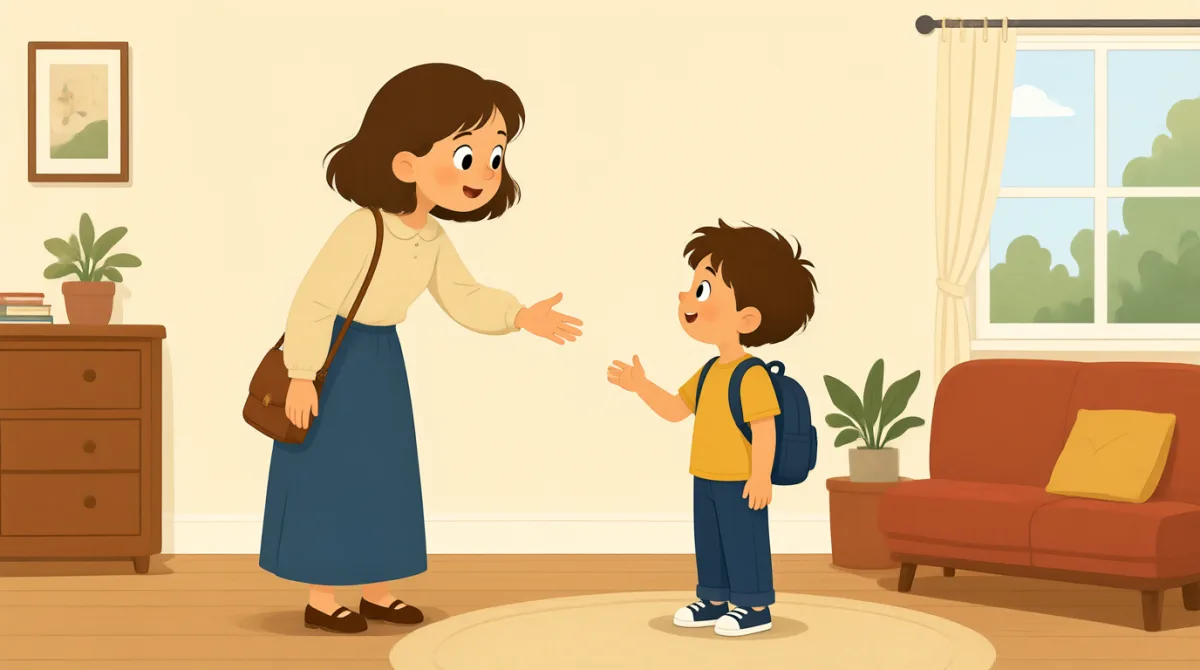

Hi, Leo! How was school today?
Hallo, Leo! Wie war die Schule heute?

It was good! We read a fun story.
Gut! Wir haben eine lustige Geschichte gelesen.
That sounds nice. What else did you do?
Das klingt schön. Was hast du sonst noch gemacht?
We drew pictures and played outside.
Wir haben Bilder gemalt und draußen gespielt.
What did you draw?
Was hast du gemalt?
I drew a big blue dog.
Ich habe einen großen blauen Hund gemalt.
Great! Are you hungry now?
Toll! Hast du jetzt Hunger?
Yes. Can we have a snack?
Ja. Können wir einen Snack essen?
Wortschatz7
- How was school today?Wie war die Schule heute?
This is a friendly way to ask about someone's school day. You can change “school” to another place or activity.
Das ist eine freundliche Art, nach dem Schultag einer Person zu fragen. Du kannst „school“ durch einen anderen Ort oder eine Aktivität ersetzen.
- It was good!Es war gut!
This is a simple way to say that something went well. You can use it to answer questions about your day or an event.
So kannst du einfach sagen, dass etwas gut gelaufen ist. Du kannst damit Fragen zu deinem Tag oder einem Ereignis beantworten.
- read a fun storyeine lustige Geschichte lesen
This means to look at and understand a story that is enjoyable. You can say “read a fun book” or “read a fun story” to talk about reading.
Damit ist gemeint, eine unterhaltsame Geschichte anzuschauen und zu verstehen. Beim Lesen kannst du „read a fun book“ oder „read a fun story“ sagen.
- What else did you do?Was hast du sonst noch gemacht?
Use this question to ask about more activities. You can replace “do” with another action, such as “What else did you see?”
Mit dieser Frage erkundigst du dich nach weiteren Aktivitäten. Du kannst „do“ durch eine andere Handlung ersetzen, zum Beispiel in „What else did you see?“.
- played outsidedraußen gespielt
This means to play outdoors, not inside a building. You can use it to talk about where you played.
Das bedeutet, im Freien und nicht in einem Gebäude zu spielen. Du kannst damit sagen, wo du gespielt hast.
- Are you hungry now?Hast du jetzt Hunger?
This is a way to ask if someone wants food at this time. You can change “hungry” to another feeling, such as “tired”.
So fragst du, ob jemand gerade etwas essen möchte. Du kannst „hungry“ durch ein anderes Gefühl ersetzen, zum Beispiel „tired“.
- have a snackeinen Snack essen
A snack is a small amount of food between meals. You can use “have a snack” to ask or talk about eating one.
Ein Snack ist eine kleine Zwischenmahlzeit. Mit „have a snack“ kannst du fragen, ob jemand eine Kleinigkeit essen möchte, oder davon erzählen.
Wichtige Sätze8
- 1
Hi, Leo! How was school today?
Hallo, Leo! Wie war die Schule heute?
This is a warm greeting and an easy way to ask about someone's day. Use “How was [place or activity] today?” to ask about another experience.
Das ist eine herzliche Begrüßung und eine einfache Art, nach dem Tag einer Person zu fragen. Mit „How was [place or activity] today?“ kannst du nach einem anderen Erlebnis fragen.
- 2
It was good! We read a fun story.
Es war gut! Wir haben eine lustige Geschichte gelesen.
This gives a simple answer and tells one thing that happened. You can use “It was [feeling]!” and add an activity you did.
Damit gibst du eine einfache Antwort und erzählst von einer Sache, die passiert ist. Du kannst „It was [feeling]!“ sagen und eine Aktivität hinzufügen, die du gemacht hast.
- 3
That sounds nice.
Das klingt schön.
This is a friendly response when someone tells you about something pleasant. You can use it to show interest in their news.
Das ist eine freundliche Reaktion, wenn dir jemand etwas Schönes erzählt. Damit zeigst du Interesse an dem, was die Person berichtet.
- 4
What else did you do?
Was hast du sonst noch gemacht?
Use this question to invite someone to share another activity. You can ask it after they tell you one thing they did.
Mit dieser Frage kannst du jemanden dazu einladen, von einer weiteren Aktivität zu erzählen. Du kannst sie stellen, nachdem die Person erzählt hat, was sie gemacht hat.
- 5
We drew pictures and played outside.
Wir haben Bilder gemalt und draußen gespielt.
This sentence names two past activities. You can use “We [past action] and [past action]” to describe things you did with a group.
Dieser Satz nennt zwei Aktivitäten in der Vergangenheit. Mit „We [past action] and [past action]“ kannst du beschreiben, was du mit einer Gruppe gemacht hast.
- 6
What did you draw?
Was hast du gemalt?
This asks someone to say what they made with a pencil, crayons, or paint. You can use “What did you [action]?” to ask about a past activity.
Damit fragst du jemanden, was die Person mit einem Bleistift, Buntstiften oder Farbe gemacht hat. Mit „What did you [action]?“ kannst du nach einer vergangenen Aktivität fragen.
- 7
Are you hungry now?
Hast du jetzt Hunger?
This asks about someone's feeling at the present time. Use “Are you [feeling] now?” to ask how someone feels.
Damit fragst du, wie sich jemand gerade fühlt. Mit „Are you [feeling] now?“ kannst du fragen, wie es jemandem geht.
- 8
Yes. Can we have a snack?
Ja. Können wir einen Snack essen?
This is a simple way to say yes and politely ask for something to eat. You can use “Can we have [food]?” to ask for food or a drink.
So kannst du einfach zustimmen und höflich um etwas zu essen bitten. Mit „Can we have [food]?“ kannst du nach Essen oder einem Getränk fragen.