Paying at the Register
An der Kasse bezahlen
Emma pays for her school supplies at the register. Grace helps her pack everything.
Emma bezahlt ihre Schulsachen an der Kasse. Grace hilft ihr, alles einzupacken.
Dialog8
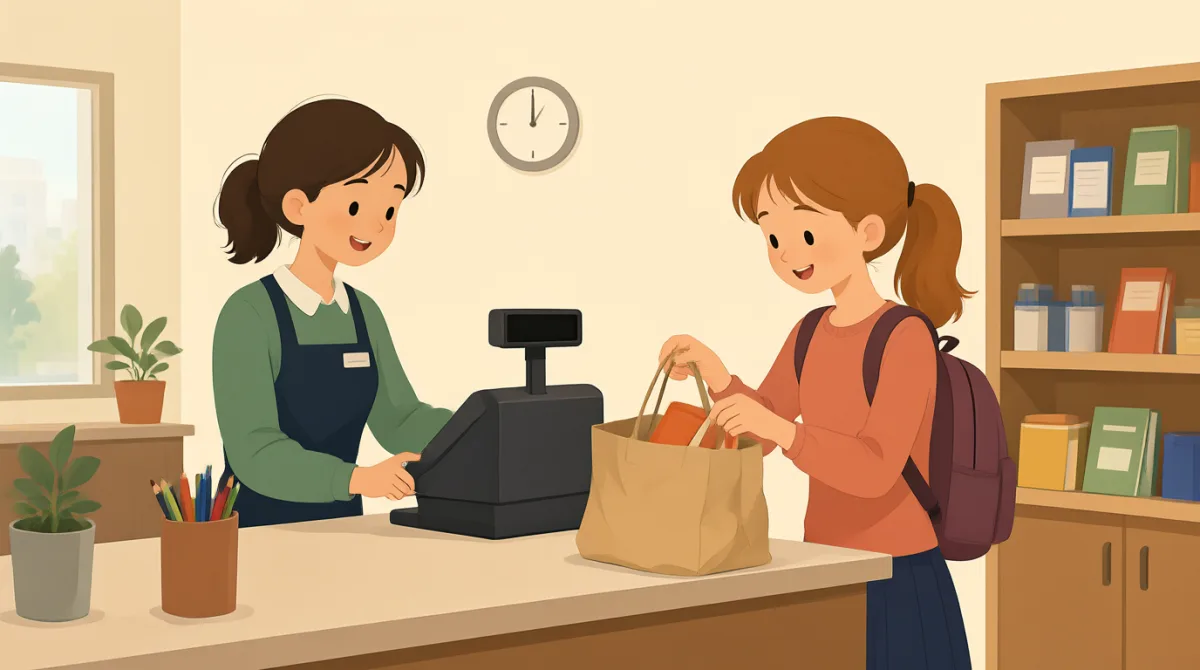

Is this everything on my school list?
Ist das alles, was auf meiner Schulliste steht?

Yes. We have notebooks, pens, and a backpack.
Ja. Wir haben Hefte, Stifte und einen Rucksack.

Your total is twenty-five dollars.
Das macht insgesamt fünfundzwanzig Dollar.
Can I pay by card?
Kann ich mit Karte bezahlen?
Sure. Please tap your card here.
Natürlich. Halten Sie Ihre Karte bitte hier dran.
Okay. Is the payment done?
Okay. Ist die Zahlung abgeschlossen?
Yes, you're all set.
Ja, alles erledigt.
Let's put everything in your backpack.
Lass uns alles in deinen Rucksack packen.
Wortschatz8
- school listSchulliste
A list of things you need for school. You can say “my school list” when you talk about supplies to buy.
Eine Liste mit Dingen, die du für die Schule brauchst. Wenn du über Schulsachen sprichst, die du kaufen möchtest, kannst du „my school list“ (meine Schulliste) sagen.
- notebooksHefte
Books with blank or lined pages for writing. You can say “I need notebooks” when shopping for school.
Bücher mit leeren oder linierten Seiten zum Schreiben. Wenn du Schulsachen einkaufst, kannst du sagen: „I need notebooks“ (Ich brauche Hefte).
- totalGesamtbetrag
The full amount of money you need to pay. You can ask, “What is the total?” at a store.
Der gesamte Geldbetrag, den du bezahlen musst. Im Geschäft kannst du fragen: „What is the total?“ (Wie hoch ist der Gesamtbetrag?).
- pay by cardmit Karte bezahlen
To use a bank card to pay for something. You can ask, “Can I pay by card?” when you are ready to pay.
Etwas mit einer Bankkarte bezahlen. Wenn du an der Kasse bezahlen möchtest, kannst du fragen: „Can I pay by card?“ (Kann ich mit Karte bezahlen?).
- tap your carddie Karte dranhalten
To touch your card to the payment machine to pay. You may hear this instruction at a store.
Die Karte an das Kartenlesegerät halten, um zu bezahlen. Diese Aufforderung hörst du vielleicht in einem Geschäft.
- paymentZahlung
The act of paying for something. You can ask, “Is the payment done?” to check that it worked.
Der Vorgang, für etwas zu bezahlen. Du kannst fragen: „Is the payment done?“ (Ist die Zahlung abgeschlossen?), um zu prüfen, ob es geklappt hat.
- all setalles erledigt
Ready or finished. A cashier can say “You’re all set” when your payment is complete.
Bereit oder fertig. Eine Kassiererin oder ein Kassierer kann nach deiner Zahlung sagen: „You’re all set“ (Alles erledigt).
- put everything in your backpackalles in deinen Rucksack packen
To place all your things inside your backpack. You can use this phrase when packing your school supplies.
Alle deine Sachen in den Rucksack legen. Diese Wendung passt, wenn du deine Schulsachen einpackst.
Wichtige Sätze8
- 1
Is this everything on my school list?
Ist das alles, was auf meiner Schulliste steht?
Use this to check that you have all the things you need. You can replace “school list” with another list, such as “shopping list.”
Mit diesem Satz prüfst du, ob du alles hast, was du brauchst. Statt „school list“ kannst du auch eine andere Liste nennen, zum Beispiel „shopping list“.
- 2
We have notebooks, pens, and a backpack.
Wir haben Hefte, Stifte und einen Rucksack.
Use this to name several things you have. You can change the items to name other things in your bag or basket.
Mit diesem Satz nennst du mehrere Dinge, die ihr dabeihabt. Du kannst die Gegenstände austauschen und andere Sachen in deiner Tasche oder deinem Korb aufzählen.
- 3
Your total is twenty-five dollars.
Das macht insgesamt fünfundzwanzig Dollar.
This is a common way to tell someone how much they need to pay. You can change the amount to give a different price.
So sagt man häufig, wie viel jemand bezahlen muss. Du kannst den Betrag ändern, um einen anderen Preis zu nennen.
- 4
Can I pay by card?
Kann ich mit Karte bezahlen?
Use this to ask if a store accepts card payments. You can replace “by card” with “in cash.”
Mit diesem Satz fragst du, ob ein Geschäft Kartenzahlung akzeptiert. Statt „by card“ kannst du „in cash“ sagen.
- 5
Please tap your card here.
Halten Sie Ihre Karte bitte hier dran.
This is a polite instruction for using a card reader. You may hear it when you pay at a store.
Das ist eine höfliche Aufforderung, ein Kartenlesegerät zu benutzen. Diesen Satz hörst du vielleicht, wenn du in einem Geschäft bezahlst.
- 6
Is the payment done?
Ist die Zahlung abgeschlossen?
Use this to check whether your payment is complete. You can also ask this if you are not sure the card reader worked.
Mit diesem Satz prüfst du, ob deine Zahlung abgeschlossen ist. Du kannst auch so fragen, wenn du nicht sicher bist, ob das Kartenlesegerät funktioniert hat.
- 7
Yes, you're all set.
Ja, alles erledigt.
This is a friendly way to say that everything is finished. You may hear it from a cashier after you pay.
Das ist eine freundliche Art zu sagen, dass alles erledigt ist. Diesen Satz hörst du vielleicht nach dem Bezahlen von der Kassiererin oder dem Kassierer.
- 8
Let's put everything in your backpack.
Lass uns alles in deinen Rucksack packen.
Use “Let’s” to suggest doing something together. You can replace “put everything in your backpack” with another action.
Mit „Let’s“ schlägst du vor, etwas gemeinsam zu tun. Statt „put everything in your backpack“ kannst du eine andere Handlung einsetzen.