Asking for Change or Breaking a Bill
換零錢或破開大鈔
A person at a small shop or cafe asks the cashier if they can break a large denomination bill or provide specific change.
一個人在小商店或咖啡館詢問收銀員是否可以破開大額鈔票或提供特定零錢。
對話8
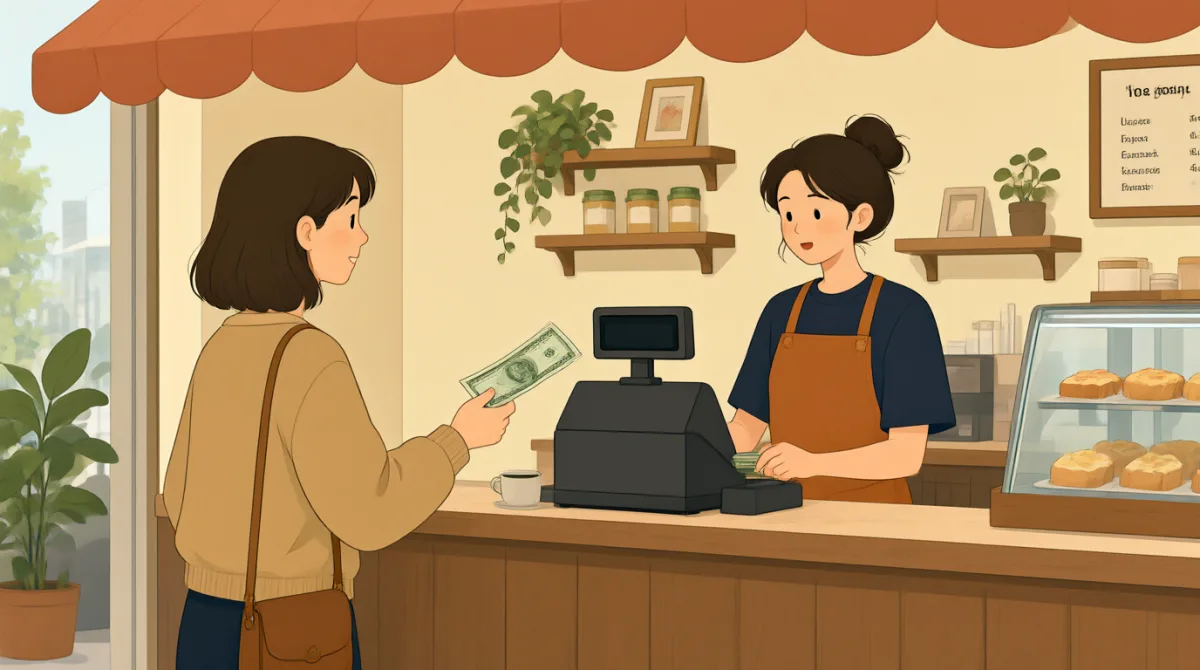

Excuse me, I just bought a coffee. Would it be possible to get some change for a larger bill?
打擾一下,我剛買了一杯咖啡。請問可以幫我把一張大額鈔票破開嗎?

Sure, no problem. What denomination is it? And how much change are you looking for?
好的,沒問題。是什麼面額的?您想要多少零錢?
It's a fifty-dollar bill. I was hoping to get some smaller bills, maybe tens or twenties, if possible.
是一張五十美元鈔票。我希望能換些小面額的,如果可以的話,最好是十美元或二十美元的。
Let me see... Yes, I can definitely do that for you. How about two twenties and a ten?
我看看……沒問題,我可以的。兩張二十的和一張十美元的怎麼樣?
That would be perfect, thank you so much!
那就太好了,非常感謝!
Here you go. Anything else I can help you with today?
給您。今天還有什麼我可以幫您的嗎?
No, that's all. Thanks again!
沒有了,就這些。再次感謝!
You're welcome. Have a great day!
不客氣。祝您愉快!
詞彙6
- change零錢
Money given back when you pay with more than the cost, or smaller coins and bills exchanged for a larger one. In this dialogue, it means breaking a large bill into smaller amounts.
指付款金額超過商品價格時找回的錢,也可以指用小面額紙幣或硬幣換開大額鈔票。在這段對話中,它指把大額鈔票換成小面額的錢。
- bill紙幣
A banknote or paper money, like a $50 bill. It's used to refer to currency notes in everyday transactions.
指紙幣,比如一張50美元鈔票。在日常交易中,人們常用這個詞來指紙幣。
- denomination面額
The value printed on a bill or coin, such as $10 or $20. It's a formal word often used in banking to ask about the amount of money.
指紙幣或硬幣上標明的金額,比如10美元或20美元。這是一個比較正式的詞,在銀行等場合常用來詢問金額。
- smaller bills小面額紙幣
Banknotes with lower values, like $10 or $20 instead of $50. Useful when you need easier-to-use money for small purchases.
面額較小的紙幣,比如10美元或20美元,而不是50美元。買小東西時,備一些小面額紙幣會更方便。
- twenties二十美元鈔票
Informal way to say $20 bills. People often shorten denominations like 'tens' for $10 bills or 'fifties' for $50 bills in casual talk.
口語中表示20美元鈔票的說法。人們常在日常交談中用類似的簡稱,比如用 “tens” 指10美元鈔票,用 “fifties” 指50美元鈔票。
- perfect正合適
Means exactly right or ideal. In responses, it's a polite way to show satisfaction, like 'That would be perfect' to agree happily.
表示恰到好處或非常理想。在回應時,這是一種禮貌地表達滿意的說法,比如用 “That would be perfect” 表示欣然接受。
關鍵句7
- 1
Excuse me, I just bought a coffee. Would it be possible to get some change for a larger bill?
打擾一下,我剛買了一杯咖啡。請問可以幫我把一張大額鈔票破開嗎?
This is a polite way to start a request. 'Would it be possible' is a soft, indirect question to ask for help without being demanding. Useful in shops when you need to exchange money after a purchase. Grammar: Conditional 'would' makes it courteous.
這是一種禮貌的開口請求方式。“Would it be possible” 是委婉、間接的問法,可以在請求幫助時避免顯得強硬。在商店買完東西后需要換零錢時很實用。語法上,使用條件式 “would” 會讓語氣更客氣。
- 2
Sure, no problem. What denomination is it? And how much change are you looking for?
好的,沒問題。是什麼面額的?您想要多少零錢?
A helpful response from service staff. 'Sure, no problem' shows willingness. 'What denomination is it?' asks for the bill's value. Useful for cashiers to clarify. The 'and' connects two questions naturally.
這是服務人員表示願意幫忙的回應。“Sure, no problem” 表示樂意幫忙。“What denomination is it?” 是在詢問鈔票的面額,收銀員可以用這句話確認情況。“And” 能自然地連線兩個問題。
- 3
It's a fifty-dollar bill. I was hoping to get some smaller bills, maybe tens or twenties, if possible.
是一張五十美元鈔票。我希望能換些小面額的,如果可以的話,最好是十美元或二十美元的。
Explains the bill and specifies the desired change. 'I was hoping' softens the request politely. 'If possible' adds courtesy. Great for specifying preferences in money exchanges. Informal abbreviations like 'tens' and 'twenties' are common in spoken English.
這句話說明了鈔票面額,也說出了想換成什麼零錢。“I was hoping” 能讓請求聽起來更委婉。“If possible” 進一步表達客氣。需要說明換零錢的偏好時,這些說法很實用。口語中常用 “tens” 和 “twenties” 來簡稱十美元和二十美元鈔票。
- 4
Let me see... Yes, I can definitely do that for you. How about two twenties and a ten?
我看看……沒問題,我可以的。兩張二十的和一張十美元的怎麼樣?
Shows checking availability then offering a solution. 'Let me see' means thinking or checking. 'How about' suggests an option politely. Useful when proposing alternatives in service situations. 'Definitely' emphasizes certainty.
先表示正在檢視是否方便,再提出解決辦法。“Let me see” 表示正在考慮或檢視。“How about” 可以用來禮貌地提出一個選項。在服務場合提出替代方案時很實用。“Definitely” 強調十分確定。
- 5
That would be perfect, thank you so much!
那就太好了,非常感謝!
Expresses strong agreement and gratitude. 'That would be' is conditional for hypothetical politeness. 'Thank you so much' intensifies thanks. Ideal for ending a positive interaction, showing appreciation in daily services.
這句話表達了欣然接受和感謝。“That would be” 用條件式表達假設,語氣更客氣。“Thank you so much” 則加強了感謝的語氣。日常服務交流中,可以用這句話表達滿意和謝意。
- 6
Here you go. Anything else I can help you with today?
給您。今天還有什麼我可以幫您的嗎?
Hands over the change and offers more help. 'Here you go' is a casual way to give something. The question invites further needs. Common in customer service to ensure satisfaction and build rapport.
這句話用於遞上零錢並詢問是否還需要其他幫助。“Here you go” 是遞東西時常用的隨和說法。後面的問題是在詢問顧客還有沒有其他需求。服務人員常用這句話確認顧客是否滿意,並增進交流。
- 7
You're welcome. Have a great day!
不客氣。祝您愉快!
Standard polite response to thanks. 'You're welcome' acknowledges gratitude. 'Have a great day' is a friendly goodbye. Use this to end conversations positively in shops or cafes.
這是回應感謝時常用的禮貌說法。“You're welcome” 表示回應對方的感謝。“Have a great day” 是友好的道別語。在商店或咖啡館結束交談時,可以用這句話讓交流有一個愉快的收尾。