Choosing the First Ride
Elegir la primera atracción
The friends look at the ride map and decide where to go first. Leo wants an exciting ride, while Mia suggests starting with something gentle.
Los amigos miran el mapa de las atracciones y deciden adónde ir primero. Leo quiere una atracción emocionante, mientras que Mia sugiere empezar con algo tranquilo.
Diálogo8
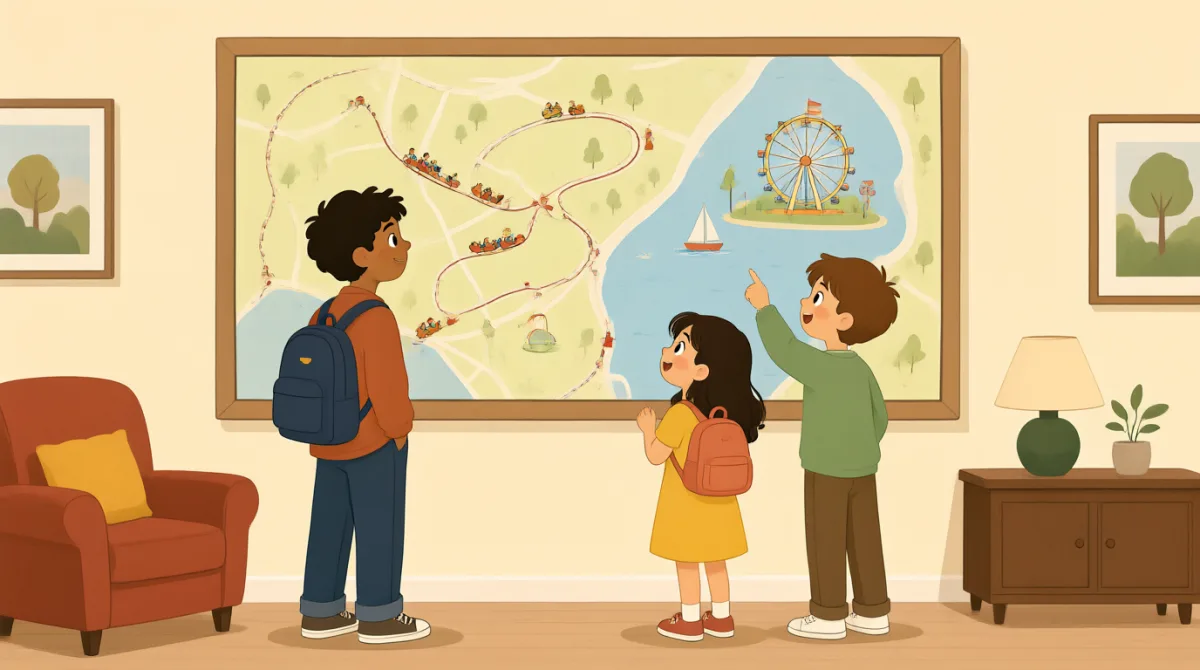

Here’s the ride map. What should we try first?
Aquí está el mapa de las atracciones. ¿Qué probamos primero?

Let’s go to the big roller coaster! It looks amazing.
¡Vamos a la montaña rusa grande! Parece increíble.

It does, but maybe we should start with something gentle.
Sí, pero quizá deberíamos empezar con algo tranquilo.
Come on, Mia! We didn’t come here to take it easy.
¡Vamos, Mia! No vinimos aquí para tomárnoslo con calma.
What about the little boat ride? It’s right over there.
¿Qué tal la atracción de los barquitos? Está justo allí.
Good idea. We can warm up there, then try a bigger ride.
Buena idea. Podemos empezar por ahí y luego probar una atracción más grande.
Fine, but after that, we’re going straight to the coaster.
Está bien, pero después iremos directamente a la montaña rusa.
Deal! Let’s follow the map and head to the boats.
¡Hecho! Sigamos el mapa y vayamos a los barquitos.
Vocabulario7
- ride mapmapa de las atracciones
A ride map shows where the rides are in the amusement park. You can use it to decide where to go.
Un mapa de las atracciones muestra dónde están las atracciones del parque. Puedes usarlo para decidir adónde ir.
- try firstprobar primero
This means to choose something to do before the other options. You can say, “What should we try first?” when making a plan.
Significa elegir algo para hacer antes que las demás opciones. Puedes decir “What should we try first?” cuando estén haciendo planes.
- something gentlealgo tranquilo
This means an activity that is not too fast or scary. You can use it to suggest an easy way to start.
Se refiere a una actividad que no es demasiado rápida ni da mucho miedo. Puedes usar esta expresión para sugerir empezar con algo fácil.
- take it easytomárselo con calma
This means to relax or do something without rushing. Here, Leo says they did not come to the park to choose an easy ride.
Significa relajarse o hacer algo sin apresurarse. Aquí, Leo dice que no vinieron al parque para elegir una atracción fácil.
- warm upempezar poco a poco
To warm up means to start with an easy activity before doing something more difficult. You can warm up before trying a bigger ride.
“Warm up” significa empezar con una actividad fácil antes de hacer algo más difícil. Puedes empezar poco a poco antes de probar una atracción más grande.
- straight toir directamente a
This means going directly to a place or activity. You can say, “Let’s go straight to the entrance.”
Significa ir a un lugar o hacer una actividad directamente. Puedes decir “Let’s go straight to the entrance.”
- head todirigirse a
To head to a place means to go there. You can say, “Let’s head to the boats” when you are ready to leave.
“Head to” significa ir a un lugar. Puedes decir “Let’s head to the boats” cuando estén listos para irse.
Frases clave7
- 1
What should we try first?
¿Qué deberíamos probar primero?
Use this question when you need to choose the first activity or place. Replace “try” with another verb, such as “visit” or “eat.”
Usa esta pregunta cuando tengas que elegir la primera actividad o el primer lugar. Cambia “try” por otro verbo, como “visit” o “eat.”
- 2
Let’s go to the big roller coaster!
¡Vamos a la montaña rusa grande!
This is a friendly way to suggest an activity. You can change the place or activity after “go to.”
Es una forma amistosa de sugerir una actividad. Puedes cambiar el lugar o la actividad después de “go to.”
- 3
Maybe we should start with something gentle.
Quizá deberíamos empezar con algo tranquilo.
Use this to suggest beginning with an easy or calm activity. “Maybe we should” makes the suggestion sound polite.
Usa esta frase para sugerir que empiecen con una actividad fácil o tranquila. “Maybe we should” hace que la sugerencia suene amable.
- 4
What about the little boat ride?
¿Qué tal la atracción de los barquitos?
Use “What about...?” to offer an idea or suggestion. You can use it with a place, activity, or plan.
Usa “What about...?” para proponer una idea o hacer una sugerencia. Puedes usarlo para hablar de un lugar, una actividad o un plan.
- 5
We can warm up there, then try a bigger ride.
Podemos empezar poco a poco allí y luego probar una atracción más grande.
This sentence explains a plan with two steps. Use “then” to show what you will do next.
Esta frase explica un plan con dos pasos. Usa “then” para indicar qué harán después.
- 6
After that, we’re going straight to the coaster.
Después de eso, iremos directamente a la montaña rusa.
Use “after that” to say what you plan to do next. “We’re going” can describe a future plan.
Usa “after that” para decir qué planeas hacer después. “We’re going” puede describir un plan futuro.
- 7
Let’s follow the map and head to the boats.
Sigamos el mapa y vayamos a los barquitos.
This is a useful way to suggest going somewhere together. Replace “the boats” with another destination.
Esta es una forma práctica de sugerir que vayan juntos a algún lugar. Cambia “the boats” por otro destino.