Asking for Directions/Help on a Train/Bus
Meminta Petunjuk atau Bantuan di Kereta/Bus
A passenger is lost, needs to know their stop, or has a question about the route or connections while on a bus, train, or subway, and asks a fellow passenger or staff member for assistance.
Seorang penumpang tersesat, perlu mengetahui di mana harus turun, atau ingin bertanya tentang rute maupun koneksi saat berada di bus, kereta, atau kereta bawah tanah. Ia meminta bantuan kepada sesama penumpang atau petugas.
Dialog7
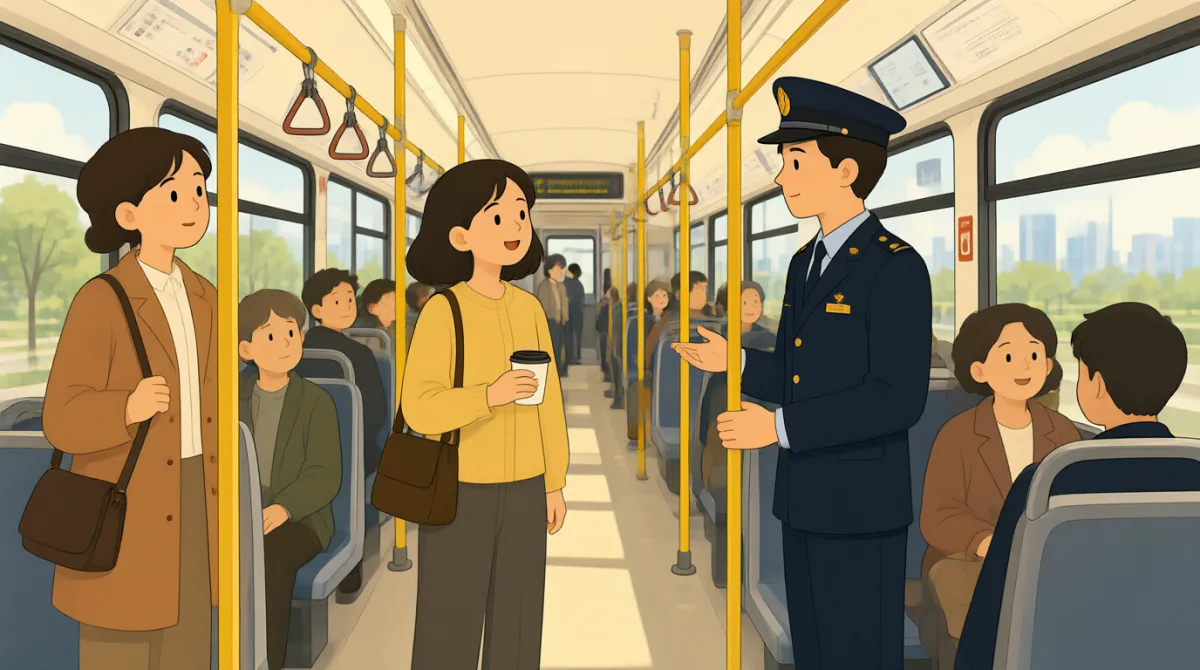

Excuse me, I hope you don't mind me asking. Is this train going towards the city center?
Permisi, semoga Anda tidak keberatan kalau saya bertanya. Apakah kereta ini menuju pusat kota?

Yes, it is. This is the downtown express. Are you looking to get to a specific station?
Ya, benar. Ini kereta ekspres ke pusat kota. Apa Anda ingin pergi ke stasiun tertentu?
Oh, great! Yes, I need to get to Grand Central. How many more stops is that from here?
Oh, bagus! Ya, saya harus ke Grand Central. Dari sini masih berapa perhentian lagi?
Grand Central? Let me see... we just passed 34th Street. Grand Central is actually the next stop, so you'll be getting off pretty soon.
Grand Central? Sebentar, saya lihat dulu... kita baru saja melewati 34th Street. Grand Central ternyata perhentian berikutnya, jadi sebentar lagi Anda turun.
Really? That's perfect! I was worried I might miss it. Thank you so much, I really appreciate your help.
Benarkah? Pas sekali! Saya khawatir tadi akan kelewatan. Terima kasih banyak, saya sangat menghargai bantuan Anda.
No problem at all! Glad I could help. Just make sure to be ready, the doors open quickly.
Sama-sama! Senang bisa membantu. Pastikan Anda sudah siap, pintunya cepat tertutup.
I will. Thanks again!
Baik. Terima kasih sekali lagi!
Kosakata7
- excuse mepermisi
A polite way to get someone's attention when you want to ask a question, like starting a conversation on public transport.
Ungkapan sopan untuk menarik perhatian seseorang saat ingin bertanya, misalnya untuk memulai percakapan di transportasi umum.
- towardsmenuju
Means in the direction of a place; use it when asking if something is heading to a certain area, like 'going towards the city center.'
Berarti ke arah suatu tempat. Gunakan kata ini untuk menanyakan apakah sesuatu sedang menuju daerah tertentu, seperti dalam 'going towards the city center' (menuju pusat kota).
- expressekspres
A type of train or bus that goes faster and skips some stops; common in public transportation to describe quicker routes.
Jenis kereta atau bus yang melaju lebih cepat dan melewati beberapa perhentian. Istilah ini umum digunakan untuk menyebut rute transportasi umum yang lebih cepat.
- stopsperhentian
The places where a bus or train pauses to let people on or off; useful for asking 'how many more stops' to your destination.
Tempat bus atau kereta berhenti agar penumpang bisa naik atau turun. Kata ini berguna saat bertanya 'how many more stops' (berapa perhentian lagi) sampai tujuan.
- getting offturun
Means leaving the bus or train at a stop; say 'getting off at the next stop' when you plan to exit soon.
Berarti meninggalkan bus atau kereta di suatu perhentian. Ucapkan 'getting off at the next stop' (turun di perhentian berikutnya) jika Anda akan segera turun.
- appreciatemenghargai
To feel grateful for someone's help; use it in polite thanks like 'I appreciate your help' after getting directions.
Merasa berterima kasih atas bantuan seseorang. Gunakan kata ini dalam ucapan terima kasih yang sopan, seperti 'I appreciate your help' (saya menghargai bantuan Anda) setelah mendapat petunjuk.
- no problemtidak masalah
A casual way to say 'you're welcome' or 'it's okay'; respond with this when someone thanks you for assistance.
Cara santai untuk mengatakan 'sama-sama' atau 'tidak apa-apa'. Gunakan ungkapan ini saat seseorang berterima kasih atas bantuan Anda.
Kalimat Kunci6
- 1
Excuse me, I hope you don't mind me asking. Is this train going towards the city center?
Permisi, semoga Anda tidak keberatan kalau saya bertanya. Apakah kereta ini menuju pusat kota?
This is a polite way to start asking for directions on public transport. 'Don't mind me asking' softens the request, making it courteous. Use it when interrupting someone.
Ini cara sopan untuk mulai bertanya tentang petunjuk arah di transportasi umum. 'Don't mind me asking' (tidak keberatan kalau saya bertanya) membuat permintaan terdengar lebih santun. Gunakan ungkapan ini saat menyela seseorang.
- 2
This is the downtown express. Are you looking to get to a specific station?
Ini kereta ekspres ke pusat kota. Apa Anda ingin pergi ke stasiun tertentu?
Here, 'downtown express' describes a fast route to the city center. The question uses 'looking to get to' for inquiring about destinations, helpful for offering help.
Di sini, 'downtown express' menjelaskan rute cepat menuju pusat kota. Pertanyaan ini menggunakan 'looking to get to' untuk menanyakan tujuan seseorang, dan berguna saat menawarkan bantuan.
- 3
How many more stops is that from here?
Dari sini masih berapa perhentian lagi?
A practical question for checking distance on a route. 'How many more stops' is a common pattern in transportation; 'from here' specifies the current location.
Pertanyaan praktis untuk mengetahui jarak dalam suatu rute. 'How many more stops' adalah pola yang umum dalam konteks transportasi, sedangkan 'from here' menunjukkan lokasi saat ini.
- 4
Grand Central is actually the next stop, so you'll be getting off pretty soon.
Grand Central ternyata perhentian berikutnya, jadi sebentar lagi Anda turun.
This gives clear directions using 'next stop' for immediacy and 'getting off' for exiting. 'Pretty soon' means very shortly; useful for reassuring someone.
Kalimat ini memberi petunjuk yang jelas dengan menggunakan 'next stop' untuk menunjukkan bahwa perhentiannya sudah dekat dan 'getting off' untuk menyatakan turun. 'Pretty soon' berarti sebentar lagi; ungkapan ini berguna untuk meyakinkan seseorang.
- 5
Thank you so much, I really appreciate your help.
Terima kasih banyak, saya sangat menghargai bantuan Anda.
A strong expression of thanks. 'Thank you so much' emphasizes gratitude, and 'appreciate your help' shows politeness. Use after receiving assistance.
Ungkapan terima kasih yang tulus. 'Thank you so much' menegaskan rasa terima kasih, sementara 'appreciate your help' menunjukkan kesopanan. Gunakan setelah menerima bantuan.
- 6
No problem at all! Glad I could help.
Sama-sama! Senang bisa membantu.
A friendly response to thanks. 'No problem at all' is casual for 'you're welcome,' and 'glad I could help' expresses pleasure in assisting. Common in everyday interactions.
Jawaban ramah atas ucapan terima kasih. 'No problem at all' adalah cara santai untuk mengatakan 'sama-sama', dan 'glad I could help' menyatakan bahwa Anda senang bisa membantu. Keduanya umum digunakan dalam percakapan sehari-hari.