Talking About the Weather
Parler du temps
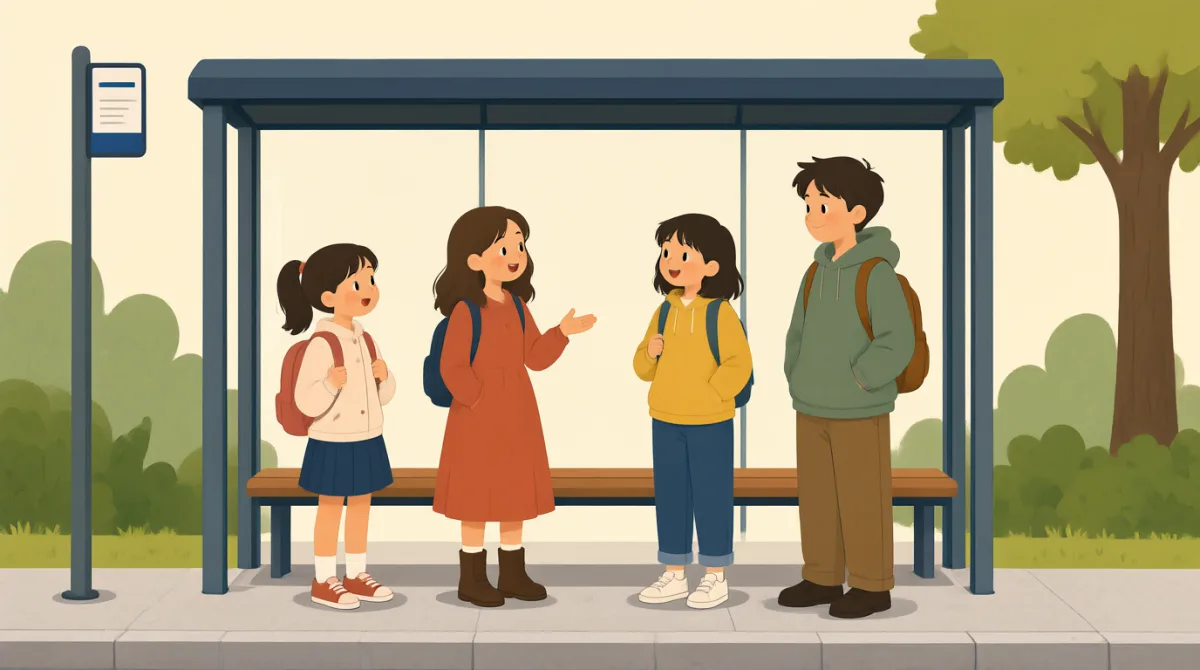
Mia joins them at the bus stop. They talk about the rain while they wait.
Mia les rejoint à l’arrêt de bus. En attendant, ils parlent de la pluie.
Dialogue7

Hi, Mia. The bus is still late.
Salut, Mia. Le bus est toujours en retard.

Yes. And now it is raining.
Oui. Et maintenant, il pleut.

I have an umbrella. We can share it.
J’ai un parapluie. On peut le partager.
Thanks, Jack. The rain is very cold.
Merci, Jack. La pluie est très froide.
I hope the bus comes soon.
J’espère que le bus va bientôt arriver.
Me too. I don't want to get wet.
Moi aussi. Je n’ai pas envie d’être trempé.
Look, the rain is getting lighter.
Regardez, la pluie faiblit.
Vocabulaire6
- still latetoujours en retard
The bus has not arrived yet. Use “still” to say that something continues.
Le bus n’est pas encore arrivé. Utilise “still” pour dire qu’une situation continue.
- rainingpleuvoir
Rain is falling from the sky. You can say “It is raining” to describe the weather now.
La pluie tombe du ciel. Tu peux dire “It is raining” pour décrire le temps qu’il fait en ce moment.
- umbrellaparapluie
An umbrella keeps rain off you. You can carry one when it rains.
Un parapluie te protège de la pluie. Tu peux en prendre un quand il pleut.
- share itle partager
Use this when two or more people use the same thing. Here, Jack offers to use his umbrella with the others.
On utilise cette expression quand deux personnes ou plus se servent de la même chose. Ici, Jack propose de partager son parapluie avec les autres.
- get wetêtre mouillé
This means to have water or rain on your clothes or body. You can say, “I don’t want to get wet.”
Cela veut dire avoir de l’eau ou de la pluie sur ses vêtements ou son corps. Tu peux dire : “I don’t want to get wet.”
- getting lighterfaiblir
Here, this means the rain is becoming less strong. Use “getting” to talk about a change happening now.
Ici, cela veut dire que la pluie devient moins forte. Utilise “getting” pour parler d’un changement qui se produit en ce moment.
Phrases clés8
- 1
The bus is still late.
Le bus est toujours en retard.
Use this to say a bus or another person has not arrived on time. You can replace “the bus” with another subject, such as “The train is still late.”
Utilise cette phrase pour dire qu’un bus ou une autre personne n’est pas arrivé à l’heure. Tu peux remplacer “the bus” par un autre sujet, par exemple : “The train is still late.”
- 2
And now it is raining.
Et maintenant, il pleut.
This is a simple way to talk about the weather. Replace “raining” with another weather word, such as “snowing.”
C’est une façon simple de parler du temps qu’il fait. Remplace “raining” par un autre mot lié à la météo, comme “snowing.”
- 3
I have an umbrella.
J’ai un parapluie.
Use this sentence to say what you have with you. You can replace “an umbrella” with another useful item.
Utilise cette phrase pour dire ce que tu as avec toi. Tu peux remplacer “an umbrella” par un autre objet utile.
- 4
We can share it.
On peut le partager.
Use this to offer to use something together. Replace “it” with the thing you want to share.
Utilise cette phrase pour proposer d’utiliser quelque chose ensemble. Remplace “it” par l’objet que tu veux partager.
- 5
The rain is very cold.
La pluie est très froide.
Use “The [weather] is very [adjective]” to describe how the weather feels. You can say, “The wind is very cold.”
Utilise “The [weather] is very [adjective]” pour décrire la sensation que te donne le temps. Tu peux dire : “The wind is very cold.”
- 6
I hope the bus comes soon.
J’espère que le bus va bientôt arriver.
Use “I hope” to say what you want to happen. Replace “the bus comes” with another event, such as “the rain stops.”
Utilise “I hope” pour dire ce que tu aimerais voir se produire. Remplace “the bus comes” par un autre événement, comme “the rain stops.”
- 7
I don't want to get wet.
Je n’ai pas envie d’être mouillé.
Use “I don’t want to” to say what you do not wish to happen. You can use it with other actions, such as “I don’t want to wait.”
Utilise “I don’t want to” pour dire que tu ne souhaites pas qu’une chose arrive. Tu peux l’utiliser avec d’autres actions, comme dans “I don’t want to wait.”
- 8
Look, the rain is getting lighter.
Regarde, la pluie faiblit.
Use “Look” to point out something you notice. “It is getting lighter” describes the rain becoming less strong.
Utilise “Look” pour attirer l’attention sur quelque chose que tu remarques. “It is getting lighter” décrit une pluie qui devient moins forte.