Talking About the Weather
Hablar del tiempo
Mia joins them at the bus stop. They talk about the rain while they wait.
Mia se reúne con ellos en la parada del autobús. Hablan de la lluvia mientras esperan.
Diálogo7
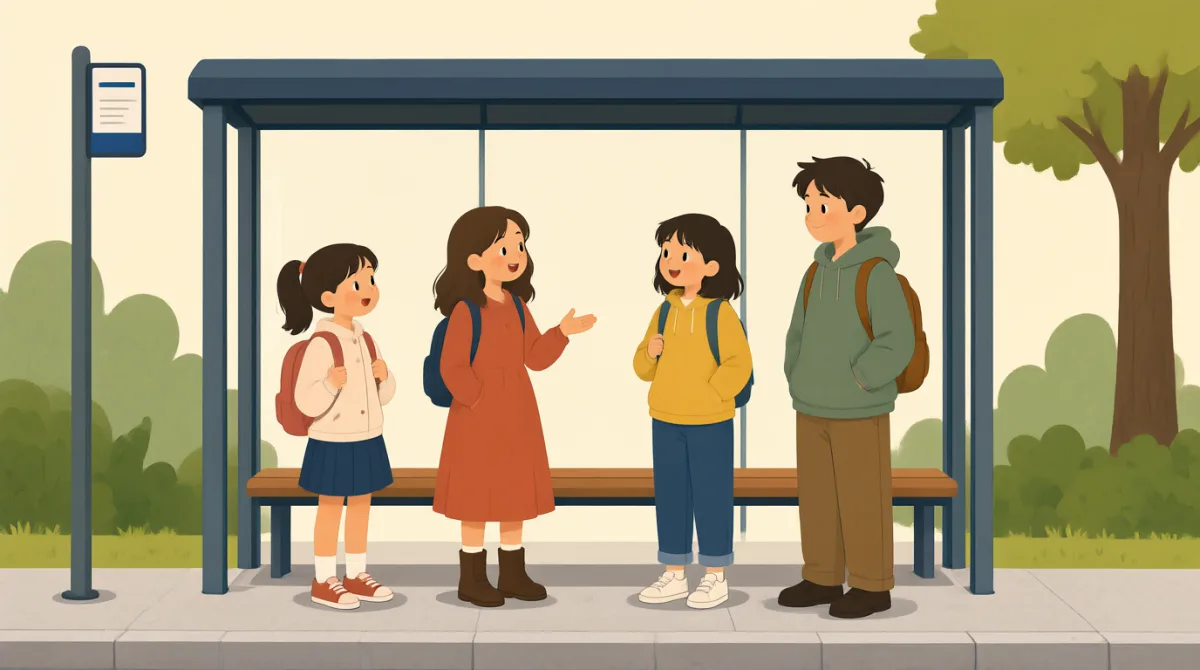

Hi, Mia. The bus is still late.
Hola, Mia. El autobús sigue llegando tarde.

Yes. And now it is raining.
Sí. Y ahora está lloviendo.

I have an umbrella. We can share it.
Tengo un paraguas. Podemos compartirlo.
Thanks, Jack. The rain is very cold.
Gracias, Jack. La lluvia está muy fría.
I hope the bus comes soon.
Espero que el autobús llegue pronto.
Me too. I don't want to get wet.
Yo también. No quiero mojarme.
Look, the rain is getting lighter.
Mira, está lloviendo cada vez menos.
Vocabulario6
- still latesigue llegando tarde
The bus has not arrived yet. Use “still” to say that something continues.
El autobús todavía no ha llegado. Usa “still” para decir que algo continúa.
- raininglloviendo
Rain is falling from the sky. You can say “It is raining” to describe the weather now.
La lluvia cae del cielo. Puedes decir “It is raining” para describir el tiempo ahora.
- umbrellaparaguas
An umbrella keeps rain off you. You can carry one when it rains.
Un paraguas te protege de la lluvia. Puedes llevar uno cuando llueve.
- share itcompartirlo
Use this when two or more people use the same thing. Here, Jack offers to use his umbrella with the others.
Usa esta expresión cuando dos o más personas usan lo mismo. Aquí, Jack ofrece compartir su paraguas con los demás.
- get wetmojarse
This means to have water or rain on your clothes or body. You can say, “I don’t want to get wet.”
Significa que te cae agua o lluvia en la ropa o el cuerpo. Puedes decir “I don’t want to get wet” (No quiero mojarme).
- getting lighterlloviendo cada vez menos
Here, this means the rain is becoming less strong. Use “getting” to talk about a change happening now.
Aquí significa que la lluvia está perdiendo intensidad. Usa “getting” para hablar de un cambio que está ocurriendo ahora.
Frases clave8
- 1
The bus is still late.
El autobús sigue llegando tarde.
Use this to say a bus or another person has not arrived on time. You can replace “the bus” with another subject, such as “The train is still late.”
Usa esta frase para decir que un autobús u otra persona todavía no ha llegado a tiempo. Puedes reemplazar “the bus” por otro sujeto, por ejemplo: “The train is still late.” (El tren también sigue llegando tarde).
- 2
And now it is raining.
Y ahora está lloviendo.
This is a simple way to talk about the weather. Replace “raining” with another weather word, such as “snowing.”
Esta es una forma sencilla de hablar del tiempo. Reemplaza “raining” por otra palabra relacionada con el tiempo, como “snowing.”
- 3
I have an umbrella.
Tengo un paraguas.
Use this sentence to say what you have with you. You can replace “an umbrella” with another useful item.
Usa esta frase para decir qué llevas contigo. Puedes reemplazar “an umbrella” por otro objeto útil.
- 4
We can share it.
Podemos compartirlo.
Use this to offer to use something together. Replace “it” with the thing you want to share.
Usa esta frase para ofrecer compartir algo. Reemplaza “it” por la cosa que quieres compartir.
- 5
The rain is very cold.
La lluvia está muy fría.
Use “The [weather] is very [adjective]” to describe how the weather feels. You can say, “The wind is very cold.”
Usa “The [weather] is very [adjective]” para describir cómo se siente el tiempo. Puedes decir “The wind is very cold.” (El viento está muy frío).
- 6
I hope the bus comes soon.
Espero que el autobús llegue pronto.
Use “I hope” to say what you want to happen. Replace “the bus comes” with another event, such as “the rain stops.”
Usa “I hope” para decir qué quieres que ocurra. Reemplaza “the bus comes” por otro acontecimiento, como “the rain stops.”
- 7
I don't want to get wet.
No quiero mojarme.
Use “I don’t want to” to say what you do not wish to happen. You can use it with other actions, such as “I don’t want to wait.”
Usa “I don’t want to” para decir que no quieres que algo ocurra o no deseas hacer algo. Puedes usarlo con otras acciones, como “I don’t want to wait.”
- 8
Look, the rain is getting lighter.
Mira, está lloviendo cada vez menos.
Use “Look” to point out something you notice. “It is getting lighter” describes the rain becoming less strong.
Usa “Look” para señalar algo que notas. “It is getting lighter” describe cómo la lluvia va perdiendo intensidad.