Buying Tape and a Hammer
Acheter du ruban adhésif et un marteau
Emma asks Jack for tape and a hammer. Jack shows her where to find them.
Emma demande du ruban adhésif et un marteau à Jack. Jack lui indique où les trouver.
Dialogue8
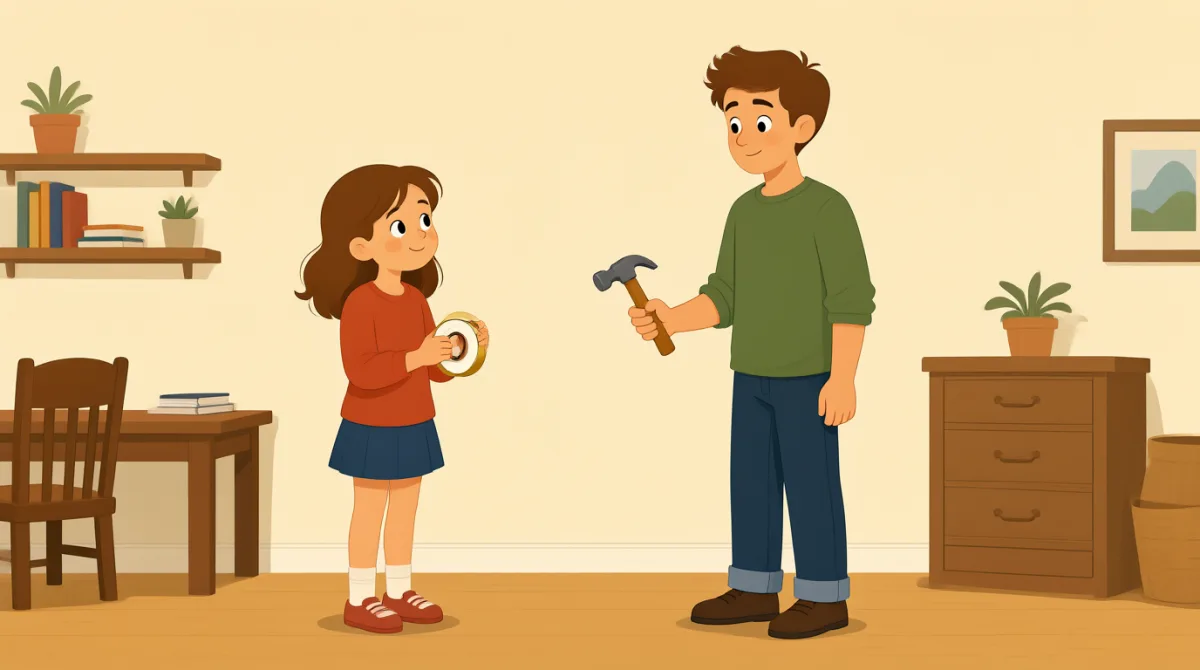

Hi, I need some tape and a hammer.
Bonjour, il me faut du ruban adhésif et un marteau.

Sure. What kind of tape do you need?
Bien sûr. De quel type de ruban adhésif avez-vous besoin ?
Just clear tape, please. Where is it?
Juste du ruban adhésif transparent, s'il vous plaît. Où se trouve-t-il ?
It’s on aisle four. The hammers are there, too.
C'est dans l'allée quatre. Les marteaux sont là aussi.
Great. Can you show me the way?
Super. Vous pouvez me montrer le chemin ?
Of course. Come with me.
Bien sûr. Suivez-moi.
Thanks! I need a small hammer.
Merci ! Il me faut un petit marteau.
Here’s one. It’s easy to hold.
En voici un. Il est facile à tenir.
Vocabulaire7
- taperuban adhésif
Tape is a strip of material that sticks things together. Here, Emma wants clear tape.
Le ruban adhésif est une bande qui permet de coller des choses entre elles. Ici, Emma cherche du ruban adhésif transparent.
- hammermarteau
A hammer is a tool for hitting nails. Emma needs a small one.
Un marteau est un outil qui sert à enfoncer des clous. Emma en cherche un petit.
- clear taperuban adhésif transparent
Clear tape is see-through tape. Use this phrase to say what kind of tape you want.
Le ruban adhésif transparent laisse voir à travers. Utilisez cette expression pour préciser le type de ruban adhésif que vous voulez.
- What kind of tape do you need?What kind of tape do you need? — De quel type de ruban adhésif avez-vous besoin ?
Ask this when you want to know what type of tape someone wants. You can also say, “What kind of [item] do you need?”
Posez cette question pour savoir quel type de ruban adhésif quelqu'un veut. Vous pouvez aussi dire “What kind of [item] do you need?” (De quel type de [article] avez-vous besoin ?).
- aisle fouraisle four — l'allée quatre
An aisle is a walkway between shelves in a store. Use “aisle” with a number to say where something is.
Une allée est le passage entre les rayons d'un magasin. Utilisez “aisle” avec un numéro pour indiquer où se trouve quelque chose.
- show me the wayshow me the way — me montrer le chemin
This means help me find a place. You can say, “Can you show me the way?” when you need directions.
Cela signifie aider quelqu'un à trouver un endroit. Vous pouvez dire “Can you show me the way?” (Pouvez-vous me montrer le chemin ?) quand vous avez besoin d'indications.
- easy to holdeasy to hold — facile à tenir
This means comfortable to hold in your hand. Use it to describe a tool or other object.
Cela signifie qu'un objet est agréable à tenir dans la main. Utilisez cette expression pour décrire un outil ou un autre objet.
Phrases clés8
- 1
Hi, I need some tape and a hammer.
Bonjour, il me faut du ruban adhésif et un marteau.
This is a simple way to ask for items in a store. Replace “tape and a hammer” with the things you need.
C'est une façon simple de demander des articles dans un magasin. Remplacez “tape and a hammer” par les choses dont vous avez besoin.
- 2
What kind of tape do you need?
De quel type de ruban adhésif avez-vous besoin ?
Use this question to ask which type of something a person wants. Replace “tape” with another item, such as “paint” or “screws.”
Utilisez cette question pour demander quel type d'article une personne veut. Remplacez “tape” par un autre article, comme “paint” ou “screws”.
- 3
Just clear tape, please.
Juste du ruban adhésif transparent, s'il vous plaît.
This is a polite way to say exactly what you want. You can use “Just [item], please” to make a simple request.
C'est une façon polie de préciser exactement ce que vous voulez. Vous pouvez utiliser “Just [item], please” pour faire une demande simple.
- 4
Where is it?
Où se trouve-t-il ?
Ask this when you want to know where one item is. You can also say, “Where are the hammers?” for more than one item.
Posez cette question pour savoir où se trouve un article. Vous pouvez aussi dire “Where are the hammers?” s'il y en a plusieurs.
- 5
The hammers are there, too.
Les marteaux sont là aussi.
This tells someone that another item is in the same place. Use “is there, too” for one item and “are there, too” for more than one.
Cette phrase indique à quelqu'un qu'un autre article se trouve au même endroit. Utilisez “is there, too” pour un seul article et “are there, too” pour plusieurs.
- 6
Can you show me the way?
Vous pouvez me montrer le chemin ?
This is a polite way to ask someone to guide you to a place. You can use it in a store or when asking for directions.
C'est une façon polie de demander à quelqu'un de vous guider jusqu'à un endroit. Vous pouvez l'utiliser dans un magasin ou pour demander votre chemin.
- 7
I need a small hammer.
Il me faut un petit marteau.
Use this sentence to say what size item you want. Replace “small hammer” with another item, such as “large box.”
Utilisez cette phrase pour préciser la taille de l'article que vous voulez. Remplacez “small hammer” par un autre article, comme “large box”.
- 8
It’s easy to hold.
Il est facile à tenir.
This describes an item that feels comfortable in your hand. You can use “It’s easy to [verb]” to say something is simple to do.
Cette phrase décrit un objet qui est agréable à tenir dans la main. Vous pouvez utiliser “It’s easy to [verb]” pour dire qu'une action est facile à faire.