Buying Tape and a Hammer
Klebeband und einen Hammer kaufen
Emma asks Jack for tape and a hammer. Jack shows her where to find them.
Emma fragt Jack nach Klebeband und einem Hammer. Jack zeigt ihr, wo sie beides findet.
Dialog8
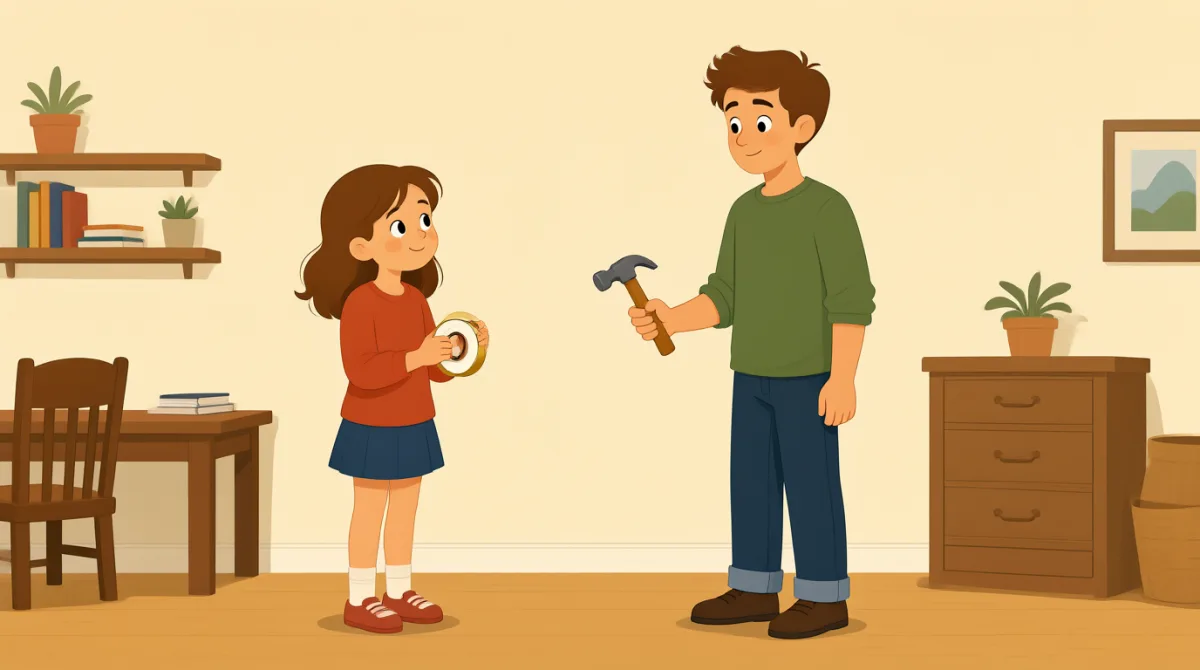

Hi, I need some tape and a hammer.
Hallo, ich brauche Klebeband und einen Hammer.

Sure. What kind of tape do you need?
Klar. Was für Klebeband brauchst du?
Just clear tape, please. Where is it?
Einfach durchsichtiges Klebeband, bitte. Wo finde ich das?
It’s on aisle four. The hammers are there, too.
Es ist in Gang vier. Die Hammer sind auch dort.
Great. Can you show me the way?
Super. Kannst du mir den Weg zeigen?
Of course. Come with me.
Natürlich. Komm mit.
Thanks! I need a small hammer.
Danke! Ich brauche einen kleinen Hammer.
Here’s one. It’s easy to hold.
Hier ist einer. Er liegt gut in der Hand.
Wortschatz7
- tapeKlebeband
Tape is a strip of material that sticks things together. Here, Emma wants clear tape.
Klebeband ist ein Streifen Material, mit dem man Dinge zusammenkleben kann. Hier möchte Emma durchsichtiges Klebeband.
- hammerHammer
A hammer is a tool for hitting nails. Emma needs a small one.
Ein Hammer ist ein Werkzeug, mit dem man Nägel einschlägt. Emma braucht einen kleinen.
- clear tapedurchsichtiges Klebeband
Clear tape is see-through tape. Use this phrase to say what kind of tape you want.
Durchsichtiges Klebeband ist durchsichtig. Mit diesem Ausdruck kannst du sagen, welche Art Klebeband du möchtest.
- What kind of tape do you need?Was für Klebeband brauchst du?
Ask this when you want to know what type of tape someone wants. You can also say, “What kind of [item] do you need?”
Diese Frage stellst du, wenn du wissen möchtest, welche Art Klebeband jemand möchte. Du kannst auch sagen: „What kind of [item] do you need?“ (Was für [einen Artikel] brauchst du?)
- aisle fourGang vier
An aisle is a walkway between shelves in a store. Use “aisle” with a number to say where something is.
Ein Gang ist ein Weg zwischen den Regalen in einem Geschäft. Mit „aisle“ und einer Zahl kannst du sagen, wo sich etwas befindet.
- show me the waymir den Weg zeigen
This means help me find a place. You can say, “Can you show me the way?” when you need directions.
Das bedeutet, mir dabei zu helfen, einen Ort zu finden. Wenn du nach dem Weg fragen möchtest, kannst du sagen: „Can you show me the way?“ (Kannst du mir den Weg zeigen?)
- easy to holdliegt gut in der Hand
This means comfortable to hold in your hand. Use it to describe a tool or other object.
Das bedeutet, dass sich etwas angenehm in der Hand halten lässt. Damit kannst du ein Werkzeug oder einen anderen Gegenstand beschreiben.
Wichtige Sätze8
- 1
Hi, I need some tape and a hammer.
Hallo, ich brauche Klebeband und einen Hammer.
This is a simple way to ask for items in a store. Replace “tape and a hammer” with the things you need.
So kannst du in einem Geschäft einfach nach Dingen fragen. Ersetze „tape and a hammer“ durch die Dinge, die du brauchst.
- 2
What kind of tape do you need?
Was für Klebeband brauchst du?
Use this question to ask which type of something a person wants. Replace “tape” with another item, such as “paint” or “screws.”
Mit dieser Frage fragst du, welche Art von etwas eine Person möchte. Ersetze „tape“ durch einen anderen Artikel, zum Beispiel „paint“ oder „screws“.
- 3
Just clear tape, please.
Einfach durchsichtiges Klebeband, bitte.
This is a polite way to say exactly what you want. You can use “Just [item], please” to make a simple request.
So kannst du höflich sagen, was genau du möchtest. Mit „Just [item], please“ kannst du einfach um etwas bitten.
- 4
Where is it?
Wo ist es?
Ask this when you want to know where one item is. You can also say, “Where are the hammers?” for more than one item.
Das fragst du, wenn du wissen möchtest, wo sich ein einzelner Artikel befindet. Bei mehreren Artikeln kannst du auch sagen: „Where are the hammers?“ (Wo sind die Hammer?)
- 5
The hammers are there, too.
Die Hammer sind auch dort.
This tells someone that another item is in the same place. Use “is there, too” for one item and “are there, too” for more than one.
Damit sagst du jemandem, dass sich ein weiterer Artikel am selben Ort befindet. Verwende „is there, too“ für einen Artikel und „are there, too“ für mehrere.
- 6
Can you show me the way?
Kannst du mir den Weg zeigen?
This is a polite way to ask someone to guide you to a place. You can use it in a store or when asking for directions.
So bittest du jemanden höflich, dich zu einem Ort zu führen. Du kannst das in einem Geschäft oder bei einer Wegauskunft sagen.
- 7
I need a small hammer.
Ich brauche einen kleinen Hammer.
Use this sentence to say what size item you want. Replace “small hammer” with another item, such as “large box.”
Mit diesem Satz sagst du, welche Größe du brauchst. Ersetze „small hammer“ durch einen anderen Gegenstand, zum Beispiel „large box“.
- 8
It’s easy to hold.
Er liegt gut in der Hand.
This describes an item that feels comfortable in your hand. You can use “It’s easy to [verb]” to say something is simple to do.
Damit beschreibst du einen Gegenstand, der sich angenehm in der Hand anfühlt. Mit „It’s easy to [verb]“ kannst du sagen, dass etwas einfach zu tun ist.