I Can't Find My Keys
Não consigo encontrar minhas chaves
Emma cannot find her keys before she leaves home. She asks Mia for help.
Emma não consegue encontrar as chaves antes de sair de casa. Ela pede ajuda a Mia.
Diálogo8
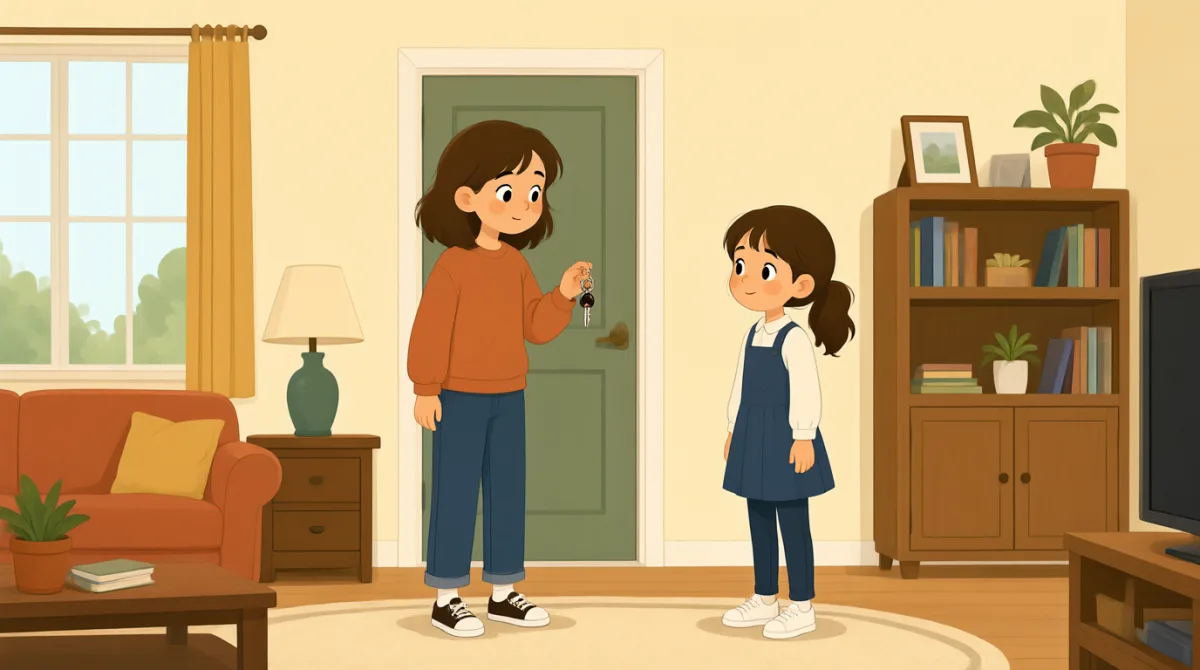

Mia, have you seen my keys?
Mia, você viu minhas chaves?

No. Where did you last see them?
Não. Onde foi a última vez que você as viu?
I don't know. I can't find them.
Não sei. Não consigo encontrá-las.
Are they on the table?
Elas estão em cima da mesa?
No, they're not there.
Não, não estão lá.
Look under your bag.
Olha embaixo da sua bolsa.
Okay. I don't see them.
Tá bom. Não estou vendo.
Let's look next to the door.
Vamos procurar ao lado da porta.
Vocabulário6
- have you seen my keys?have you seen my keys?
Ask if someone has seen something you cannot find. You can replace “my keys” with another item.
Pergunte se alguém viu algo que você não consegue encontrar. Você pode substituir “my keys” pelo nome de outro objeto.
- Where did you last see them?Where did you last see them?
Ask about the last place someone saw something. Use “it” for one thing and “them” for more than one.
Pergunte qual foi o último lugar onde alguém viu algo. Use “it” para uma coisa e “them” para mais de uma.
- I can't find them.I can't find them.
Say this when you do not know where something is. Use “it” instead of “them” for one thing.
Diga isso quando não souber onde está alguma coisa. Use “it” em vez de “them” para uma coisa só.
- on the tableon the table
This phrase tells where something is. Use “on” for something resting on a surface.
Essa expressão indica onde algo está. Use “on” quando algo está apoiado sobre uma superfície.
- under your bagunder your bag
This phrase tells someone where to look. Use “under” for a place below something.
Essa expressão diz a alguém onde procurar. Use “under” para indicar um lugar abaixo de alguma coisa.
- next to the doornext to the door
This phrase means beside the door. Use “next to” to say one thing is near another.
Essa expressão significa ao lado da porta. Use “next to” para dizer que uma coisa fica perto de outra.
Frases-chave8
- 1
Mia, have you seen my keys?
Mia, você viu minhas chaves?
Use this question when you cannot find something. Replace “my keys” with the item you are looking for.
Use essa pergunta quando não conseguir encontrar alguma coisa. Substitua “my keys” pelo objeto que você está procurando.
- 2
Where did you last see them?
Onde foi a última vez que você as viu?
Ask this to find out where someone saw something most recently. Change “them” to “it” for one thing.
Pergunte isso para descobrir onde alguém viu algo mais recentemente. Troque “them” por “it” quando se tratar de uma coisa só.
- 3
I don't know.
Não sei.
Use this short sentence when you do not have an answer. It works in many everyday situations.
Use essa frase curta quando não tiver uma resposta. Ela serve para muitas situações do dia a dia.
- 4
I can't find them.
Não consigo encontrá-las.
Use this to say that something is missing. Replace “them” with “it” when you mean one thing.
Use essa frase para dizer que algo está perdido. Substitua “them” por “it” quando estiver falando de uma coisa só.
- 5
Are they on the table?
Elas estão em cima da mesa?
Use this question to check if things are on a surface. Replace “they” with “it” for one thing.
Use essa pergunta para verificar se algumas coisas estão sobre uma superfície. Substitua “they” por “it” para uma coisa só.
- 6
Look under your bag.
Olha embaixo da sua bolsa.
Use this simple instruction to tell someone where to search. Replace “your bag” with another object.
Use essa instrução simples para dizer a alguém onde procurar. Substitua “your bag” por outro objeto.
- 7
I don't see them.
Não estou vendo.
Use this to say that something is not visible to you. Replace “them” with “it” for one thing.
Use essa frase para dizer que não está conseguindo ver algo. Substitua “them” por “it” para uma coisa só.
- 8
Let's look next to the door.
Vamos procurar ao lado da porta.
Use “Let's” to suggest doing something together. Replace “next to the door” with another place to search.
Use “Let's” para sugerir que vocês façam algo juntos. Substitua “next to the door” por outro lugar para procurar.