I Can't Find My Keys
Ich finde meine Schlüssel nicht
Emma cannot find her keys before she leaves home. She asks Mia for help.
Emma kann ihre Schlüssel nicht finden, bevor sie das Haus verlässt. Sie bittet Mia um Hilfe.
Dialog8
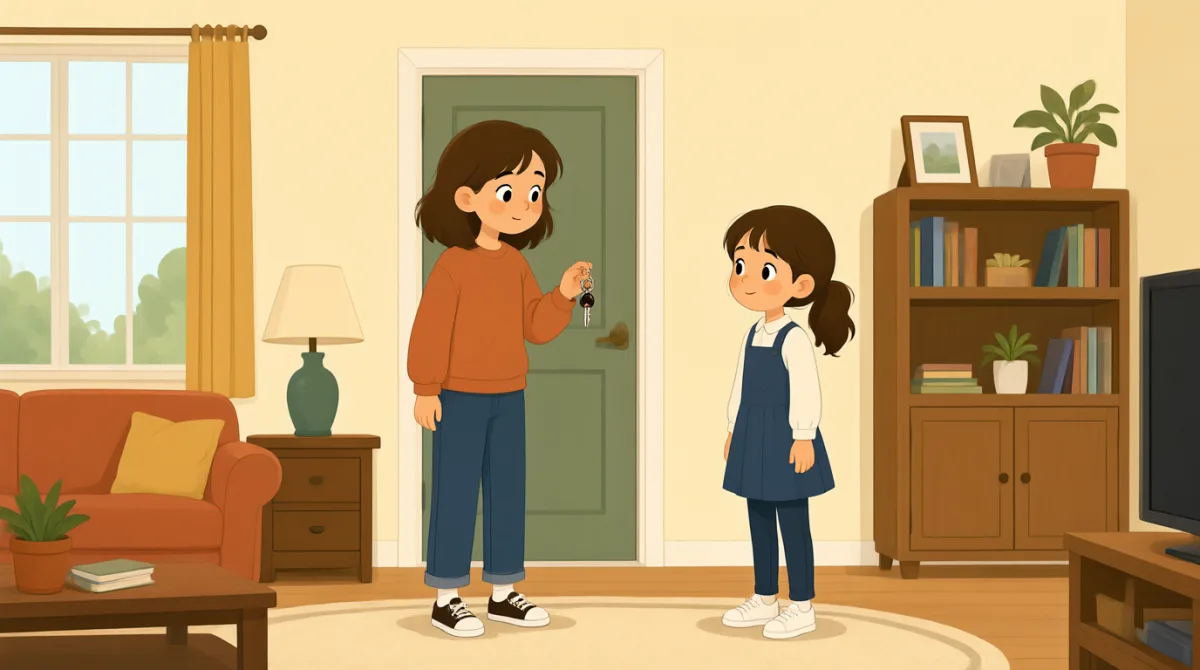

Mia, have you seen my keys?
Mia, hast du meine Schlüssel gesehen?

No. Where did you last see them?
Nein. Wo hast du sie zuletzt gesehen?
I don't know. I can't find them.
Ich weiß nicht. Ich kann sie nicht finden.
Are they on the table?
Liegen sie auf dem Tisch?
No, they're not there.
Nein, da liegen sie nicht.
Look under your bag.
Schau unter deiner Tasche nach.
Okay. I don't see them.
Okay. Ich sehe sie nicht.
Let's look next to the door.
Schauen wir neben der Tür nach.
Wortschatz6
- have you seen my keys?Hast du meine Schlüssel gesehen?
Ask if someone has seen something you cannot find. You can replace “my keys” with another item.
Frag, ob jemand etwas gesehen hat, das du nicht finden kannst. Du kannst „my keys“ durch einen anderen Gegenstand ersetzen.
- Where did you last see them?Wo hast du sie zuletzt gesehen?
Ask about the last place someone saw something. Use “it” for one thing and “them” for more than one.
Frag nach dem letzten Ort, an dem jemand etwas gesehen hat. Verwende „it“ für eine Sache und „them“ für mehrere.
- I can't find them.Ich kann sie nicht finden.
Say this when you do not know where something is. Use “it” instead of “them” for one thing.
Das sagst du, wenn du nicht weißt, wo etwas ist. Verwende „it“ statt „them“, wenn es um eine Sache geht.
- on the tableauf dem Tisch
This phrase tells where something is. Use “on” for something resting on a surface.
Mit dieser Wendung sagst du, wo sich etwas befindet. Verwende „on“, wenn etwas auf einer Oberfläche liegt.
- under your bagunter deiner Tasche
This phrase tells someone where to look. Use “under” for a place below something.
Mit dieser Wendung sagst du jemandem, wo er suchen soll. Verwende „under“ für einen Ort unter etwas.
- next to the doorneben der Tür
This phrase means beside the door. Use “next to” to say one thing is near another.
Diese Wendung bedeutet, dass etwas direkt neben der Tür ist. Verwende „next to“, um auszudrücken, dass sich etwas nahe bei einer anderen Sache befindet.
Wichtige Sätze8
- 1
Mia, have you seen my keys?
Mia, hast du meine Schlüssel gesehen?
Use this question when you cannot find something. Replace “my keys” with the item you are looking for.
Verwende diese Frage, wenn du etwas nicht finden kannst. Ersetze „my keys“ durch den Gegenstand, den du suchst.
- 2
Where did you last see them?
Wo hast du sie zuletzt gesehen?
Ask this to find out where someone saw something most recently. Change “them” to “it” for one thing.
Mit dieser Frage findest du heraus, wo jemand etwas zuletzt gesehen hat. Ändere „them“ in „it“, wenn es um eine Sache geht.
- 3
I don't know.
Ich weiß nicht.
Use this short sentence when you do not have an answer. It works in many everyday situations.
Verwende diesen kurzen Satz, wenn du keine Antwort hast. Er passt zu vielen Alltagssituationen.
- 4
I can't find them.
Ich kann sie nicht finden.
Use this to say that something is missing. Replace “them” with “it” when you mean one thing.
Damit sagst du, dass etwas fehlt. Ersetze „them“ durch „it“, wenn du eine Sache meinst.
- 5
Are they on the table?
Liegen sie auf dem Tisch?
Use this question to check if things are on a surface. Replace “they” with “it” for one thing.
Verwende diese Frage, um zu prüfen, ob sich Dinge auf einer Oberfläche befinden. Ersetze „they“ durch „it“, wenn es um eine Sache geht.
- 6
Look under your bag.
Schau unter deiner Tasche nach.
Use this simple instruction to tell someone where to search. Replace “your bag” with another object.
Mit dieser einfachen Aufforderung sagst du jemandem, wo er suchen soll. Ersetze „your bag“ durch einen anderen Gegenstand.
- 7
I don't see them.
Ich sehe sie nicht.
Use this to say that something is not visible to you. Replace “them” with “it” for one thing.
Damit sagst du, dass etwas für dich nicht sichtbar ist. Ersetze „them“ durch „it“, wenn es um eine Sache geht.
- 8
Let's look next to the door.
Schauen wir neben der Tür nach.
Use “Let's” to suggest doing something together. Replace “next to the door” with another place to search.
Verwende „Let's“, um vorzuschlagen, etwas gemeinsam zu tun. Ersetze „next to the door“ durch einen anderen Ort, an dem ihr suchen könnt.