I Can't Find My Keys
No encuentro mis llaves
Emma cannot find her keys before she leaves home. She asks Mia for help.
Emma no encuentra las llaves antes de salir de casa. Le pide ayuda a Mia.
Diálogo8
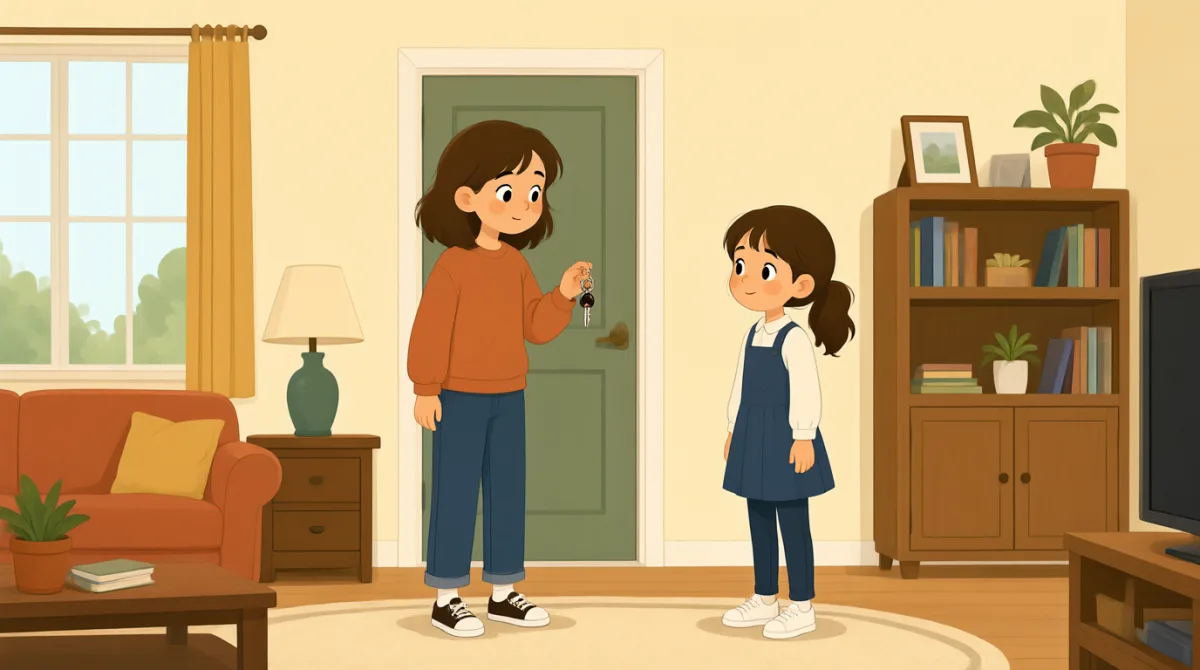

Mia, have you seen my keys?
Mia, ¿has visto mis llaves?

No. Where did you last see them?
No. ¿Dónde las viste por última vez?
I don't know. I can't find them.
No lo sé. No las encuentro.
Are they on the table?
¿Están en la mesa?
No, they're not there.
No, no están ahí.
Look under your bag.
Mira debajo de tu bolso.
Okay. I don't see them.
Vale. No las veo.
Let's look next to the door.
Vamos a mirar junto a la puerta.
Vocabulario6
- have you seen my keys?¿has visto mis llaves?
Ask if someone has seen something you cannot find. You can replace “my keys” with another item.
Pregunta si alguien ha visto algo que no encuentras. Puedes cambiar “my keys” por otro objeto.
- Where did you last see them?¿Dónde las viste por última vez?
Ask about the last place someone saw something. Use “it” for one thing and “them” for more than one.
Pregunta por el último lugar donde alguien vio algo. Usa “it” para una cosa y “them” para más de una.
- I can't find them.No las encuentro.
Say this when you do not know where something is. Use “it” instead of “them” for one thing.
Di esto cuando no sabes dónde está algo. Usa “it” en vez de “them” para una sola cosa.
- on the tableen la mesa
This phrase tells where something is. Use “on” for something resting on a surface.
Esta frase indica dónde está algo. Usa “on” para algo que está apoyado sobre una superficie.
- under your bagdebajo de tu bolso
This phrase tells someone where to look. Use “under” for a place below something.
Esta frase le indica a alguien dónde buscar. Usa “under” para un lugar que está debajo de algo.
- next to the doorjunto a la puerta
This phrase means beside the door. Use “next to” to say one thing is near another.
Esta frase significa al lado de la puerta. Usa “next to” para decir que algo está cerca de otra cosa.
Frases clave8
- 1
Mia, have you seen my keys?
Mia, ¿has visto mis llaves?
Use this question when you cannot find something. Replace “my keys” with the item you are looking for.
Usa esta pregunta cuando no encuentras algo. Cambia “my keys” por el objeto que estás buscando.
- 2
Where did you last see them?
¿Dónde las viste por última vez?
Ask this to find out where someone saw something most recently. Change “them” to “it” for one thing.
Pregunta esto para saber dónde vio alguien algo más recientemente. Cambia “them” por “it” si se trata de una sola cosa.
- 3
I don't know.
No lo sé.
Use this short sentence when you do not have an answer. It works in many everyday situations.
Usa esta frase corta cuando no tienes una respuesta. Sirve en muchas situaciones cotidianas.
- 4
I can't find them.
No las encuentro.
Use this to say that something is missing. Replace “them” with “it” when you mean one thing.
Usa esto para decir que algo no aparece. Cambia “them” por “it” cuando hables de una sola cosa.
- 5
Are they on the table?
¿Están en la mesa?
Use this question to check if things are on a surface. Replace “they” with “it” for one thing.
Usa esta pregunta para comprobar si varias cosas están sobre una superficie. Cambia “they” por “it” si se trata de una sola cosa.
- 6
Look under your bag.
Mira debajo de tu bolso.
Use this simple instruction to tell someone where to search. Replace “your bag” with another object.
Usa esta instrucción sencilla para decirle a alguien dónde buscar. Cambia “your bag” por otro objeto.
- 7
I don't see them.
No las veo.
Use this to say that something is not visible to you. Replace “them” with “it” for one thing.
Usa esto para decir que no puedes ver algo. Cambia “them” por “it” si se trata de una sola cosa.
- 8
Let's look next to the door.
Vamos a mirar junto a la puerta.
Use “Let's” to suggest doing something together. Replace “next to the door” with another place to search.
Usa “Let's” para proponer hacer algo juntos. Cambia “next to the door” por otro lugar donde buscar.