Asking a Roommate
Perguntando a um colega de quarto
Emma asks her roommate Jack if he has seen the keys. Jack remembers seeing them near the front door.
Emma pergunta ao colega de quarto, Jack, se ele viu as chaves. Jack se lembra de tê-las visto perto da porta de entrada.
Diálogo7
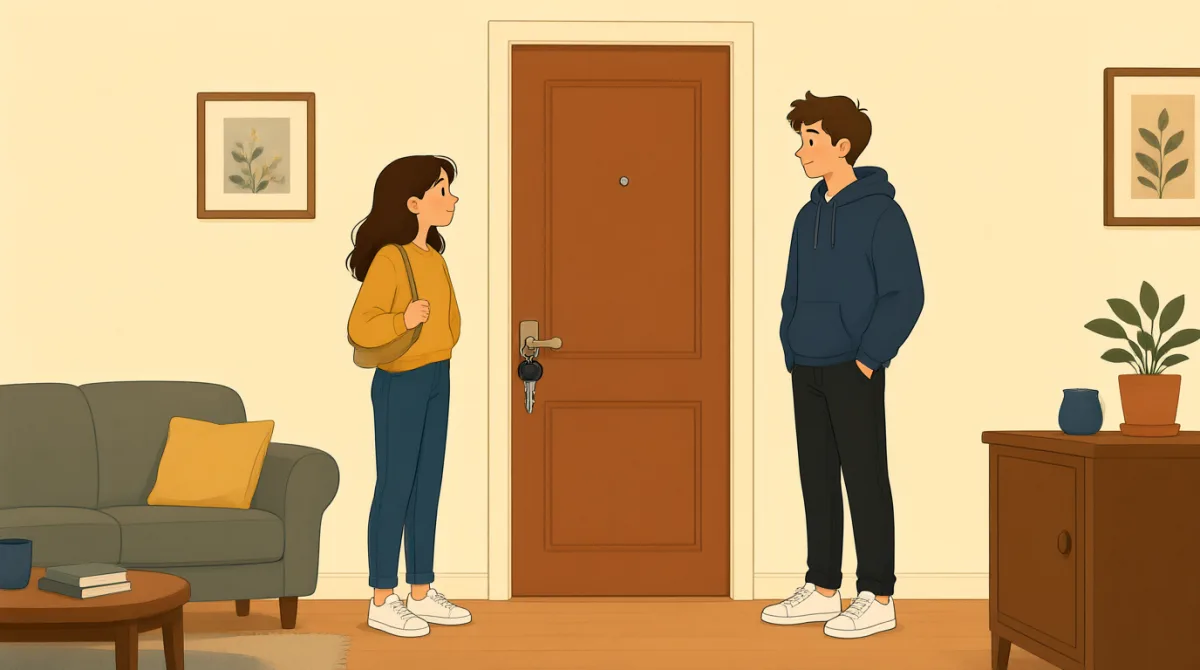

Jack, have you seen my keys?
Jack, você viu minhas chaves?

Your keys? What do they look like?
Suas chaves? Como elas são?
They are small, with a blue key ring.
Elas são pequenas e têm um chaveiro azul.
I saw them near the front door earlier.
Vi elas perto da porta de entrada mais cedo.
Were they on the table or on the floor?
Elas estavam em cima da mesa ou no chão?
I think they were next to your bag.
Acho que estavam ao lado da sua bolsa.
Okay, I'll look by the front door.
Beleza, vou procurar perto da porta de entrada.
Vocabulário7
- have you seen my keys?você viu minhas chaves?
Use this to ask if someone has seen your keys. You can replace “my keys” with another missing item.
Use “have you seen my keys?” para perguntar se alguém viu suas chaves. Você pode trocar “my keys” por outro objeto que perdeu.
- What do they look like?Como elas são?
Use this to ask someone to describe something. “They” refers to the keys.
Use “What do they look like?” para pedir que alguém descreva algo. “They” se refere às chaves.
- key ringchaveiro
A key ring holds keys together. You can describe its color to help someone find your keys.
Um “key ring” (chaveiro) mantém as chaves juntas. Você pode dizer a cor dele para ajudar alguém a encontrar suas chaves.
- front doorporta de entrada
The front door is the main entrance to a home or building. Use this phrase to say where something is.
“Front door” é a entrada principal de uma casa ou de um prédio. Use essa expressão para dizer onde algo está.
- on the tableem cima da mesa
Use this phrase to say that something is resting on a table. “On” tells us where it is.
Use “on the table” para dizer que algo está apoiado em uma mesa. “On” indica onde a coisa está.
- next to your bagao lado da sua bolsa
Use this phrase to say that something is beside a bag. You can replace “your bag” with another object.
Use “next to your bag” para dizer que algo está ao lado de uma bolsa. Você pode trocar “your bag” por outro objeto.
- look by the front doorprocurar perto da porta de entrada
Use this phrase to say that you will search near the front door. “By” means near.
Use “look by the front door” para dizer que você vai procurar perto da porta de entrada. “By” significa perto.
Frases-chave7
- 1
Jack, have you seen my keys?
Jack, você viu minhas chaves?
This is a simple way to ask if someone has seen something you cannot find. Replace “my keys” with another missing item.
Essa é uma maneira simples de perguntar se alguém viu algo que você não consegue encontrar. Troque “my keys” por outro objeto que tenha perdido.
- 2
What do they look like?
Como elas são?
Use this question to ask for a description. You can change “they” to “it” when asking about one item.
Use “What do they look like?” para pedir uma descrição. Você pode trocar “they” por “it” ao perguntar sobre um único objeto.
- 3
They are small, with a blue key ring.
Elas são pequenas e têm um chaveiro azul.
This sentence describes the keys and their key ring. Use “They are…” to give details about more than one thing.
Essa frase descreve as chaves e o chaveiro. Use “They are…” para dar detalhes sobre mais de uma coisa.
- 4
I saw them near the front door earlier.
Vi elas perto da porta de entrada mais cedo.
Use this to say where and when you last saw something. Replace “them” with the thing you saw.
Use “I saw them near the front door earlier.” para dizer onde e quando você viu algo pela última vez. Troque “them” pelo objeto que viu.
- 5
Were they on the table or on the floor?
Elas estavam em cima da mesa ou no chão?
This question asks someone to choose between two possible places. You can use the same pattern to ask where something was.
Essa pergunta pede que a pessoa escolha entre dois lugares possíveis. Você pode usar a mesma estrutura para perguntar onde algo estava.
- 6
I think they were next to your bag.
Acho que estavam ao lado da sua bolsa.
Use “I think…” when you are not completely sure. “Next to” tells where something was.
Use “I think…” quando não tiver certeza absoluta. “Next to” indica onde algo estava.
- 7
Okay, I'll look by the front door.
Beleza, vou procurar perto da porta de entrada.
Use this to say you will search near a place. “I'll” is short for “I will.”
Use “Okay, I'll look by the front door.” para dizer que você vai procurar perto de um lugar. “I'll” é a forma curta de “I will.”