Saying Thanks the Next Day
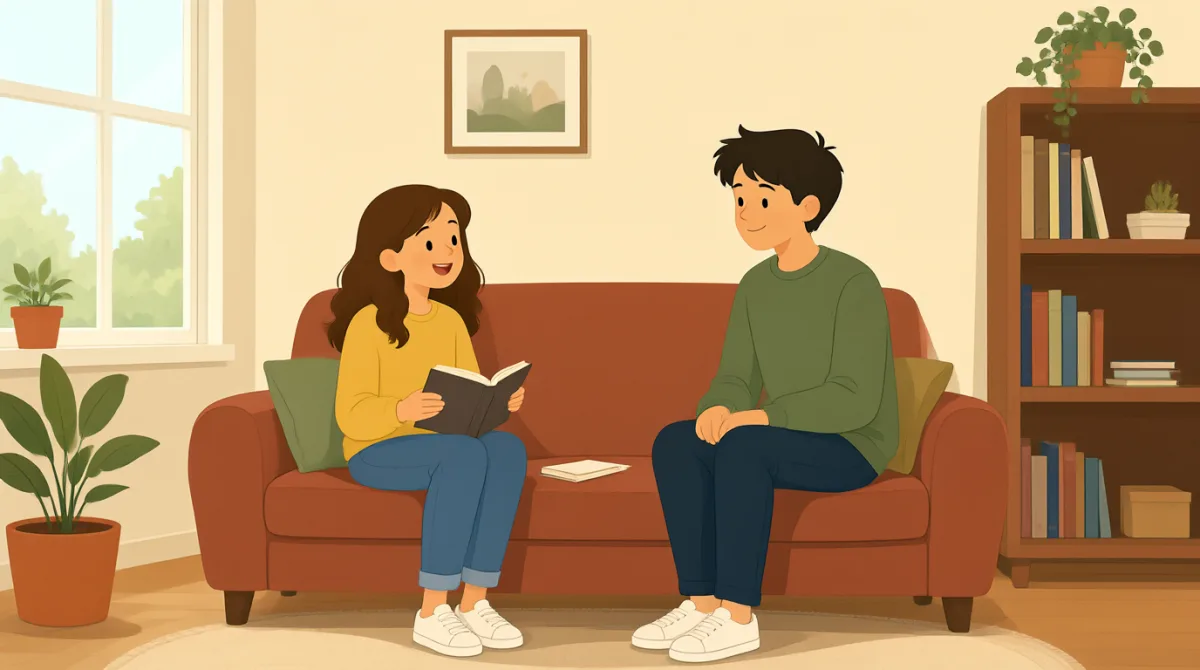
The next day, Emma thanks Leo for keeping the music low. Leo says he is glad she could study.
Dialogue6

Thanks for keeping the music low yesterday.

No problem. I hope you studied well.
I did. It was much easier to study.
Great! I’m glad you had some quiet time.
Thanks. The test went well, too.
That’s great news! We can keep the music low.
Vocabulary8
- Thanks for keeping the music low
Emma thanks Leo for playing the music quietly. Use “Thanks for…” to show you are grateful for something someone did.
- No problem
Leo says that helping Emma was easy. You can say “No problem” when someone thanks you.
- I hope you studied well
Leo hopes Emma was able to study. Use “I hope…” to say you want something good to happen.
- much easier
Emma says studying was easier when the music was low. Use “much” before a describing word to say something is a lot more easy, good, or difficult.
- quiet time
This means time without loud sounds or music. You can use it to talk about a calm time for studying or resting.
- went well
Emma says the test was good. Use “went well” to say an event or activity had a good result.
- That’s great news
Leo says this when he hears something good. Use it to show that you are happy about someone’s news.
- keep the music low
This means to continue playing music quietly. Use “keep” plus an action to ask or say that something should continue.
Key Sentences8
- 1
Thanks for keeping the music low yesterday.
Use this sentence to thank someone for something they did in the past. You can change “keeping the music low” to another helpful action.
- 2
No problem.
This is a short, friendly reply to “thank you.” You can use it when helping someone was easy.
- 3
I hope you studied well.
Use “I hope…” to say you want something good for someone. Change “studied well” to another action, such as “slept well.”
- 4
I did.
This short answer means “I studied well” here. You can use “I did” to answer a question about an action you did.
- 5
It was much easier to study.
Use this sentence to say that something became easier. You can change “to study” to another activity.
- 6
I’m glad you had some quiet time.
Use “I’m glad…” to say you are happy about something. You can replace “quiet time” with another good experience.
- 7
The test went well, too.
Use “went well” to say an event had a good result. Add “too” when you are adding another piece of good news.
- 8
We can keep the music low.
Use “We can…” to suggest something you are able to do together. “Keep the music low” means to continue playing it quietly.