Explaining Food and Walks
ごはんと散歩について説明する
Emma shows Jack where the dog food and leash are. She explains when Buddy eats and how often he needs walks.
エマはジャックに、ドッグフードとリードの場所を教えます。バディの食事の時間と、散歩に連れて行く頻度について説明します。
会話8
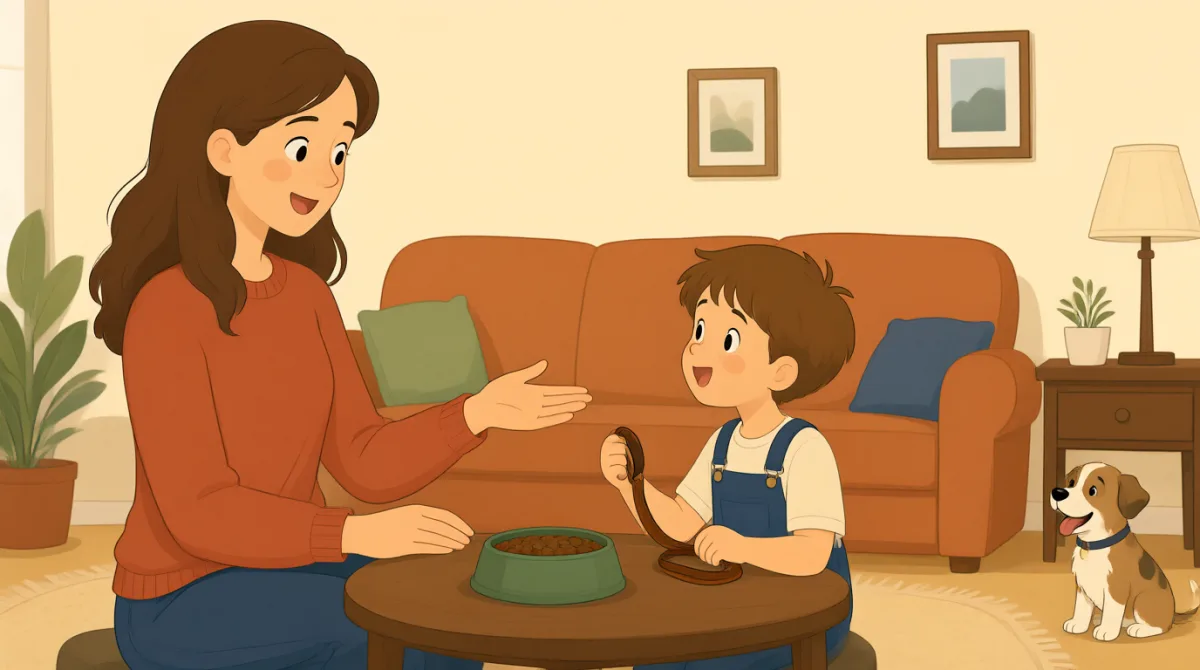

The dog food is in this bin. Buddy eats one cup in the morning and one at night.
ドッグフードはこの容器に入ってるよ。バディは朝に1カップ、夜に1カップ食べるんだ。

Got it. Should I give him breakfast before or after his walk?
わかった。朝ごはんは散歩の前と後、どっちにあげればいい?
After his morning walk, please. He likes to eat when he gets back.
朝の散歩のあとにお願い。帰ってきてから食べるのが好きなんだ。
Okay. Where do you keep his leash?
わかった。リードはどこに置いてあるの?
It’s hanging by the front door. Please take him out three times a day.
玄関のそばに掛けてあるよ。1日に3回、外に連れて行ってね。
How long should each walk be?
散歩は毎回どれくらいの長さがいい?
About twenty minutes is good. Keep him on the leash, please.
20分くらいがいいよ。リードはつけたままにしてね。
Sure. I’ll take him out after breakfast, in the afternoon, and before dinner.
もちろん。朝ごはんのあとと、午後と、夕食の前に外に連れて行くね。
語彙8
- dog foodドッグフード
Food that is made for dogs. You can use this phrase when talking about what a dog eats.
犬用に作られた食べ物のことです。犬が何を食べるか話すときに使えます。
- one cup1カップ
A measurement for the amount of food Buddy should eat. You can use it to explain how much to give someone or something.
バディが食べるフードの量を表す単位です。人や動物にどれくらいの量をあげるか説明するときに使えます。
- morning walk朝の散歩
A walk taken in the morning. You can use this phrase to talk about a regular daily activity.
朝にする散歩のことです。毎日の習慣について話すときに使えます。
- gets back帰ってくる
Returns to a place. Here, Buddy gets back home after his walk.
ある場所に戻るという意味です。ここでは、バディが散歩のあとに家に帰ってくることを表しています。
- leashリード
A strap used to keep a dog safely beside you while walking. You can ask where someone keeps a pet’s leash.
散歩中に犬がそばを離れないようにつなぐひものことです。ペットのリードをどこに置いているか尋ねるときにも使えます。
- take him out外に連れて行く
Take Buddy outside, usually for a walk. You can use this phrase when talking about caring for a dog.
バディを外に連れ出すことで、たいていは散歩に連れて行くことを指します。犬の世話について話すときに使える表現です。
- three times a day1日に3回
Three times during each day. You can use this phrase to explain how often an activity should happen.
毎日3回という意味です。何かをどのくらいの頻度でするか説明するときに使えます。
- keep him on the leashリードをつけたままにする
Make sure Buddy stays attached to his leash. You can use this phrase to give a simple safety instruction.
バディがリードにつながった状態を保つことです。安全のための簡単な指示として使えます。
重要な文8
- 1
Buddy eats one cup in the morning and one at night.
バディは朝に1カップ、夜に1カップ食べるんだ。
This sentence explains a daily feeding schedule. Reuse the pattern “one [amount] in the morning and one at night” to describe routines.
毎日の食事の時間と量を説明する文です。“one [amount] in the morning and one at night”(朝に[量]、夜に1つ)という形を使うと、習慣について説明できます。
- 2
Should I give him breakfast before or after his walk?
朝ごはんは散歩の前と後、どっちにあげればいい?
This is a polite way to ask about the order of two activities. Replace “breakfast” and “his walk” with other tasks to ask about a routine.
2つのことをどちらの順番でするか、丁寧に尋ねる表現です。“breakfast”や“his walk”をほかの作業に置き換えて、日課について尋ねることもできます。
- 3
After his morning walk, please.
朝の散歩のあとにお願い。
This gives a short, clear answer about when to do something. You can use “After [activity], please” to give a simple instruction.
何かをいつするか、短くはっきり伝える表現です。“After [activity], please”([活動]のあとにお願い)を使うと、簡単な指示ができます。
- 4
It’s hanging by the front door.
玄関のそばに掛けてあるよ。
This tells someone where an item is. Reuse “It’s hanging by…” to describe where something can be found.
物がどこにあるか伝える文です。“It’s hanging by…”(〜のそばに掛けてあるよ)を使って、物の場所を説明できます。
- 5
Please take him out three times a day.
1日に3回、外に連れて行ってね。
This politely explains how often Buddy needs to go outside. You can use “Please [action] [number] times a day” for regular instructions.
バディをどのくらいの頻度で外に連れて行く必要があるか、丁寧に説明する文です。“Please [action] [number] times a day”(1日に[回数]、[行動]してください)を使うと、日常的な指示ができます。
- 6
About twenty minutes is good.
20分くらいがいいよ。
This gives an approximate amount of time. Use “About [length of time] is good” to suggest how long an activity should last.
時間の長さをおおよそで伝える表現です。“About [length of time] is good”([時間]くらいがいいです)を使って、活動にどれくらい時間をかけるとよいか提案できます。
- 7
Keep him on the leash, please.
リードはつけたままにしてね。
This is a polite safety instruction. You can use “Keep [someone or something] on…” to explain what should stay attached or in place.
安全のための丁寧な指示です。“Keep [someone or something] on…”を使うと、誰かや何かをつないだまま、または所定の位置に保つよう伝えられます。
- 8
I’ll take him out after breakfast, in the afternoon, and before dinner.
朝ごはんのあとと、午後と、夕食の前に外に連れて行くね。
This sentence lays out a plan for the day using clear time expressions. Reuse “I’ll [action] after…, in…, and before…” to describe a schedule.
時間を表す言葉を使って、その日の予定をわかりやすく伝える文です。“I’ll [action] after…, in…, and before…”(…のあとと、…に、…の前に[行動]するね)を使うと、予定を説明できます。