Finding the Exit
หาทางออก
Emma and Jack get off at their stop and look for the right exit. They check the signs before leaving the station.
เอ็มมากับแจ็กลงที่สถานีของตัวเอง แล้วมองหาทางออกที่ถูกต้อง ทั้งคู่ดูป้ายก่อนออกจากสถานี
บทสนทนา8
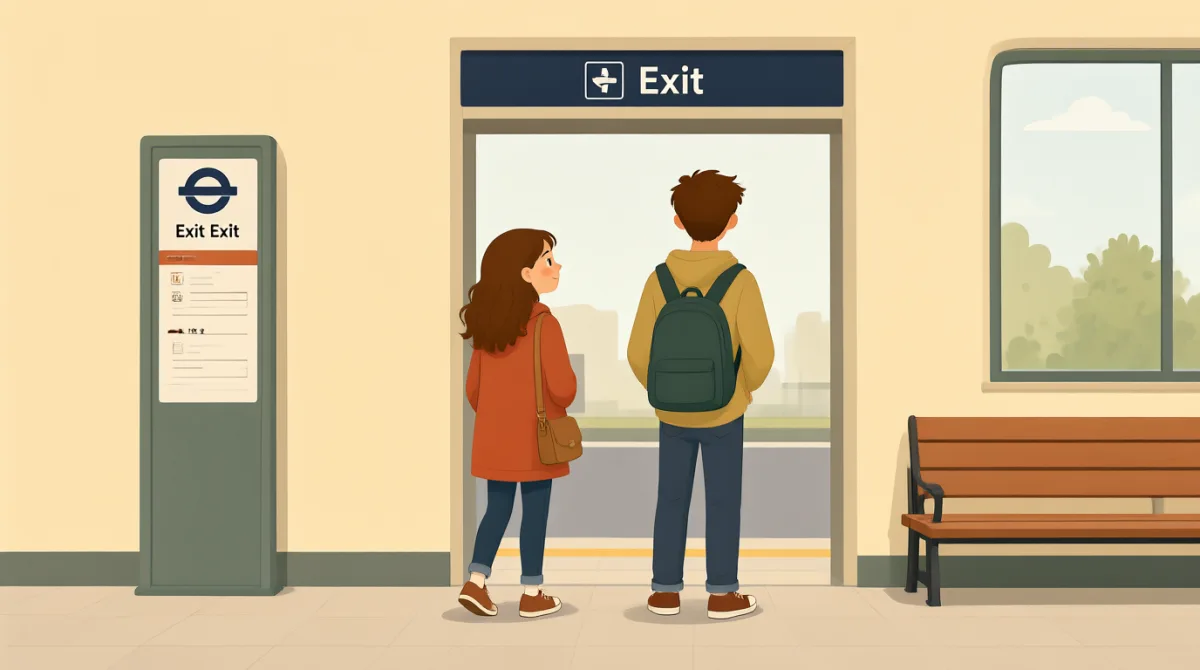

We’re at our stop. Which exit do we need?
ถึงสถานีที่เราจะลงแล้ว ทางออกไหนนะ?

Let’s check the signs. Where do you want to go?
มาดูป้ายกัน เธอจะไปไหน?
I need the main street. Is this exit right?
ฉันต้องไปถนนสายหลัก ทางออกนี้ใช่ไหม?
Yes. The sign says Main Street. Let’s follow it.
ใช่ ป้ายเขียนว่าถนนสายหลัก ไปตามป้ายกันเถอะ
Great. Do we go up these stairs?
ดีเลย เราขึ้นบันไดพวกนี้ไปใช่ไหม?
Yes. The exit is at the top.
ใช่ ทางออกอยู่ข้างบนสุด
Thanks for helping me find the right exit.
ขอบใจที่ช่วยฉันหาทางออกที่ถูกต้องนะ
You’re welcome. Now we’re on the right street.
ยินดีเลย ตอนนี้เราอยู่บนถนนที่ถูกต้องแล้ว
คำศัพท์8
- at our stopถึงสถานีที่เราจะลง
We use this when we arrive at the station where we need to get off. You can say, “We’re at our stop” when it is time to leave the train.
ใช้สำนวนนี้เมื่อเรามาถึงสถานีที่ต้องลงจากรถไฟ พอถึงเวลาลงจากรถไฟ ก็พูดได้ว่า “We’re at our stop” (ถึงสถานีที่เราจะลงแล้ว)
- exitทางออก
An exit is a way to leave a place. You can ask, “Which exit do we need?” when you are looking for the right way out.
ทางออกคือทางที่ใช้เดินออกจากสถานที่หนึ่ง ถ้ากำลังหาทางออกที่ถูกต้อง ก็ถามได้ว่า “Which exit do we need?” (เราต้องไปทางออกไหน?)
- check the signsดูป้าย
This means to look at signs for information or directions. You can say, “Let’s check the signs” when you are not sure where to go.
หมายถึงดูป้ายเพื่อหาข้อมูลหรือทิศทาง ถ้าไม่แน่ใจว่าต้องไปทางไหน ก็พูดได้ว่า “Let’s check the signs” (มาดูป้ายกัน)
- main streetถนนสายหลัก
The main street is an important or central street in an area. You can say, “I need the main street” to explain where you want to go.
ถนนสายหลักคือถนนสำคัญหรือถนนใจกลางของย่านนั้น พูดว่า “I need the main street” (ฉันต้องไปถนนสายหลัก) เพื่อบอกว่าต้องการไปที่ไหน
- follow itไปตามป้าย
This means to go in the direction shown by a sign or route. You can say, “Let’s follow it” after finding the right direction.
หมายถึงเดินไปตามทิศทางที่ป้ายหรือเส้นทางแสดงไว้ เมื่อรู้ทิศทางที่ถูกต้องแล้ว ก็พูดได้ว่า “Let’s follow it” (ไปตามป้ายกันเถอะ)
- go up these stairsขึ้นบันไดพวกนี้
This means to walk up the stairs. You can ask, “Do we go up these stairs?” when checking how to reach an exit.
หมายถึงเดินขึ้นบันได ถ้าต้องการถามว่าต้องขึ้นบันไดทางไหนเพื่อไปทางออก ก็ถามได้ว่า “Do we go up these stairs?” (เราขึ้นบันไดพวกนี้ไปใช่ไหม?)
- at the topอยู่ข้างบนสุด
This means at the highest point of something, such as a set of stairs. You can say, “The exit is at the top” to give a simple direction.
หมายถึงอยู่ตรงจุดที่สูงที่สุด เช่น บนสุดของบันได พูดว่า “The exit is at the top” (ทางออกอยู่ข้างบนสุด) เพื่อบอกทางอย่างง่าย ๆ
- You’re welcome.ยินดีเลย
This is a polite reply when someone says thank you. You can use it after helping someone.
เป็นคำตอบสุภาพเมื่อมีคนพูดขอบคุณ ใช้พูดหลังจากช่วยเหลือใครสักคนได้
ประโยคสำคัญ8
- 1
Which exit do we need?
เราต้องไปทางออกไหน?
Use this question when you need to find the right way out. You can replace “exit” with another place, such as “Which platform do we need?”
ใช้คำถามนี้เมื่อต้องหาทางออกที่ถูกต้อง เปลี่ยน “exit” เป็นสถานที่อื่นได้ เช่น “Which platform do we need?” (เราต้องไปชานชาลาไหน?)
- 2
Let’s check the signs.
มาดูป้ายกัน
This is a simple way to suggest looking for directions or information. Use “Let’s” plus an action to suggest doing something together.
นี่เป็นวิธีชวนกันดูทิศทางหรือข้อมูลแบบง่าย ๆ ใช้ “Let’s” ตามด้วยการกระทำ เพื่อชวนอีกคนทำอะไรด้วยกัน
- 3
Where do you want to go?
เธอจะไปไหน?
Use this question to ask someone about their destination. You can answer with a place, such as “I want to go to the main street.”
ใช้คำถามนี้ถามใครสักคนว่าจะไปที่ไหน คำตอบอาจเป็นสถานที่ เช่น “I want to go to the main street.” (ฉันอยากไปถนนสายหลัก)
- 4
Is this exit right?
ทางออกนี้ใช่ไหม?
Use this question to check if an exit is the correct one. You can change “exit” to another choice, such as “Is this door right?”
ใช้คำถามนี้เพื่อตรวจสอบว่าทางออกนี้ถูกต้องหรือไม่ เปลี่ยน “exit” เป็นตัวเลือกอื่นได้ เช่น “Is this door right?” (ประตูนี้ใช่ไหม?)
- 5
The sign says Main Street.
ป้ายเขียนว่าถนนสายหลัก
Use this sentence to share information written on a sign. You can replace “Main Street” with the words you see.
ใช้ประโยคนี้เพื่อบอกข้อมูลที่เขียนอยู่บนป้าย เปลี่ยน “Main Street” เป็นข้อความที่เห็นบนป้ายได้
- 6
Do we go up these stairs?
เราขึ้นบันไดพวกนี้ไปใช่ไหม?
Use this question to check if you should take a set of stairs. You can replace “up” with “down” to ask about going down.
ใช้คำถามนี้เพื่อตรวจสอบว่าควรขึ้นบันไดหรือไม่ เปลี่ยน “up” เป็น “down” เมื่อต้องการถามเรื่องการเดินลง
- 7
The exit is at the top.
ทางออกอยู่ข้างบนสุด
This sentence gives a clear location for the exit. You can use “at the top” to describe where something is on stairs or a hill.
ประโยคนี้บอกตำแหน่งของทางออกอย่างชัดเจน ใช้ “at the top” เพื่อบอกว่าสิ่งนั้นอยู่ตรงไหนบนบันไดหรือเนินเขา
- 8
Thanks for helping me find the right exit.
ขอบใจที่ช่วยฉันหาทางออกที่ถูกต้องนะ
Use this sentence to thank someone for helping you. You can replace “exit” with another thing, such as “the station.”
ใช้ประโยคนี้ขอบคุณคนที่ช่วยเหลือ เปลี่ยน “exit” เป็นสิ่งอื่นได้ เช่น “the station” (สถานี)