Finding the Exit
找到出口
Emma and Jack get off at their stop and look for the right exit. They check the signs before leaving the station.
Emma和Jack在目的地下車,尋找正確的出口。他們看好指示牌後離開車站。
對話8
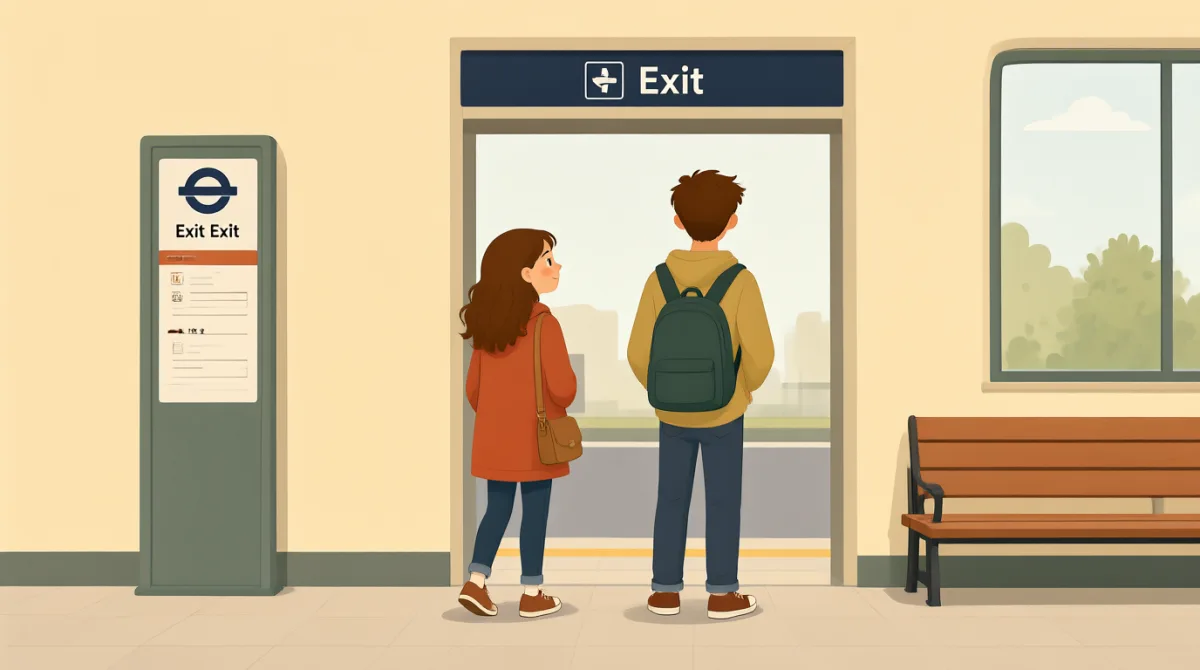

We’re at our stop. Which exit do we need?
我們到站了。我們該走哪個出口?

Let’s check the signs. Where do you want to go?
我們看看指示牌。你想去哪裡?
I need the main street. Is this exit right?
我要去主街。這個出口對嗎?
Yes. The sign says Main Street. Let’s follow it.
對。指示牌上寫著“主街”。我們跟著走吧。
Great. Do we go up these stairs?
太好了。我們走上這些樓梯嗎?
Yes. The exit is at the top.
對。出口就在上面。
Thanks for helping me find the right exit.
謝謝你幫我找到正確的出口。
You’re welcome. Now we’re on the right street.
不客氣。現在我們到對的街上了。
詞彙8
- at our stop到站了
We use this when we arrive at the station where we need to get off. You can say, “We’re at our stop” when it is time to leave the train.
到達需要下車的車站時,可以用這個表達。該下車時,你可以說:“We’re at our stop”(我們到站了)。
- exit出口
An exit is a way to leave a place. You can ask, “Which exit do we need?” when you are looking for the right way out.
出口是離開某個地方的通道。尋找正確的出口時,你可以問:“Which exit do we need?”(我們該走哪個出口?)。
- check the signs檢視指示牌
This means to look at signs for information or directions. You can say, “Let’s check the signs” when you are not sure where to go.
這個表達的意思是檢視指示牌上的資訊或方向。不確定該往哪兒走時,你可以說:“Let’s check the signs”(我們看看指示牌)。
- main street主街
The main street is an important or central street in an area. You can say, “I need the main street” to explain where you want to go.
主街是某個區域裡重要或位於中心位置的街道。你可以說:“I need the main street”(我要去主街),說明自己想去哪裡。
- follow it跟著它走
This means to go in the direction shown by a sign or route. You can say, “Let’s follow it” after finding the right direction.
這個表達的意思是按照指示牌或路線指明的方向走。找到正確的方向後,你可以說:“Let’s follow it”(我們跟著走吧)。
- go up these stairs走上這些樓梯
This means to walk up the stairs. You can ask, “Do we go up these stairs?” when checking how to reach an exit.
這個表達的意思是往上走樓梯。確認怎麼去出口時,你可以問:“Do we go up these stairs?”(我們走上這些樓梯嗎?)。
- at the top在上面
This means at the highest point of something, such as a set of stairs. You can say, “The exit is at the top” to give a simple direction.
這個表達指某個物體的最高處,比如一段樓梯的頂端。你可以說:“The exit is at the top”(出口就在上面),簡單地說明方向。
- You’re welcome.不客氣。
This is a polite reply when someone says thank you. You can use it after helping someone.
別人向你道謝時,可以用這句話禮貌地回應。幫過別人之後就可以這樣說。
關鍵句8
- 1
Which exit do we need?
我們該走哪個出口?
Use this question when you need to find the right way out. You can replace “exit” with another place, such as “Which platform do we need?”
需要找到正確的出口時,可以用這個問題。你可以把“exit”換成其他地點,比如:“Which platform do we need?”
- 2
Let’s check the signs.
我們看看指示牌吧。
This is a simple way to suggest looking for directions or information. Use “Let’s” plus an action to suggest doing something together.
這是一個簡單的提議,表示一起檢視方向或資訊。用“Let’s”加上一個動作,就可以提議一起做某事。
- 3
Where do you want to go?
你想去哪裡?
Use this question to ask someone about their destination. You can answer with a place, such as “I want to go to the main street.”
可以用這個問題詢問別人要去哪裡。回答時可以說一個地點,比如:“I want to go to the main street.”
- 4
Is this exit right?
這個出口對嗎?
Use this question to check if an exit is the correct one. You can change “exit” to another choice, such as “Is this door right?”
可以用這個問題確認出口是否正確。你可以把“exit”換成其他選項,比如:“Is this door right?”
- 5
The sign says Main Street.
指示牌上寫著“主街”。
Use this sentence to share information written on a sign. You can replace “Main Street” with the words you see.
可以用這句話告訴別人指示牌上寫了什麼。你可以把“Main Street”換成你看到的文字。
- 6
Do we go up these stairs?
我們走上這些樓梯嗎?
Use this question to check if you should take a set of stairs. You can replace “up” with “down” to ask about going down.
可以用這個問題確認是否該走這段樓梯。把“up”換成“down”,就可以詢問是否要往下走。
- 7
The exit is at the top.
出口就在上面。
This sentence gives a clear location for the exit. You can use “at the top” to describe where something is on stairs or a hill.
這句話清楚地說明了出口的位置。你可以用“at the top”描述某物在樓梯或山坡上的位置。
- 8
Thanks for helping me find the right exit.
謝謝你幫我找到正確的出口。
Use this sentence to thank someone for helping you. You can replace “exit” with another thing, such as “the station.”
可以用這句話感謝幫助你的人。你可以把“exit”換成其他事物,比如“the station”。